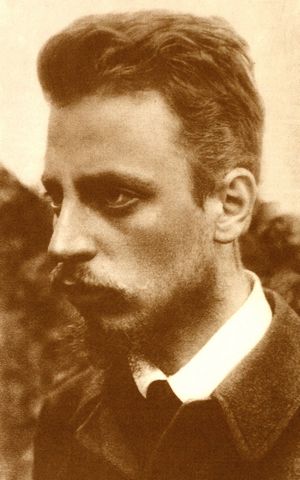
Rainer Maria Rilke słynne cytaty
Źródło: Już wszystkie rzeczy…, w: Wiersze rozproszone i pośmiertne z lat 1906–1926, wybrał i przełożył Bernard Antochewicz, Wrocław 1991.
Rainer Maria Rilke Cytaty o ludziach
Denn Verse sind nicht, wie die Leute meinen, Gefühle (die hat man früh genug), – es sind Erfahrungen. (niem.)
Źródło: Zapiski Maltego Lauridsa Brigge
Rainer Maria Rilke książka Malte
Źródło: Malte. Pamiętniki Malte-Lauridsa Brigge, tłum. Witold Hulewicz.
Rainer Maria Rilke Cytaty o miłości
O Herr, gib jedem seinen eignen Tod,
das Sterben, das aus jenem Leben geht,
darin er Liebe hatte, Sinn und Not.
Denn wir sind nur die Schale und das Blatt.
Der große Tod, den jeder in sich hat,
das ist die Frucht, um die sich alles dreht. (niem.)
Źródło: Księga godzin, O ubóstwie i śmierci, wyd. L. Chomińskiego, Wilno 1935, s. 140–141, tłum. Witold Hulewicz.
Rainer Maria Rilke cytaty
Źródło: List do młodego poety
„Zgaś moje oczy: ja Cię widzieć mogę,
uszy zatrzaśnij: ja Ciebie usłyszę…”
Lösch mir die Augen aus: ich kann dich sehn,
wirf mir die Ohren zu: ich kann dich hören… (niem.)
Źródło: Księga godzin, O pielgrzymstwie, wyd. L. Chomińskiego, Wilno 1935, s. 90, tłum. Witold Hulewicz.
Rainer Maria Rilke książka Malte
Źródło: Malte. Pamiętniki Malte-Lauridsa Brigge, tłum. Witold Hulewicz.
Źródło: Przypomnienie, tłum. Mieczysław Jastrun
Źródło: Pieśń miłosna, tłumaczenie Adam Pomorski
„Kto teraz płacze gdziekolwiek na świecie,
bez powodu płacze na świecie,
płacze nade mną.”
Źródło: tom Godzina powagi, tłum. Janina Brzostowska
Rainer Maria Rilke: Cytaty po angielsku
“I am much too alone in this world, yet not alone enough.”
Number 2 (as translated by Cliff Crego)
I am much too alone in this world, yet not alone enough
to truly consecrate the hour.
I am much too small in this world, yet not small enough
to be to you just object and thing,
dark and smart.
I want my free will and want it accompanying
the path which leads to action;
and want during times that beg questions,
where something is up,
to be among those in the know,
or else be alone.
(as translated by Annemarie S. Kidder)
Das Stunden-Buch (The Book of Hours) (1905)
Źródło: Rilke's Book of Hours: Love Poems to God
Kontekst: I am too alone in the world, and yet not alone enough
to make every hour holy.
I am too small in the world, and yet not tiny enough
just to stand before you like a thing,
dark and shrewd.
I want my will, and I want to be with my will
as it moves towards deed;
and in those quiet, somehow hesitating times,
when something is approaching,
I want to be with those who are wise
or else alone.
Rainer Maria Rilke książka Letters to a Young Poet
Letter Three (23 April 1903)
Letters to a Young Poet (1934)
Kontekst: No experience has been too unimportant, and the smallest event unfolds like a fate, and fate itself is like a wonderful, wide fabric in which every thread is guided by an infinitely tender hand and laid alongside another thread and is held and supported by a hundred others.
Rainer Maria Rilke książka Letters to a Young Poet
Źródło: Letters to a Young Poet
“Rose, oh pure contradiction, desire,
To be no one's sleep under so many
Lids.”
Rose, oh reiner Widerspruch, Lust,
Niemandes Schlaf zu sein unter soviel
Lidern.
Rilke wrote his own epitaph sometime before October 27, 1925. He requested that it be inscribed on his gravestone. This was fifteen months before his death. (Translation: John J.L.Mood)
Źródło: The Selected Poetry of Rainer Maria Rilke
Rainer Maria Rilke książka Letters to a Young Poet
Źródło: Letters to a Young Poet
Rainer Maria Rilke książka Letters to a Young Poet
Źródło: Letters to a Young Poet
Rainer Maria Rilke książka Duino Elegies
Źródło: Duino Elegies
Rainer Maria Rilke książka Malte
Źródło: The Notebooks of Malte Laurids Brigge
“And as for the rest, let life happen to you. Believe me: life is in the right, always.”
Rainer Maria Rilke książka Letters to a Young Poet
Wariant: Let life happen to you. Believe me: life is in the right, always.
Źródło: Letters to a Young Poet
“So we are grasped by what we cannot grasp.”
Źródło: Rilke's Book of Hours: Love Poems to God
Rainer Maria Rilke książka Duino Elegies
First Elegy (as translated by Stephen Mitchell)
Źródło: Duino Elegies (1922)
Kontekst: Yes—the springtimes needed you. Often a star
was waiting for you to notice it. A wave rolled toward you
out of the distant past, or as you walked
under an open window, a violin
yielded itself to your hearing. All this was mission.
But could you accomplish it? Weren't you always
distracted by expectation, as if every event
announced a beloved? (Where can you find a place
to keep her, with all the huge strange thoughts inside you
going and coming and often staying all night.)
“Do not allow yourself to be misled by the surfaces of things.”
Rainer Maria Rilke książka Letters to a Young Poet
Źródło: Letters to a Young Poet
Rainer Maria Rilke książka Letters to a Young Poet
Letter Ten (26 December 1908)
Letters to a Young Poet (1934)
Źródło: Ahead of All Parting: The Selected Poetry and Prose


