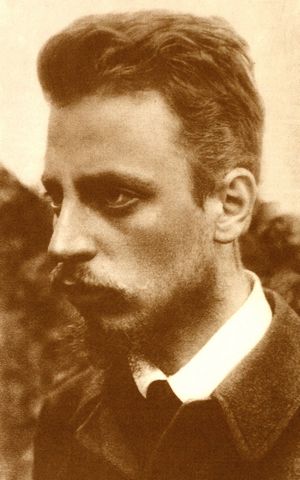
Rainer Maria Rilke słynne cytaty
Źródło: Już wszystkie rzeczy…, w: Wiersze rozproszone i pośmiertne z lat 1906–1926, wybrał i przełożył Bernard Antochewicz, Wrocław 1991.
Rainer Maria Rilke Cytaty o ludziach
Denn Verse sind nicht, wie die Leute meinen, Gefühle (die hat man früh genug), – es sind Erfahrungen. (niem.)
Źródło: Zapiski Maltego Lauridsa Brigge
Rainer Maria Rilke książka Malte
Źródło: Malte. Pamiętniki Malte-Lauridsa Brigge, tłum. Witold Hulewicz.
Rainer Maria Rilke Cytaty o miłości
O Herr, gib jedem seinen eignen Tod,
das Sterben, das aus jenem Leben geht,
darin er Liebe hatte, Sinn und Not.
Denn wir sind nur die Schale und das Blatt.
Der große Tod, den jeder in sich hat,
das ist die Frucht, um die sich alles dreht. (niem.)
Źródło: Księga godzin, O ubóstwie i śmierci, wyd. L. Chomińskiego, Wilno 1935, s. 140–141, tłum. Witold Hulewicz.
Rainer Maria Rilke cytaty
Źródło: List do młodego poety
„Zgaś moje oczy: ja Cię widzieć mogę,
uszy zatrzaśnij: ja Ciebie usłyszę…”
Lösch mir die Augen aus: ich kann dich sehn,
wirf mir die Ohren zu: ich kann dich hören… (niem.)
Źródło: Księga godzin, O pielgrzymstwie, wyd. L. Chomińskiego, Wilno 1935, s. 90, tłum. Witold Hulewicz.
Rainer Maria Rilke książka Malte
Źródło: Malte. Pamiętniki Malte-Lauridsa Brigge, tłum. Witold Hulewicz.
Źródło: Przypomnienie, tłum. Mieczysław Jastrun
Źródło: Pieśń miłosna, tłumaczenie Adam Pomorski
„Kto teraz płacze gdziekolwiek na świecie,
bez powodu płacze na świecie,
płacze nade mną.”
Źródło: tom Godzina powagi, tłum. Janina Brzostowska
Rainer Maria Rilke: Cytaty po angielsku
Rainer Maria Rilke książka Sonnets to Orpheus
Translated by Stephen Mitchell
Sonnets to Orpheus (1922)
Rainer Maria Rilke książka Letters to a Young Poet
Letter Six (23 December 1903)
Letters to a Young Poet (1934)
“Death is the side of life which is turned away from us.”
Letter to W. von Hulewicz
Letter to his wife, reprinted in Rilke’s Letters on Cézanne (1952, trans. 1985). (October 21, 1907)
Rilke's Letters
“He was a poet and hated the approximate.”
The Journal of My Other Self
Rainer Maria Rilke książka New Poems
Wie soll ich meine Seele halten, daß
sie nicht an deine rührt? Wie soll ich sie
hinheben über dich zu andern Dingen?
Ach gerne möchte ich sie bei irgendetwas
Verlorenem im Dunkel unterbringen
an einer fremden stillen Stelle, die
nicht weiterschwingt, wenn diene Tiefen schwingen.
Doch alles, was uns anrührt, dich und mich,
nimmt uns zusammen wie ein Bogenstrich,
die aus zwei Saiten eine Stimme zieht.
Auf welches Instrument sind wir gespannt?
Und welcher Geiger hat uns in der Hand?
O süßes Lied.
Liebes-Lied (Love Song) (as translated by Cliff Crego)
Neue Gedichte (New Poems) (1907)
Rainer Maria Rilke książka Letters to a Young Poet
Letter Seven (14 May 1904)
Letters to a Young Poet (1934)
Letter to his wife, reprinted in Rilke’s Letters on Cézanne (1952, trans. 1985). (October 23, 1907)
Rilke's Letters
Rainer Maria Rilke książka The Book of Hours
Translated by Annemarie S. Kidder
Das Stunden-Buch (The Book of Hours) (1905)
Rainer Maria Rilke książka Letters to a Young Poet
Letter Eight (12 August 1904)
Letters to a Young Poet (1934)
Rainer Maria Rilke książka The Panther
Sein Blick ist vom Vorübergehen der Stäbe
so müd geworden, daß er nichts mehr hält.
Ihm ist, als ob es tausend Stäbe gäbe
und hinter tausend Stäben keine Welt.<p>Der weiche Gang geschmeidig starker Schritte,
der sich im allerkleinsten Kreise dreht,
ist wie ein Tanz von Kraft um eine Mitte,
in der betäubt ein großer Wille steht.<p>Nur manchmal schiebt der Vorhang der Pupille
sich lautlos auf—. Dann geht ein Bild hinein,
geht durch der Glieder angespannte Stille—
und hört im Herzen auf zu sein.
As translated by Albert Ernest Flemming
Der Panther (The Panther) (1907)
Translated by Annemarie S. Kidder
In Celebration of Me (1909)
Rainer Maria Rilke książka Letters to a Young Poet
On young couples who have not yet matured enough to recognize and respect each other's solitude
Letter Seven (14 May 1904)
Letters to a Young Poet (1934)
Letter to his wife, reprinted in Rilke’s Letters on Cézanne (1952, trans. 1985). (October 23, 1907)
Rilke's Letters
Rainer Maria Rilke książka Letters to a Young Poet
About Rome.
Letter Five (29 October 1903)
Letters to a Young Poet (1934)
Rainer Maria Rilke książka Letters to a Young Poet
Letter Three (23 April 1903)
Letters to a Young Poet (1934)
Rainer Maria Rilke książka Letters to a Young Poet
Letter Four (16 July 1903)
Letters to a Young Poet (1934)
Rainer Maria Rilke książka Letters to a Young Poet
Letter Ten (26 December 1908)
Letters to a Young Poet (1934)
Letter to his wife, reprinted in Rilke’s Letters on Cézanne (1952, trans. 1985). (June 24, 1907)
Rilke's Letters
Rainer Maria Rilke książka Letters to a Young Poet
Letter One (17 February 1903)
Letters to a Young Poet (1934)
“They more adeptly bend the willow's branches
who have experience of the willow's roots.”
Rainer Maria Rilke książka Sonnets to Orpheus
Sonnet 6 (as translated by Edward Snow)
Sonnets to Orpheus (1922)
Rainer Maria Rilke książka The Book of Images
Herr: es ist Zeit. Der Sommer war sehr groß.
Leg deinen Schatten auf die Sonnenuhren,
und auf den Fluren laß die Winde los.
Herbsttag (Autumn Day) (as translated by Cliff Crego)
Das Buch der Bilder (The Book of Images) (1902)
“Everywhere I am folded, there I am a lie.”
As quoted in News of the Universe : Poems of Twofold Consciousness (1995) by Robert Bly, p. 125
Rainer Maria Rilke książka Letters to a Young Poet
Letter One (17 February 1903)
Letters to a Young Poet (1934)
Rainer Maria Rilke książka Malte
Oryginał: (de) Mein Gott, fiel es mir mit Ungestüm ein, so bist du also. Es giebt Beweise für deine Existenz. Ich habe sie alle vergessen und habe keinen je verlangt, denn welche unge heuere Verpflichtung läge in deiner Gewißheit. Und doch, nun wird mirs gezeigt.
Źródło: The Notebooks of Malte Laurids Brigge (1910), p. 135
Rainer Maria Rilke książka Letters to a Young Poet
Źródło: Letters to a Young Poet


