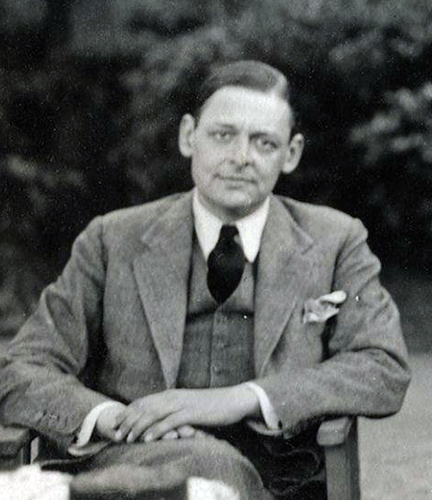
Thomas Stearns Eliot słynne cytaty
Źródło: Jake Page, Jak koty widzą świat i ludzi?, tłum. A. Nowicki, wyd. Bellona, Warszawa 2010, s. 23.
„Tylko ci, którzy ryzykują pójście za daleko dowiedzą się jak daleko można dojść.”
Only those who will risk going too far can possibly find out how far one can go. (ang.)
Thomas Stearns Eliot Cytaty o czasie
„W minucie znajdzie się czas,
By postanowić i sprostować
To, co minuta odmieni.”
In a minute there is time
For decisions and revisions which a minute will reverse. (ang.)
Źródło: Prufrock and Other Observations [w:] Wybór poezji, tłum. W. Dulęba, Wrocław 1990, s. 5.
Źródło: Spalony Norton
Thomas Stearns Eliot cytaty
„I tak właśnie kończy się świat. Nie hukiem a skomleniem.”
Źródło: Wydrążeni ludzie
„Niedojrzali poeci imitują, dojrzali kradną.”
Immature poets imitate, mature poets steal. (ang.)
The Wasteland, Prufrock and Other Poems
I have seen the moment of my greatness flicker,
And I have seen the eternal Footman hold my coat, and snicker
And in short, I was afraid. (ang.)
Źródło: Prufrock and Other Observations [w:] Wybór poezji, tłum. W. Dulęba, Wrocław 1990, s. 7.
Źródło: Melania Sobańska-Bondaruk, Stanisław Bogusław Lenard (oprac.), Wiek XX w źródłach, Wydawnictwo Naukowe PWN, Warszawa 2002, ISBN 8301127104, s. 244.
Thomas Stearns Eliot: Cytaty po angielsku
Choruses from The Rock (1934)
Kontekst: O perpetual revolution of configured stars,
O perpetual recurrence of determined seasons,
O world of spring and autumn, birth and dying!
The endless cycle of idea and action,
Endless invention, endless experiment,
Brings knowledge of motion, but not of stillness;
Knowledge of speech, but not of silence;
Knowledge of words, and ignorance of The Word.
All our knowledge brings us nearer to our ignorance,
All our ignorance brings us nearer to death,
But nearness to death no nearer to God.
Where is the Life we have lost in living?
Where is the wisdom we have lost in knowledge?
Where is the knowledge we have lost in information?
The cycles of Heaven in twenty centuries
Brings us farther from God and nearer to the Dust.
Choruses from The Rock (1934)
Kontekst: The lot of man is ceaseless labor,
Or ceaseless idleness, which is still harder,
Or irregular labour, which is not pleasant.
I have trodden the winepress alone, and I know
That it is hard to be really useful, resigning
The things that men count for happiness, seeking
The good deeds that lead to obscurity, accepting
With equal face those that bring ignominy,
The applause of all or the love of none.
All men are ready to invest their money
But most expect dividends.
I say to you: Make perfect your will.
I say: take no thought of the harvest,
But only of proper sowing.
“Old Deuteronomy's lived a long time;
He's a Cat who has lived many lives in succession.”
T.S. Eliot książka Old Possum's Book of Practical Cats
Old Deuteronomy
Old Possum's Book of Practical Cats (1939)
Kontekst: Old Deuteronomy's lived a long time;
He's a Cat who has lived many lives in succession.
He was famous in proverb and famous in rhyme
A long while before Queen Victoria's accession.
Letter to Marquis Childs quoted in St. Louis Post Dispatch (15 October 1930) and in the address "American Literature and the American Language" delivered at Washington University (9 June 1953) published in Washington University Studies, New Series: Literature and Language, no. 23 (St. Louis : Washington University Press, 1953), p. 6
Kontekst: It is self-evident that St. Louis affected me more deeply than any other environment has ever done. I feel that there is something in having passed one's childhood beside the big river, which is incommunicable to those people who have not. I consider myself fortunate to have been born here, rather than in Boston, or New York, or London.
T.S. Eliot The Love Song of J. Alfred Prufrock
The Love Song of J. Alfred Prufrock (1915)
Kontekst: There will be time, there will be time
To prepare a face to meet the faces that you meet;
There will be time to murder and create,
And time for all the works and days of hands,
That lift and drop a question on your plate;
Time for you and time for me,
And time yet for a hundred indecisions,
And for a hundred visions and revisions,
Before the taking of a toast and tea.
“I have heard the mermaids singing, each to each.
I do not think that they will sing to me.”
T.S. Eliot The Love Song of J. Alfred Prufrock
Źródło: The Love Song of J. Alfred Prufrock (1915)
Kontekst: I grow old … I grow old...
I shall wear the bottoms of my trousers rolled.
Shall I part my hair behind? Do I dare to eat a peach?
I shall wear white flannel trousers, and walk upon the beach.
I have heard the mermaids singing, each to each.
I do not think that they will sing to me.
I have seen them riding seaward on the waves
Combing the white hair of the waves blown back
When the wind blows the water white and black.
We have lingered in the chambers of the sea
By sea-girls wreathed with seaweed red and brown
Till human voices wake us, and we drown.
The Love Song of J. Alfred Prufrock (1915)
Źródło: The Love Song of J. Alfred Prufrock and Other Poems
Kontekst: I grow old … I grow old...
I shall wear the bottoms of my trousers rolled.
Shall I part my hair behind? Do I dare to eat a peach?
I shall wear white flannel trousers, and walk upon the beach.
I have heard the mermaids singing, each to each.
I do not think that they will sing to me.
I have seen them riding seaward on the waves
Combing the white hair of the waves blown back
When the wind blows the water white and black.
We have lingered in the chambers of the sea
By sea-girls wreathed with seaweed red and brown
Till human voices wake us, and we drown.
T.S. Eliot książka Ziemia jałowa
The final lines of the poem.
The Waste Land (1922)
Źródło: The Waste Land and Other Poems
“Love is most nearly itself
When here and now cease to matter.”
T.S. Eliot książka Four Quartets
Źródło: Four Quartets
T.S. Eliot książka Four Quartets
Źródło: Four Quartets
“Light
Light
The visible reminder of Invisible Light.”
Choruses from The Rock (1934)
“Do I dare Disturb the universe?”
Źródło: The Wasteland, Prufrock and Other Poems
The Love Song of J. Alfred Prufrock (1915)
Źródło: The Love Song of J. Alfred Prufrock and Other Poems
Kontekst: I am no prophet — and here's no great matter;
I have seen the moment of my greatness flicker,
And I have seen the eternal Footman hold my coat, and snicker,
And in short, I was afraid.
Ash-Wednesday (1930)
Wariant: Suffer us not to mock ourselves with falsehood
Teach us to care and not to care


