

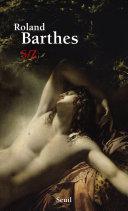
Roland Barthes livre S/Z
S/Z, 1970
Roland Barthes, né le 12 novembre 1915 à Cherbourg et mort le 26 mars 1980 à Paris, est un philosophe, critique littéraire et sémiologue français, directeur d'études à l'École pratique des hautes études et professeur au Collège de France.
Il fut l'un des principaux animateurs du post-structuralisme et de la sémiologie linguistique et photographique en France. Wikipedia

Roland Barthes livre S/Z
S/Z, 1970
Roland Barthes livre Mythologies
Mythologies, 1957
Roland Barthes livre Mythologies
Mythologies, 1957
L'empire des signes, 1970
L'empire des signes, 1970
“L'altérité est le concept le plus antipathique au « bon sens.»”
Roland Barthes livre Mythologies
Mythologies, 1957
L'empire des signes, 1970
“La littérature ne permet pas de marcher mais elle permet de respirer.”
Critical Essays
Variante: La littérature ne permet pas de marcher, mais elle permet de respirer.
Variante: C'est sous la pression de l'Histoire et de la tradition, que s'établissent les écritures possibles d'un écrivain donné: il y a une Histoire de l'écriture; mais cette Histoire est double: au moment même où l'Histoire générale propose -- ou impose -- une nouvelle problématique du langage littéraire, l'écriture reste encore pleine du souvenir de ses usages antérieurs, car le langage n'est jamais innocent: les mots ont une mémoire seconde qui se prolonge mystérieusement au milieu des significations nouvelles. L'écriture est précisément ce compromis entre une liberté et une souvenir, elle est cette liberté souvenante qui n'est liberté que dans le geste du choix, mais déja plus dans sa durée.
“Aussi, le style est-il toujours un secret[…]”
Roland Barthes livre Le Degré zéro de l'écriture
Writing Degree Zero
Roland Barthes livre Mythologies
Mythologies, 1957
L'empire des signes, 1970
“J'observe avec horreur un futur antérieur dont la mort est l'enjeu.”
Roland Barthes livre La Chambre claire
La Chambre claire (notes sur la photographie), 1980
“Toute l'histoire repose, en dernière instance, sur le corps humain.”
Michelet par lui-même, 1954
L'empire des signes, 1970
Roland Barthes livre Fragments d'un discours amoureux
Fragments d'un discours amoureux, 1977
Roland Barthes livre Fragments d'un discours amoureux
Fragments d'un discours amoureux, 1977
L'empire des signes, 1970
L'empire des signes, 1970
Roland Barthes livre Fragments d'un discours amoureux
à quoi ?
Fragments d'un discours amoureux, 1977
Roland Barthes livre La Chambre claire
Camera Lucida: Reflections on Photography
A Lover's Discourse: Fragments
Variante: Amour au bandeau: Ce proverbe est faux. L'amour ouvre grand les yeux, il rend clairvoyant:"J'ai, de toi, sur toi, le savoir absolu." Rapport du clerc au maître; tu a tout pouvoir sur moi, mais j'ai tout savoir sur toi.
“Quand je me sais photographié, je me transforme en image…”
Roland Barthes livre Fragments d'un discours amoureux
Fragments d'un discours amoureux, 1977
“What love lays bare in me is energy.”
Roland Barthes livre Fragments d'un discours amoureux
Source: A Lover's Discourse: Fragments
Proposition 4
From Work to Text (1971)
Contexte: The Text is plural. Which is not simply to say that it has several meanings, but that it accomplishes the very plural of meaning: an irreducible (and not merely an acceptable) plural. The Text is not a co-existence of meanings but a passage, an overcrossing; thus it answers not to an interpretation, even a liberal one, but to an explosion, a dissemination.
“A work has two levels of meaning: literal and concealed.”
Proposition 3
Variant translation: The Text can be approached, experienced, in reaction to the sign. The work closes on a signified. There are two modes of signification which can be attributed to this signified: either it is claimed to be evident and the work is then the object of a literal science, of philology, or else it is considered to be secret, ultimate, something to be sought out, and the work then falls under the scope of a hermeneutics, of an interpretation
From Work to Text (1971)
Contexte: A work has two levels of meaning: literal and concealed.
A Text, on the other hand is engaged in a movement … a deferral … a dilation of meaning … the play of signification.
Metonymy — the association of part to whole — characterized the logic of the Text.
In this sense the Text is "radically symbolic" and lacks closure.
“I am interested in language because it wounds or seduces me.”
Roland Barthes livre The Pleasure of the Text
Source: The Pleasure of the Text
“The theory of the Text can coincide only with a practice of writing.”
Conclusion
From Work to Text (1971)
Contexte: The discourse on the Text should itself be nothing other than text, research, textual activity, since the Text is that social space which leaves no language safe, outside, nor any subject of the enunciation in position as judge, master, analyst, confessor, decoder. The theory of the Text can coincide only with a practice of writing.
Roland Barthes livre Fragments d'un discours amoureux
Source: A Lover's Discourse: Fragments
Source: Camera Lucida: Reflections on Photography
Roland Barthes livre Fragments d'un discours amoureux
Source: A Lover's Discourse: Fragments
La forme bâtarde de la culture de masse est la répétition honteuse: on répète les contenus, les schèmes idéologiques, le gommage des contradictions, mais on varie les formes superficielles: toujours des livres, des émissions, des films nouveaux, des faits divers, mais toujours le même sens.
"Modern," in The Pleasure of the Text (1975)
“The lover's fatal identity is precisely this: I am the one who waits.”
Roland Barthes livre Fragments d'un discours amoureux
Source: A Lover's Discourse: Fragments
Source: Camera Lucida: Reflections on Photography
“…the book creates meaning, the meaning creates life.”
Roland Barthes livre The Pleasure of the Text
Source: The Pleasure of the Text
Roland Barthes livre Fragments d'un discours amoureux
Source: A Lover's Discourse: Fragments
“We know that the war against intelligence is always waged in the name of common sense.”
Roland Barthes livre Mythologies
Source: Mythologies
“I make the other’s absence responsible for my worldliness.”
Roland Barthes livre Fragments d'un discours amoureux
Source: A Lover's Discourse: Fragments
Roland Barthes livre Fragments d'un discours amoureux
Source: A Lover's Discourse: Fragments
Roland Barthes livre The Pleasure of the Text
Source: The Pleasure of the Text
“To make someone wait: the constant prerogative of all power, "age-old pastime of humanity".”
Roland Barthes livre Fragments d'un discours amoureux
Source: A Lover's Discourse: Fragments
“The incapacity to name is a good symptom of disturbance.”
Source: Camera Lucida: Reflections on Photography
“I have not a desire but a need for solitude.”
Source: Mourning Diary


