„Nie wolno zgadzać się na pełzanie, gdy czujemy potrzebę latania.”
Źródło: Gordon Dryden, Jeanette Vos, Rewolucja w uczeniu, wyd. Moderski i S-ka, Poznań 2000, tłum. Bożena Jóźwiak, s. 370.
Helen Adams Keller – amerykańska głuchoniewidoma pisarka, pedagog i działaczka społeczna.
W wieku 19 miesięcy przeszła chorobę, która pozbawiła ją wzroku, słuchu i częściowo możności mówienia. Kiedy miała 6 lat, jej rodzice poprosili o konsultację Aleksandra Grahama Bella. Ten skontaktował ich z Anną Mansfield Sullivan , która zaczęła kształcić Helen.
Pod opieką Sullivan Helen robiła ogromne postępy. Nauczyła się alfabetu Braille'a i studiowała w Horace Mann School for the Deaf . Uzyskała bakalaureat i zdobyła znajomość kilku języków. Prowadziła działalność naukową i społeczną.
Poświęciła życie innym osobom upośledzonym. Napisała wiele książek, z których najsławniejsza to The Story of My Life , wydana po polsku w 1904 r. pt. Historia mego życia.
Keller angażowała się w wiele inicjatyw społeczno-politycznych. Była członkinią amerykańskiej Partii Socjalistycznej i związku zawodowego Industrial Workers of the World. Działała na rzecz równouprawnienia kobiet.
Sztuka Williama Gibsona oparta na życiu Keller i Sullivan zdobyła Nagrodę Tony , została też sfilmowana .
== Przypisy ==
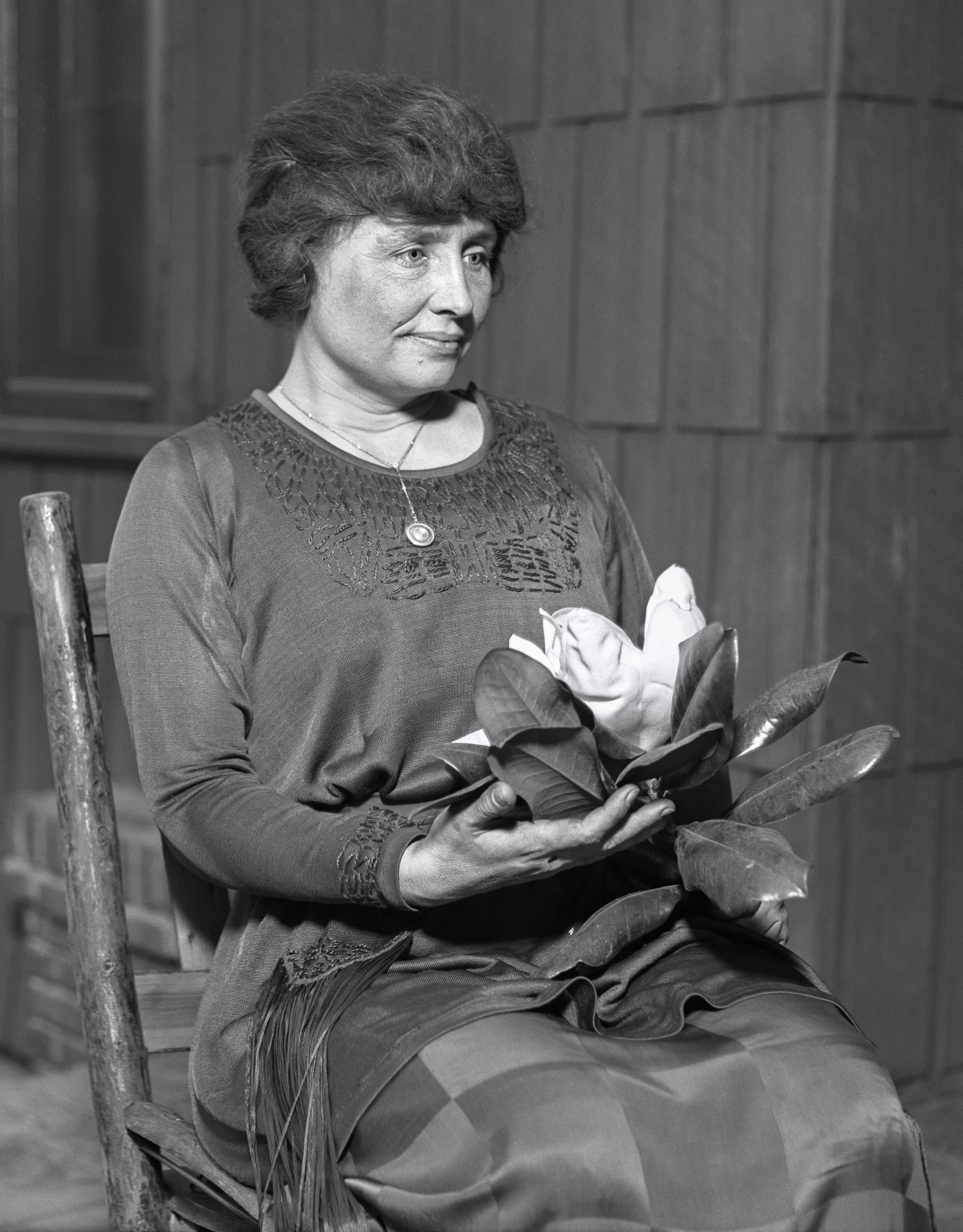
„Nie wolno zgadzać się na pełzanie, gdy czujemy potrzebę latania.”
Źródło: Gordon Dryden, Jeanette Vos, Rewolucja w uczeniu, wyd. Moderski i S-ka, Poznań 2000, tłum. Bożena Jóźwiak, s. 370.
„Literatura jest moją utopią.”
Literature is my Utopia. (ang.)
Źródło: Historia mego życia
w 1911, w liście do jednej z angielskich sufrażystek, Tweedledum i Tweedledee to postacie z powieści Lewisa Carrolla Po drugiej stronie lustra, kontynuacji Alicji w Krainie Czarów.
Źródło: Howard Zinn, Ludowa historia Stanów Zjednoczonych. Od roku 1492 do dziś, tłum. Andrzej Wojtasik, Wyd. Krytyki Politycznej, Warszawa 2016, s. 447.
Edward Everett Hale in a statement published in A Year of Beautiful Thoughts (1902) by Jeanie Ashley Bates Greenough, p. 172; <!-- and perhaps as early as an edition of Ten Times One is Ten (1870) by Hale--> This has been misattributed to Keller in published works since at least 1980. Keller and Hale were good friends, and letters to Hale can be found in her youthful autobiography The Story of My Life (1902). In 1910 Keller dedicated her poem "The Song of the Stone Wall" to Hale who had died in 1909.
Misattributed
Wariant: I am only one, but I am one. I can not do everything, but I can do something. I must not fail to do the something that I can do.
Wariant: The best and most beautiful things in the world cannot be seen or even touched. They must be felt with the heart.
Wariant: The best and most beautiful things in the world cannot be seen, nor touched... but are felt in the heart.
“I would rather walk with a friend in the dark, than alone in the light.”
Wariant: Walking with a friend in the dark is better than walking alone in the light.
Źródło: The Open Door (1957) This quotation is often contracted into: Security is mostly a superstition... Life is either a daring adventure, or nothing. or paraphrased: Life is either a daring adventure or nothing at all.
Helen Keller książka Optimism
Optimism (1903)
Kontekst: The highest result of education is tolerance. Long ago men fought and died for their faith; but it took ages to teach them the other kind of courage, — the courage to recognize the faiths of their brethren and their rights of conscience. Tolerance is the first principle of community; it is the spirit which conserves the best that all men think.
Helen Keller: Her Socialist Years (1967)
Kontekst: Some people do not like to think. If one thinks, one must reach conclusions; and conclusions are not always pleasant. They are a thorn in the spirit. But I consider it a priceless gift and a deep responsibility to think.
“Alone we can do so little; together we can do so much.”
"Helen and Teacher: The Story of Helen Keller and Anne Sullivan Macy", Joseph P. Lash (1980) http://quoteinvestigator.com/2014/04/21/together/
Helen Adams Keller (p. 60. Helen Keller's Journal: 1936-1937, Doubleday, Doran & company, inc., 1938)
Helen Keller książka The Story of My Life
Źródło: The Story of My Life (1903), Ch. 21
“One can never consent to creep when one feels an impulse to soar.”
Helen Keller książka The Story of My Life
Źródło: Address to the American Association to Promote the Teaching of Speech to the Deaf at Mt. Airy, Philadelphia, Pennsylvania (8 July 1896) http://www.afb.org/mylife/book.asp?ch=P3Ch4, quoted in supplement to The Story of My Life
“Keep your face to the sun and you will never see the shadows.”
Wariant: Keep your face to the sunshine and you cannot see the shadows. It's what the sunflowers do.
Helen Keller książka The Story of My Life
Źródło: The Story of My Life (1903), Ch. 21
Kontekst: Ruth is so loyal and gentle-hearted, we cannot help loving her, as she stands with the reapers amid the waving corn. Her beautiful, unselfish spirit shines out like a bright star in the night of a dark and cruel age. Love like Ruth's, love which can rise above conflicting creeds and deep-seated racial prejudices, is hard to find in all the world.
“Be not dumb, obedient slaves in an army of destruction. Be heroes in an army of construction.”
"Strike Against War", speech in Carnegie Hall (5 January 1916) http://www.historyisaweapon.com/defcon1/helenstrike.html <br class="br">Kontekst: Strike against war, for without you no battles can be fought. Strike against manufacturing shrapnel and gas bombs and all other tools of murder. Strike against preparedness that means death and misery to millions of human beings. Be not dumb, obedient slaves in an army of destruction. Be heroes in an army of construction.
Helen Keller książka The Story of My Life
Źródło: The Story of My Life (1903), Ch. 4
Kontekst: The most important day I remember in all my life is the one on which my teacher, Anne Mansfield Sullivan, came to me. I am filled with wonder when I consider the immeasurable contrasts between the two lives which it connects. It was the third of March, 1887, three months before I was seven years old.
Quoted in, The Black Stork: Eugenics and the Death of "Defective" Babies in American Medicine and Motion Pictures since 1915, (1996), Martin S. Pernick, Oxford University Press, New York, NY., ISBN 0195135393 ISBN 9780195135398Part I: Withholding Treatment, ch. 4, Eliminating the Unfit: Euthanasia and Eugenics, p. 92, https://books.google.com/books?id=IJJVYrnImOsC&pg=PA92&dq=%22our+puny+sentimentalism%22&hl=en&sa=X&ei=q2xmVd7AL4XPsAX43ICoAw&ved=0CC8Q6AEwAw#v=onepage&q=%22our%20puny%20sentimentalism%22&f=false citing New York Call Magazine, Novermber 26, 1915, p. 5. https://books.google.com/books?id=gQfbAAAAMAAJ&q=%22call+november+26+1915%22++++black+stork&dq=%22call+november+26+1915%22++++black+stork&hl=en&sa=X&ei=d25mVfC4DoGLsQXDnYHgCg&ved=0CB0Q6AEwAA Compare: "The laws of nature require the obliteration of the unfit and human life is valuable only when it is of use to the community or race." - Madison Grant, The Passing of the Great Race: Or, The Racial Basis of European History (1922), Charles Scribner's Sons, New York, p. 49. https://books.google.com/books?id=AdcKAAAAIAAJ&pg=PA49&dq=laws+of+nature+require+the+obliteration+of+the+unfit+and+human+life+is+valuable&hl=en&sa=X&ei=Q15mVcfBCsfusAX-0IDQCg&ved=0CCIQ6AEwATgU#v=onepage&q=laws%20of%20nature%20require%20the%20obliteration%20of%20the%20unfit%20and%20human%20life%20is%20valuable&f=false ("Hitler thanked Grant for writing the Passing of the Great Race and said that 'the book was his Bible.'" See, Nazi Connection: Eugenics, American Racism, and German National Socialism (1994), Stefan Kühl, Oxford University Press, ISBN 0195082605 ch. 8, p. 85, https://books.google.com/books?id=UGYfRv3DWuQC&pg=PA85&dq=Leon+Whitney,++bible+grant&hl=en&sa=X&ei=DmZmVdSkC4eRsAXtiIHQCw&ved=0CCgQ6AEwAg#v=onepage&q=Leon%20Whitney%2C%20%20bible%20grant&f=false Kühl cites: Leon Fradley Whitney (1894-1973), unpublished autobiography, 1971, Whitney Papers, APS, 204-5. https://books.google.com/books?id=NiX6ol8VO0oC&pg=PT264&dq=unpublished+autobiography+of+Leon+F.+Whitney,1971,+Whitney+Papers,&hl=en&sa=X&ei=VmlmVZz3BMX7sAXBjYAI&ved=0CDIQ6AEwAg#v=onepage&q=unpublished%20autobiography%20of%20Leon%20F.%20Whitney%2C1971%2C%20Whitney%20Papers%2C&f=false Compare also: "As a result of our modern sentimental humanitarianism we are trying to maintain the weak at the expense of the healthy," Adolph Hitler, as quote in A.E. Samaan, From a "Race of Masters" to a "Master Race": 1948 to 1848, Create Space, ISBN 0615747884 ISBN 9780615747880p. 318. https://books.google.com/books?id=JkXJZtI9DQoC&pg=PA318&dq=%22As+a+result+of+our+modern+sentimental+humanitarianism+we+are+trying+to+maintain+the+weak+at+the+expense+of+the+healthy.%22&hl=en&sa=X&ei=sGBmVa_UMMyqsAXeooGIAg&ved=0CCMQ6AEwAQ#v=onepage&q=%22As%20a%20result%20of%20our%20modern%20sentimental%20humanitarianism%20we%20are%20trying%20to%20maintain%20the%20weak%20at%20the%20expense%20of%20the%20healthy.%22&f=false


