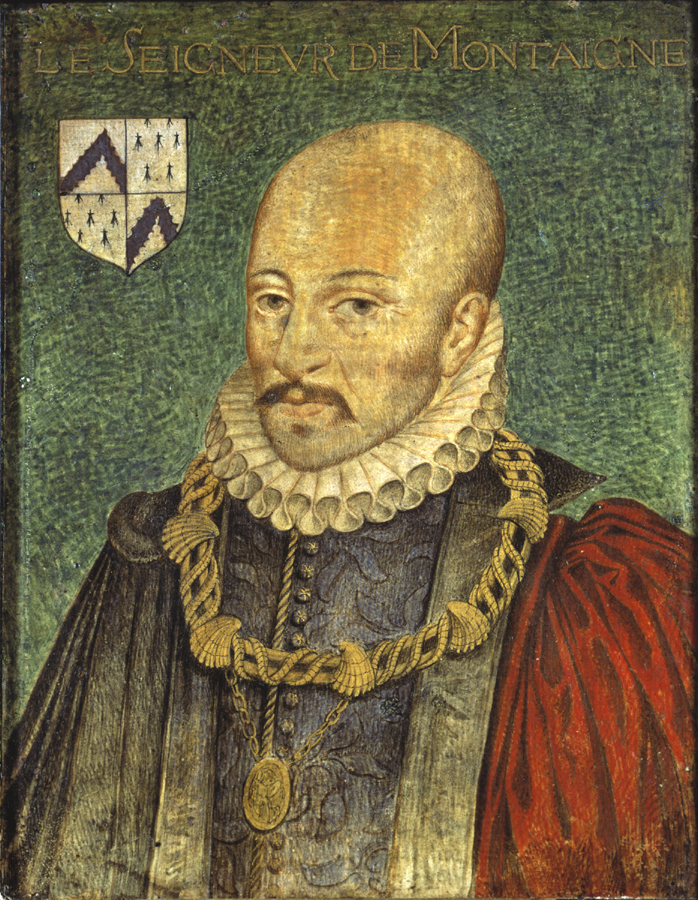
Michel Eyquem de Montaigne híres idézetei
Michel Eyquem de Montaigne Idézetek az emberekről
Michel Eyquem de Montaigne Idézetek a világról
Michel Eyquem de Montaigne idézetek
Michel Eyquem de Montaigne: Idézetek angolul
“Man in sooth is a marvellous, vain, fickle, and unstable subject.”
Book I, Ch. 1. That Men by various Ways arrive at the same End
Essais (1595), Bartlett's Familiar Quotations, 10th ed. (1919)
Attributed
Book III, Ch. 8. Of the Art of Conversation
Essais (1595), Bartlett's Familiar Quotations, 10th ed. (1919)
“We seek and offer ourselves to be gulled.”
Book III, Ch. 11. Of Cripples
Essais (1595), Bartlett's Familiar Quotations, 10th ed. (1919)
“Live as long as you please, you will strike nothing off the time you will have to spend dead.”
Book I, Ch. 20
Essais (1595), Book I
“In my opinion, every rich man is a miser.”
Book I, Ch. 14
Essais (1595), Book I
“The sage says that all that is under heaven incurs the same law and the same fate.”
Book II, Ch. 12
Essais (1595), Book II
“The laws of conscience, which we pretend to be derived from nature, proceed from custom.”
Book I, Ch. 22. Of Custom
Essais (1595), Bartlett's Familiar Quotations, 10th ed. (1919)
“He who is not sure of his memory, should not undertake the trade of lying.”
Book I, Ch. 9
Attributed
Változat: He who is not very strong in memory should not meddle with lying.
Változat: It is not without good reason said, that he who has not a good memory should never take upon him the trade of lying.
“Like rowers, who advance backward.”
Book III, Ch. 1. Of Profit and Honesty
Essais (1595), Bartlett's Familiar Quotations, 10th ed. (1919)
“We must not attach knowledge to the mind, we have to incorporate it there.”
Book I, Ch. 25
Essais (1595), Book I
Book II, Ch. 11. Of Cruelty
Essais (1595), Bartlett's Familiar Quotations, 10th ed. (1919)
Il n'est si homme de bien, qu'il mette à l'examen des loix toutes ses actions et pensées, qui ne soit pendable dix fois en sa vie.
Book III, Ch. 9
Essais (1595), Book III
Változat: There is no man so good, who, were he to submit all his thoughts and actions to the laws, would not deserve hanging ten times in his life.
“Fortune, seeing that she could not make fools wise, has made them lucky.”
Book III, Ch. 8
This quote is a paraphrase of a lengthier statement, as follows: We ordinarily see, in the actions of the world, that Fortune, to shew us her power in all things, and who takes a pride in abating our presumption, seeing she could not make fools wise, has made them fortunate in emulation of virtue; and most favours those operations the web of which is most purely her own; whence it is that the simplest amongst us bring to pass great business, both public and private; and, as Seiramnes, the Persian, answered those who wondered that his affairs succeeded so ill, considering that his deliberations were so wise, ‘that he was sole master of his designs, but success was wholly in the power of fortune’; these may answer the same, but with a contrary turn.
From Essays of Michel de Montaigne, translated by Charles Cotton (1877), Book the Third, Chapter VIII — Of The Art Of Conference. Note : this is the version found at Project Gutenberg.
Attributed
“Man is forming thousands of ridiculous relations between himself and God.”
Book II, Ch. 12
Essais (1595), Book II
“How many worthy men have we seen survive their own reputation!”
Book II, Ch. 16. Of Glory
Essais (1595), Bartlett's Familiar Quotations, 10th ed. (1919)
Változat: How many valiant men we have seen to survive their own reputation!
Book II, Ch. 8. Of the Affections of Fathers
Essais (1595), Bartlett's Familiar Quotations, 10th ed. (1919)
“There are some defeats more triumphant than victories.”
Book I, Ch. 30. Of Cannibals
Essais (1595), Bartlett's Familiar Quotations, 10th ed. (1919)
“Few men have been admired by their own domestics.”
Book iii. Chap 2. Of Repentance
Essais (1595), Bartlett's Familiar Quotations, 10th ed. (1919)
Változat: Few men have been admired by their own households.


