Alan Moore Quotes
page 5

Alan Moore is an English writer known primarily for his work in comic books including Watchmen, V for Vendetta, The Ballad of Halo Jones, Swamp Thing, Batman: The Killing Joke and From Hell. Regarded by some as the best comics writer in the English language, he is widely recognized among his peers and critics. He has occasionally used such pseudonyms as Curt Vile, Jill de Ray, and Translucia Baboon; also, reprints of some of his work have been credited to The Original Writer when Moore requested that his name be removed.Moore started writing for British underground and alternative fanzines in the late 1970s before achieving success publishing comic strips in such magazines as 2000 AD and Warrior. He was subsequently picked up by the American DC Comics, and as "the first comics writer living in Britain to do prominent work in America", he worked on major characters such as Batman and Superman , substantially developed the character Swamp Thing, and penned original titles such as Watchmen. During that decade, Moore helped to bring about greater social respectability for comics in the United States and United Kingdom. He prefers the term "comic" to "graphic novel". In the late 1980s and early 1990s he left the comic industry mainstream and went independent for a while, working on experimental work such as the epic From Hell and the prose novel Voice of the Fire. He subsequently returned to the mainstream later in the 1990s, working for Image Comics, before developing America's Best Comics, an imprint through which he published works such as The League of Extraordinary Gentlemen and the occult-based Promethea. In 2016, he published Jerusalem: a 1266-page experimental novel set in his hometown of Northampton, UK.

Moore is an occultist, ceremonial magician, and anarchist, and has featured such themes in works including Promethea, From Hell, and V for Vendetta, as well as performing avant-garde spoken word occult "workings" with The Moon and Serpent Grand Egyptian Theatre of Marvels, some of which have been released on CD.

Despite his own personal objections, his works have provided the basis for a number of Hollywood films, including From Hell , The League of Extraordinary Gentlemen , V for Vendetta , and Watchmen . Moore has also been referenced in popular culture, and has been recognised as an influence on a variety of literary and television figures including Neil Gaiman, Joss Whedon, and Damon Lindelof. He has lived a significant portion of his life in Northampton, England, and he has said in various interviews that his stories draw heavily from his experiences living there. Wikipedia  

✵ 18. November 1953
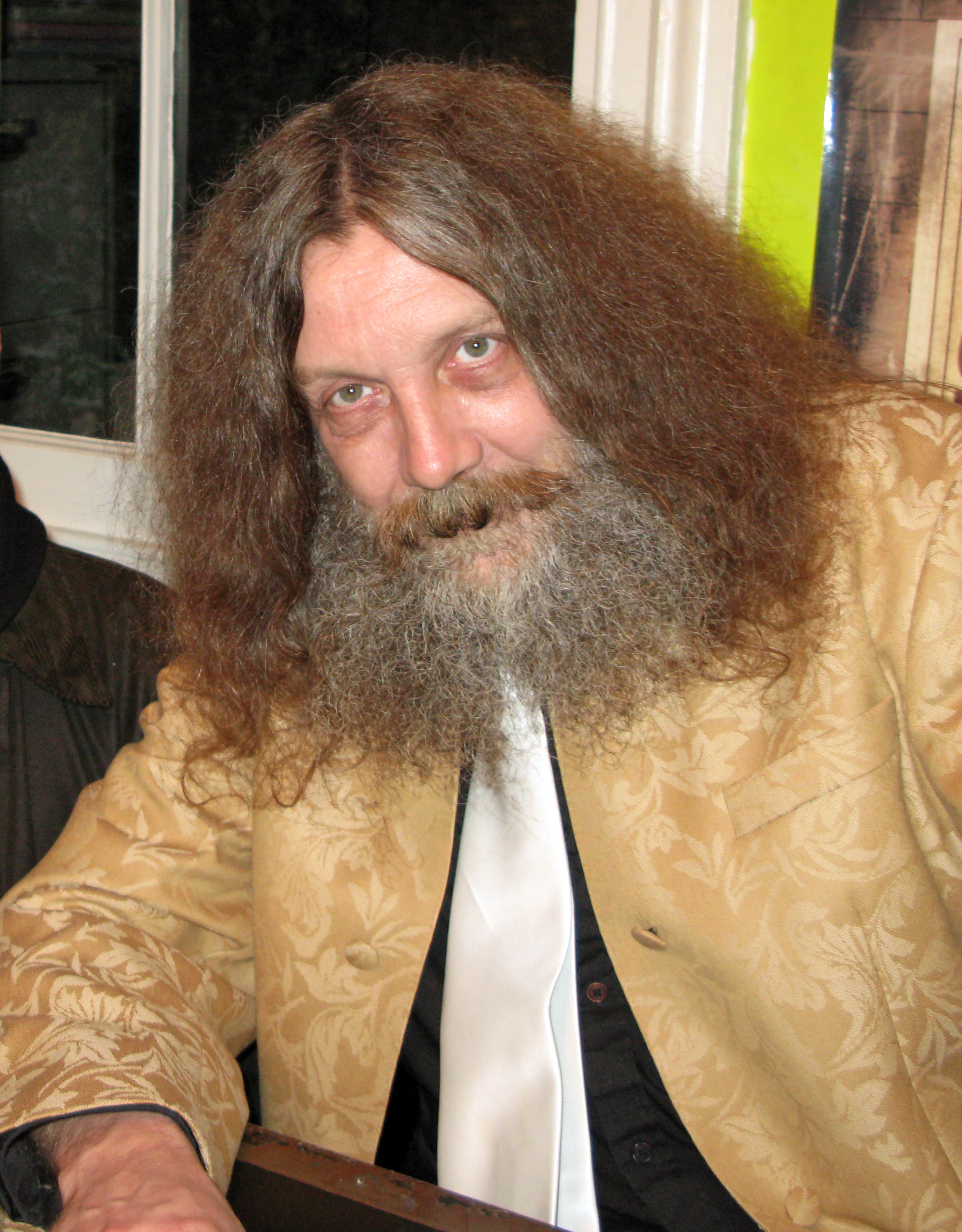
Alan Moore photo
Alan Moore: 274   quotes 13   likes

Alan Moore Quotes

“Sex is glorious, it's how we all got here, and it's most people's favourite activity.”

http://www.independent.co.uk/arts-entertainment/books/features/alan-moore-the-reluctant-hero-64407.html

“For whatever the future holds, one thing is certain… It just won't be the same.”

Source: V for Vendetta, Vol. I of X

“Murder? Don't talk to me about murder. I invented murder!”

Cain, Saga of the Swamp Thing #33
Swamp Thing (1983–1987)

“When modern horror films or fundamentalists talk about “demons,” they mean something very different than what Socrates meant by the term. It was a lot closer to what I was talking about: the essential drive, the highest self, if you like. So maybe there is a connection, when I met, or appeared to meet, a demon. It was a little bit frightening at first, but after a while we found that we got on OK and we could have a civilized conversation, and I found him very engaging, very pleasant. And it struck me that this was a brilliant literal example of the process of demonization. That when I had approached the demon with fear and loathing, it was fearsome and loathsome. When I approached it with respect, then it was respectable. And I thought, All right, there’s a kind of mirroring that is going on here that is probably applicable to a wide number of social situations. The people or classes of people that we demonize, and that we treat with fear and loathing, respond accordingly. We are projecting a persona of manner of behavior upon them, as well as responding to a manner of behavior that’s already there. When we’re looking at the flaws in their personality that we are able to recognize, the fact that we can recognize them suggests that they are probably in some way a version of flaws that we have ourselves.”

As quoted in ""HEY, YOU CAN JUST MAKE STUFF UP." Differences between magic and art: None" https://www.believermag.com/issues/201306/?read=interview_moore, by Peter Bebergal, The Believer, (2013).
The Believer interview (2013)

“I suppose that the main drive is to find the edge of something and then throw myself over it.”

On the issue of creativity, from the interview with Channel 4, "V for Vendetta: the man behind the mask" (11 January 2012) http://www.channel4.com/news/v-for-vendetta-the-man-behind-the-mask

“Memories so treacherous…”

Batman : The Killing Joke (1988)

“There is an inverse relationship between imagination and money.”

About the film adaptation of V for Vendetta, in an MTV interview "Alan Moore : The Last Angry Man" http://www.mtv.com/shared/movies/interviews/m/moore_alan_060315/

“I was talking earlier — about anarchy and fascism being the two poles of politics. On one hand you’ve got fascism, with the bound bundle of twigs, the idea that in unity and uniformity there is strength; on the other you have anarchy, which is completely determined by the individual, and where the individual determines his or her own life. Now if you move that into the spiritual domain, then in religion, I find very much the spiritual equivalent of fascism. The word “religion” comes from the root word ligare, which is the same root word as ligature, and ligament, and basically means “bound together in one belief.” It’s basically the same as the idea behind fascism; there’s not even necessarily a spiritual component it. Everything from the Republican Party to the Girl Guides could be seen as a religion, in that they are bound together in one belief. So to me, like I said, religion becomes very much the spiritual equivalent of fascism. And by the same token, magic becomes the spiritual equivalent of anarchy, in that it is purely about self-determination, with the magician simply a human being writ large, and in more dramatic terms, standing at the center of his or her own universe. Which I think is a kind of a spiritual statement of the basic anarchist position. I find an awful lot in common between anarchist politics and the pursuit of magic, that there’s a great sympathy there.”

Alan Moore on Anarchism (2009)

“I'm not a millionaire but I'm very comfortable doing what I do, and I'm more productive now than I was in my mid-20s. It's all down to functionality eventually. If you're functional it doesn't matter if you're mad.”

As quoted in "Moore's murderer", in The Guardian (2 February 2002) http://www.guardian.co.uk/film/2002/feb/02/sciencefictionfantasyandhorror.books

“If you wear black, then kindly, irritating strangers will touch your arm consolingly and inform you that the world keeps on turning.
They're right. It does.
However much you beg it to stop.
It turns and lets grenadine spill over the horizon, sends hard bars of gold through my window and I wake up and feel happy for three seconds and then I remember.
It turns and tips people out of their beds and into their cars, their offices, an avalanche of tiny men and women tumbling through life…
All trying not to think about what's waiting at the bottom.
Sometimes it turns and sends us reeling into each other's arms. We cling tight, excited and laughing, strangers thrown together on a moving funhouse floor.
Intoxicated by the motion we forget all the risks.
And then the world turns…
And somebody falls off…
And oh God it's such a long way down.
Numb with shock, we can only stand and watch as they fall away from us, gradually getting smaller…
Receding in our memories until they're no longer visible.
We gather in cemeteries, tense and silent as if for listening for the impact; the splash of a pebble dropped into a dark well, trying to measure its depth.
Trying to measure how far we have to fall.
No impact comes; no splash. The moment passes. The world turns and we turn away, getting on with our lives…
Wrapping ourselves in comforting banalities to keep us warm against the cold.
"Time's a great healer."
"At least it was quick.”

"The world keeps turning.
Oh Alec—
Alec's dead."
Swamp Thing (1983–1987)

“I despise the comic industry, but I will always love the comic medium.”

New York Press interview (15 June 2006) http://www.nypress.com/19/24/books/feature2.cfm

“There are people. There are stories. The people think they shape the stories, but the reverse is often closer to the truth.”

"Down Among the Dead Men", Swamp Thing Annual #2, 1985
Swamp Thing (1983–1987)