
John Steinbeck book The Acts of King Arthur and His Noble Knights
Source: The Acts of King Arthur and His Noble Knights
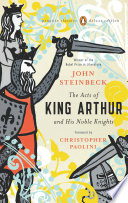
The Acts of King Arthur and His Noble Knights is John Steinbeck's retelling of the Arthurian legend, based on the Winchester Manuscript text of Sir Thomas Malory's Le Morte d'Arthur. He began his adaptation in November 1956. Steinbeck had long been a lover of the Arthurian legends. The introduction to his translation contains an anecdote about him reading them as a young boy. His enthusiasm for Arthur is apparent in the work. The book was left unfinished at his death, and ends with the death of chivalry in Arthur's purest knight, Lancelot of the Lake.Steinbeck took a "living approach" to the retelling of Malory's work. He followed Malory's structure and retained the original chapter titles, but he explored the psychological underpinning of the events, and tuned the use of language to sound natural and accessible to a Modern English speaker:
John Steinbeck book The Acts of King Arthur and His Noble Knights
Source: The Acts of King Arthur and His Noble Knights
“The final weapon is the brain, all else is supplemental.”
John Steinbeck book The Acts of King Arthur and His Noble Knights
Source: The Acts of King Arthur and His Noble Knights
“The profession of book-writing makes horse-racing seem like a solid, stable business.”
John Steinbeck book The Acts of King Arthur and His Noble Knights
The Acts of King Arthur and His Noble Knights (1976), but a statement he is first quoted as having made in Newsweek (24 December 1962)
John Steinbeck book The Acts of King Arthur and His Noble Knights
The Acts of King Arthur and His Noble Knights (1976)
“Most people live in a half-dream all their lives and call it reality.”
John Steinbeck book The Acts of King Arthur and His Noble Knights
Appendix, letter to Elizabeth Otis (25 July 1959)
The Acts of King Arthur and His Noble Knights (1976)
John Steinbeck book The Acts of King Arthur and His Noble Knights
Appendix, letter to Chase Horton (8 June 1959)
The Acts of King Arthur and His Noble Knights (1976)
“An artist should be open on all sides to every kind of light and darkness.”
John Steinbeck book The Acts of King Arthur and His Noble Knights
Appendix, letter to Elizabeth Otis and Chase Horton (20 April 1959)
The Acts of King Arthur and His Noble Knights (1976)
John Steinbeck book The Acts of King Arthur and His Noble Knights
Appendix, letter to Elizabeth Otis and Chase Horton (14 March 1958)
The Acts of King Arthur and His Noble Knights (1976)
“In the combat between wisdom and feeling, wisdom never wins.”
John Steinbeck book The Acts of King Arthur and His Noble Knights
Merlin to King Arthur in "The Death of Merlin"
The Acts of King Arthur and His Noble Knights (1976)
John Steinbeck book The Acts of King Arthur and His Noble Knights
Introduction
The Acts of King Arthur and His Noble Knights (1976)


