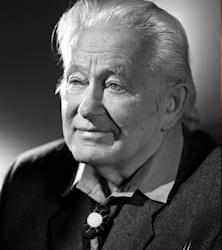
Źródło: Zmarł Charpak, zakochany w fizyce, gazeta.pl, 1 października 2010 http://wyborcza.pl/1,75476,8450793,Zmarl_Charpak__zakochany_w_fizyce.html#ixzz1Awa8ouPn
Georges Charpak: 5 cytatów0 Polubień
Georges Charpak cytaty
Źródło: Nobel nr 137, wyborcza.pl, 1 października 2010 http://wyborcza.pl/1,75476,8453664,Nobel_nr_137.html#ixzz1AwZdS0iE
Georges Charpak: Cytaty po angielsku
“History of science played a very important role for me.”
Nobel interview http://nobelprize.org/mediaplayer/index.php?id=425 with Professor Georges Charpak by Joanna Rose, science writer, 6 December 2001. <br class="br">Kontekst: History of science played a very important role for me. Before I knew well how to do an experiment, I knew why Joliot has missed the neutron, why his wife missed the fission, why they succeeded in having artificial radioactivity, and even why they almost missed the other things, by doing very nice experiments, but didn't come to the conclusion. That is science. Science is doubt, is research. It is not something which is – and that is the danger of teaching – which is too academic and which the people explain you it is like the logic thing that comes out of the computer, which is not true. You have intuition, you have passion.
“You have intuition, you have passion.”
Nobel interview http://nobelprize.org/mediaplayer/index.php?id=425 with Professor Georges Charpak by Joanna Rose, science writer, 6 December 2001. <br class="br">Kontekst: History of science played a very important role for me. Before I knew well how to do an experiment, I knew why Joliot has missed the neutron, why his wife missed the fission, why they succeeded in having artificial radioactivity, and even why they almost missed the other things, by doing very nice experiments, but didn't come to the conclusion. That is science. Science is doubt, is research. It is not something which is – and that is the danger of teaching – which is too academic and which the people explain you it is like the logic thing that comes out of the computer, which is not true. You have intuition, you have passion.
“literally: If we want to do something, we must deal with education.”
Si on veut faire quelque chose, il faut donc s'occuper d'éducation.
If there's one thing to do, it's to engage in education.
in an edition by [Michel Serres, Les Limites de L'humain, L'Age d'Homme, 2004, 2825118974, 81]


