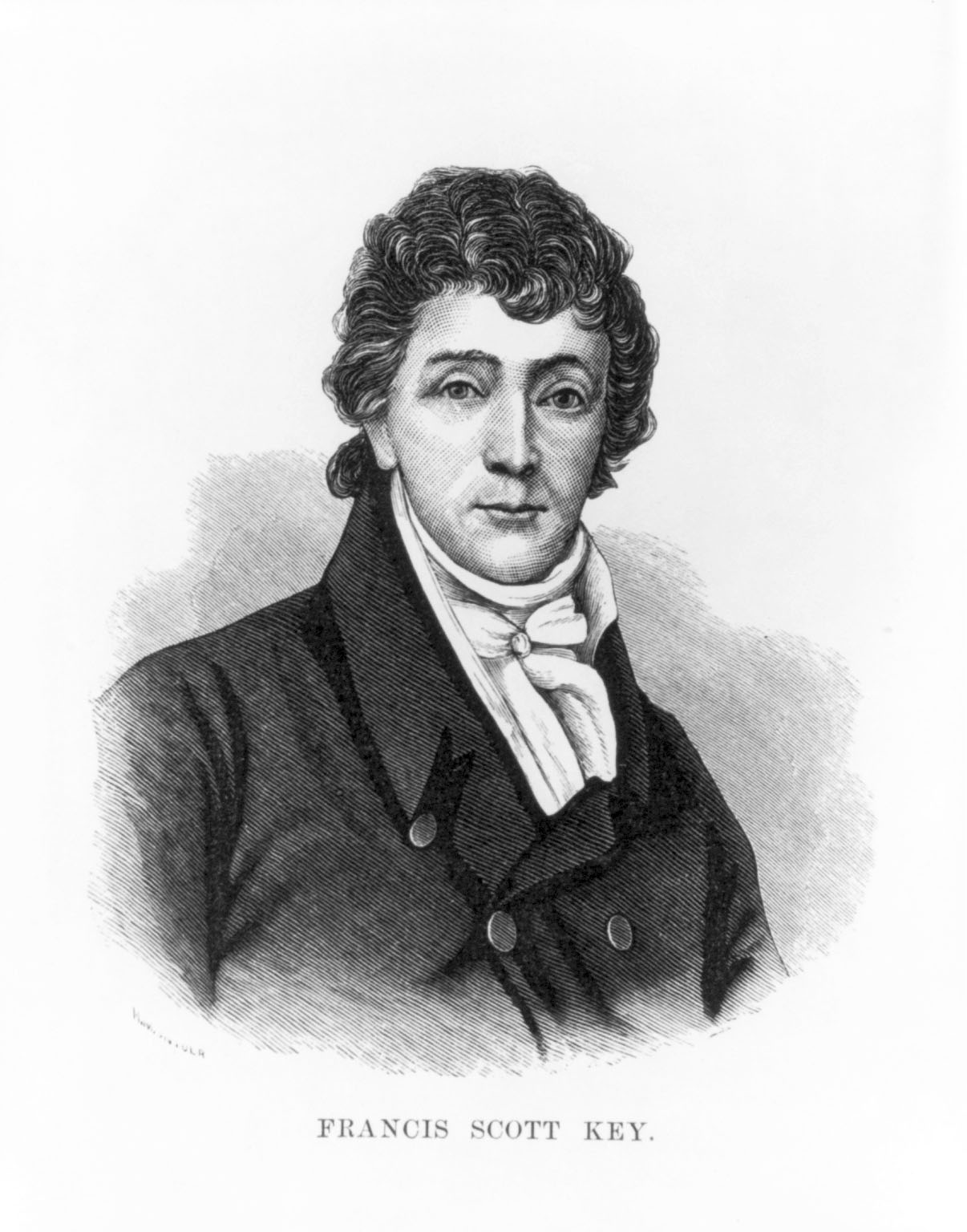
Francis Scott Key cytaty

Francis Scott Key - prawnik i poeta amerykański, autor hymnu państwowego Stanów Zjednoczonych, The Star-Spangled Banner Wikipedia  

✵ 1. Sierpień 1779 – 11. Styczeń 1843
Francis Scott Key Fotografia
Francis Scott Key: 8 cytatów0 Polubień

Francis Scott Key: Cytaty po angielsku

“O thus be it ever, when freemen shall stand
Between their loved home and the war's desolation.”

Francis Scott Key

A line in the final stanzas is comparable to "It made and preserves us a nation" in The Flag of our Union by George Pope Morris.
The Star-Spangled Banner (1814)
Kontekst: O say can you see by the dawn's early light,
What so proudly we hailed at the twilight's last gleaming,
Whose broad stripes and bright stars through the perilous fight,
O'er the ramparts we watched, were so gallantly streaming?
And the rockets' red glare, the bombs bursting in air,
Gave proof through the night that our flag was still there;
O say does that star-spangled banner yet wave,
O'er the land of the free and the home of the brave?On the shore dimly seen through the mists of the deep,
Where the foe's haughty host in dread silence reposes,
What is that which the breeze, o'er the towering steep,
As it fitfully blows, half conceals, half discloses?
Now it catches the gleam of the morning's first beam,
In full glory reflected now shines in the stream:
'Tis the star-spangled banner, O! long may it wave
O'er the land of the free and the home of the brave. And where is that band who so vauntingly swore
That the havoc of war and the battle's confusion,
A home and a country, should leave us no more?
Their blood has washed out their foul footsteps' pollution.
No refuge could save the hireling and slave
From the terror of flight, or the gloom of the grave:
And the star-spangled banner in triumph doth wave,
O'er the land of the free and the home of the brave.O thus be it ever, when freemen shall stand
Between their loved home and the war's desolation.
Blest with vict'ry and peace, may the Heav'n rescued land
Praise the Power that hath made and preserved us a nation!
Then conquer we must, when our cause it is just,
And this be our motto: "In God is our trust."
And the star-spangled banner in triumph shall wave
O'er the land of the free and the home of the brave!

“So sings the world's fond slave! so flies the dream
Of life's gay morn; so sinks the meteor ray
Of fancy into darkness; and no beam
Of purer light shines on the wanderer's way.”

Francis Scott Key

"On Reading Fawcett's Lines On Revisiting Scenes Of Early Life" in Poems of the Late Francis Scott Key, Esq. (1857), p. 87.
Kontekst: p>So sings the world's fond slave! so flies the dream
Of life's gay morn; so sinks the meteor ray
Of fancy into darkness; and no beam
Of purer light shines on the wanderer's way.So sings not he who soars on other wings
Than fancy lends him; whom a cheering faith
Warms and sustains, and whose freed spirit springs
To joys that bloom beyond the reach of death.And thou would'st live again! again dream o'er
The wild and feverish visions of thy youth
Again to wake in sorrow, and deplore
Thy wanderings from the peaceful paths of truth! Yet yield not to despair! be born again,
And thou shalt live a life of joy and peace,
Shall die a death of triumph, and thy strain
Be changed to notes of rapture ne'er to cease.</p

“Praise the Power that hath made and preserved us a nation!
Then conquer we must, when our cause it is just,
And this be our motto: "In God is our trust."
And the star-spangled banner in triumph shall wave
O'er the land of the free and the home of the brave!”

Francis Scott Key

A line in the final stanzas is comparable to "It made and preserves us a nation" in The Flag of our Union by George Pope Morris.
The Star-Spangled Banner (1814)
Kontekst: O say can you see by the dawn's early light,
What so proudly we hailed at the twilight's last gleaming,
Whose broad stripes and bright stars through the perilous fight,
O'er the ramparts we watched, were so gallantly streaming?
And the rockets' red glare, the bombs bursting in air,
Gave proof through the night that our flag was still there;
O say does that star-spangled banner yet wave,
O'er the land of the free and the home of the brave?On the shore dimly seen through the mists of the deep,
Where the foe's haughty host in dread silence reposes,
What is that which the breeze, o'er the towering steep,
As it fitfully blows, half conceals, half discloses?
Now it catches the gleam of the morning's first beam,
In full glory reflected now shines in the stream:
'Tis the star-spangled banner, O! long may it wave
O'er the land of the free and the home of the brave. And where is that band who so vauntingly swore
That the havoc of war and the battle's confusion,
A home and a country, should leave us no more?
Their blood has washed out their foul footsteps' pollution.
No refuge could save the hireling and slave
From the terror of flight, or the gloom of the grave:
And the star-spangled banner in triumph doth wave,
O'er the land of the free and the home of the brave.O thus be it ever, when freemen shall stand
Between their loved home and the war's desolation.
Blest with vict'ry and peace, may the Heav'n rescued land
Praise the Power that hath made and preserved us a nation!
Then conquer we must, when our cause it is just,
And this be our motto: "In God is our trust."
And the star-spangled banner in triumph shall wave
O'er the land of the free and the home of the brave!

“When the warrior returns, from the battle afar,
To the home and the country he nobly defended,
O! warm be the welcome to gladden his ear,
And loud be the joy that his perils are ended”

Francis Scott Key

"Song" in The Port Folio Vol. 1, No. 1 (11 January 1806), p. 79; also in Poems of the Late Francis Scott Key, Esq. (1857), p. 34.
Kontekst: When the warrior returns, from the battle afar,
To the home and the country he nobly defended,
O! warm be the welcome to gladden his ear,
And loud be the joy that his perils are ended:
In the full tide of song let his fame roll along,
To the feast-flowing board let us gratefully throng,
Where, mixed with the olive, the laurel shall wave,
And form a bright wreath for the brows of the brave.

“O say can you see by the dawn's early light,
What so proudly we hailed at the twilight's last gleaming”

Francis Scott Key

A line in the final stanzas is comparable to "It made and preserves us a nation" in The Flag of our Union by George Pope Morris.
The Star-Spangled Banner (1814)
Kontekst: O say can you see by the dawn's early light,
What so proudly we hailed at the twilight's last gleaming,
Whose broad stripes and bright stars through the perilous fight,
O'er the ramparts we watched, were so gallantly streaming?
And the rockets' red glare, the bombs bursting in air,
Gave proof through the night that our flag was still there;
O say does that star-spangled banner yet wave,
O'er the land of the free and the home of the brave?On the shore dimly seen through the mists of the deep,
Where the foe's haughty host in dread silence reposes,
What is that which the breeze, o'er the towering steep,
As it fitfully blows, half conceals, half discloses?
Now it catches the gleam of the morning's first beam,
In full glory reflected now shines in the stream:
'Tis the star-spangled banner, O! long may it wave
O'er the land of the free and the home of the brave. And where is that band who so vauntingly swore
That the havoc of war and the battle's confusion,
A home and a country, should leave us no more?
Their blood has washed out their foul footsteps' pollution.
No refuge could save the hireling and slave
From the terror of flight, or the gloom of the grave:
And the star-spangled banner in triumph doth wave,
O'er the land of the free and the home of the brave.O thus be it ever, when freemen shall stand
Between their loved home and the war's desolation.
Blest with vict'ry and peace, may the Heav'n rescued land
Praise the Power that hath made and preserved us a nation!
Then conquer we must, when our cause it is just,
And this be our motto: "In God is our trust."
And the star-spangled banner in triumph shall wave
O'er the land of the free and the home of the brave!

“O say does that star-spangled banner yet wave,
O'er the land of the free and the home of the brave?”

Francis Scott Key

A line in the final stanzas is comparable to "It made and preserves us a nation" in The Flag of our Union by George Pope Morris.
The Star-Spangled Banner (1814)
Kontekst: O say can you see by the dawn's early light,
What so proudly we hailed at the twilight's last gleaming,
Whose broad stripes and bright stars through the perilous fight,
O'er the ramparts we watched, were so gallantly streaming?
And the rockets' red glare, the bombs bursting in air,
Gave proof through the night that our flag was still there;
O say does that star-spangled banner yet wave,
O'er the land of the free and the home of the brave?On the shore dimly seen through the mists of the deep,
Where the foe's haughty host in dread silence reposes,
What is that which the breeze, o'er the towering steep,
As it fitfully blows, half conceals, half discloses?
Now it catches the gleam of the morning's first beam,
In full glory reflected now shines in the stream:
'Tis the star-spangled banner, O! long may it wave
O'er the land of the free and the home of the brave. And where is that band who so vauntingly swore
That the havoc of war and the battle's confusion,
A home and a country, should leave us no more?
Their blood has washed out their foul footsteps' pollution.
No refuge could save the hireling and slave
From the terror of flight, or the gloom of the grave:
And the star-spangled banner in triumph doth wave,
O'er the land of the free and the home of the brave.O thus be it ever, when freemen shall stand
Between their loved home and the war's desolation.
Blest with vict'ry and peace, may the Heav'n rescued land
Praise the Power that hath made and preserved us a nation!
Then conquer we must, when our cause it is just,
And this be our motto: "In God is our trust."
And the star-spangled banner in triumph shall wave
O'er the land of the free and the home of the brave!

“Yet yield not to despair! be born again,
And thou shalt live a life of joy and peace,
Shall die a death of triumph, and thy strain
Be changed to notes of rapture ne'er to cease.”

Francis Scott Key

"On Reading Fawcett's Lines On Revisiting Scenes Of Early Life" in Poems of the Late Francis Scott Key, Esq. (1857), p. 87.
Kontekst: p>So sings the world's fond slave! so flies the dream
Of life's gay morn; so sinks the meteor ray
Of fancy into darkness; and no beam
Of purer light shines on the wanderer's way.So sings not he who soars on other wings
Than fancy lends him; whom a cheering faith
Warms and sustains, and whose freed spirit springs
To joys that bloom beyond the reach of death.And thou would'st live again! again dream o'er
The wild and feverish visions of thy youth
Again to wake in sorrow, and deplore
Thy wanderings from the peaceful paths of truth! Yet yield not to despair! be born again,
And thou shalt live a life of joy and peace,
Shall die a death of triumph, and thy strain
Be changed to notes of rapture ne'er to cease.</p

Podobni autorzy

Henry David Thoreau Fotografia
Henry David Thoreau94
amerykański pisarz, poeta i filozof None
Walt Whitman Fotografia
Walt Whitman16
poeta amerykański None
Henry Wadsworth Longfellow Fotografia
Henry Wadsworth Longfellow19
poeta amerykański None
Robert Browning Fotografia
Robert Browning8
angielski poeta None
Percy Bysshe Shelley Fotografia
Percy Bysshe Shelley6
angielski poeta None
Edgar Allan Poe Fotografia
Edgar Allan Poe20
poeta i nowelista amerykański None
Arthur Rimbaud Fotografia
Arthur Rimbaud40
francuski poeta None
Samuel Taylor Coleridge Fotografia
Samuel Taylor Coleridge33
poeta angielski None
Heinrich Heine Fotografia
Heinrich Heine44
poeta niemiecki None
Hans Christian Andersen Fotografia
Hans Christian Andersen12
duński pisarz i poeta None