Choruses from The Rock (1934)
Context: The lot of man is ceaseless labor,
Or ceaseless idleness, which is still harder,
Or irregular labour, which is not pleasant.
I have trodden the winepress alone, and I know
That it is hard to be really useful, resigning
The things that men count for happiness, seeking
The good deeds that lead to obscurity, accepting
With equal face those that bring ignominy,
The applause of all or the love of none.
All men are ready to invest their money
But most expect dividends.
I say to you: Make perfect your will.
I say: take no thought of the harvest,
But only of proper sowing.
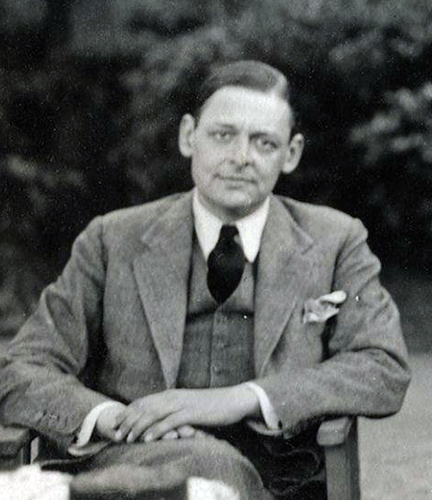
T.S. Eliot: 270 quotes53 likes
T.S. Eliot Quotes
“Old Deuteronomy's lived a long time;
He's a Cat who has lived many lives in succession.”
T.S. Eliot book Old Possum's Book of Practical Cats
Old Deuteronomy
Old Possum's Book of Practical Cats (1939)
Context: Old Deuteronomy's lived a long time;
He's a Cat who has lived many lives in succession.
He was famous in proverb and famous in rhyme
A long while before Queen Victoria's accession.
Letter to Marquis Childs quoted in St. Louis Post Dispatch (15 October 1930) and in the address "American Literature and the American Language" delivered at Washington University (9 June 1953) published in Washington University Studies, New Series: Literature and Language, no. 23 (St. Louis : Washington University Press, 1953), p. 6
Context: It is self-evident that St. Louis affected me more deeply than any other environment has ever done. I feel that there is something in having passed one's childhood beside the big river, which is incommunicable to those people who have not. I consider myself fortunate to have been born here, rather than in Boston, or New York, or London.
T.S. Eliot The Love Song of J. Alfred Prufrock
The Love Song of J. Alfred Prufrock (1915)
Context: There will be time, there will be time
To prepare a face to meet the faces that you meet;
There will be time to murder and create,
And time for all the works and days of hands,
That lift and drop a question on your plate;
Time for you and time for me,
And time yet for a hundred indecisions,
And for a hundred visions and revisions,
Before the taking of a toast and tea.
“I have heard the mermaids singing, each to each.
I do not think that they will sing to me.”
T.S. Eliot The Love Song of J. Alfred Prufrock
Source: The Love Song of J. Alfred Prufrock (1915)
Context: I grow old … I grow old...
I shall wear the bottoms of my trousers rolled.
Shall I part my hair behind? Do I dare to eat a peach?
I shall wear white flannel trousers, and walk upon the beach.
I have heard the mermaids singing, each to each.
I do not think that they will sing to me.
I have seen them riding seaward on the waves
Combing the white hair of the waves blown back
When the wind blows the water white and black.
We have lingered in the chambers of the sea
By sea-girls wreathed with seaweed red and brown
Till human voices wake us, and we drown.
The Love Song of J. Alfred Prufrock (1915)
Source: The Love Song of J. Alfred Prufrock and Other Poems
Context: I grow old … I grow old...
I shall wear the bottoms of my trousers rolled.
Shall I part my hair behind? Do I dare to eat a peach?
I shall wear white flannel trousers, and walk upon the beach.
I have heard the mermaids singing, each to each.
I do not think that they will sing to me.
I have seen them riding seaward on the waves
Combing the white hair of the waves blown back
When the wind blows the water white and black.
We have lingered in the chambers of the sea
By sea-girls wreathed with seaweed red and brown
Till human voices wake us, and we drown.
T.S. Eliot book The Waste Land
The final lines of the poem.
The Waste Land (1922)
Source: The Waste Land and Other Poems
“Love is most nearly itself
When here and now cease to matter.”
T.S. Eliot book Four Quartets
Source: Four Quartets
The Love Song of J. Alfred Prufrock (1915)
Source: The Love Song of J. Alfred Prufrock and Other Poems
Context: I am no prophet — and here's no great matter;
I have seen the moment of my greatness flicker,
And I have seen the eternal Footman hold my coat, and snicker,
And in short, I was afraid.
Ash-Wednesday (1930)
Variant: Suffer us not to mock ourselves with falsehood
Teach us to care and not to care
“I grow old … I grow old …
I shall wear the bottoms of my trousers rolled.”
The Love Song of J. Alfred Prufrock (1915)
Source: The Love Song of J. Alfred Prufrock and Other Poems
Context: I grow old … I grow old...
I shall wear the bottoms of my trousers rolled.
Shall I part my hair behind? Do I dare to eat a peach?
I shall wear white flannel trousers, and walk upon the beach.
I have heard the mermaids singing, each to each.
I do not think that they will sing to me.
I have seen them riding seaward on the waves
Combing the white hair of the waves blown back
When the wind blows the water white and black.
We have lingered in the chambers of the sea
By sea-girls wreathed with seaweed red and brown
Till human voices wake us, and we drown.
“music heard so deeply
That it is not heard at all, but
you are the music
While the music lasts.”
Source: Collected Poems, 1909-1962
“I should have been a pair of ragged claws
Scuttling across the floors of silent seas.”
The Love Song of J. Alfred Prufrock (1915)
Source: The Love Song of J. Alfred Prufrock and Other Poems
Source: Quoted in Herbert Howarth, Notes on Some Figures behind T. S. Eliot (Boston: Houghton Mifflin, 1964), p. 89
T.S. Eliot book The Sacred Wood
Source: "Philip Massinger", a biographical essay in The Sacred Wood (1920)
T.S. Eliot book Four Quartets
Variant: Footfalls echo in the memory, down the passage we did not take, towards the door we never opened, into the rose garden.
Source: Four Quartets


