
“Only those who will risk going too far can possibly find out how far one can go.”
Preface to Transit of Venus: Poems by Harry Crosby (1931)
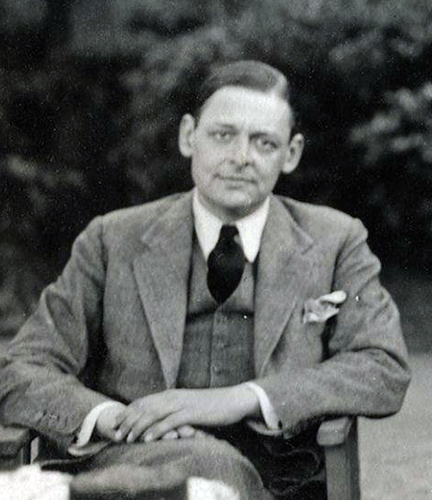
Thomas Stearns Eliot, was a British essayist, publisher, playwright, literary and social critic, and "one of the twentieth century's major poets". He moved from his native United States to England in 1914 at the age of 25, settling, working, and marrying there. He eventually became a British subject in 1927 at the age of 39, renouncing his American citizenship.
Eliot attracted widespread attention for his poem "The Love Song of J. Alfred Prufrock" , which was seen as a masterpiece of the Modernist movement. It was followed by some of the best-known poems in the English language, including The Waste Land , "The Hollow Men" , "Ash Wednesday" , and Four Quartets . He was also known for his seven plays, particularly Murder in the Cathedral and The Cocktail Party . He was awarded the Nobel Prize in Literature in 1948, "for his outstanding, pioneer contribution to present-day poetry".
“Only those who will risk going too far can possibly find out how far one can go.”
Preface to Transit of Venus: Poems by Harry Crosby (1931)
Source: The Use of Poetry and the Use of Criticism
T.S. Eliot The Love Song of J. Alfred Prufrock
The Love Song of J. Alfred Prufrock (1915)
Context: Do I dare
Disturb the universe?
In a minute there is time
For decisions and revisions which a minute will reverse.
For I have known them all already, known them all: —
Have known the evenings, mornings, afternoons,
I have measured out my life with coffee spoons;
I know the voices dying with a dying fall
Beneath the music from a farther room.
T.S. Eliot book Tradition and the Individual Talent
Tradition and the Individual Talent (1919)
Context: The historical sense involves a perception, not only of the pastness of the past, but of its presence; the historical sense compels a man to write not merely with his own generation in his bones, but with a feeling that the whole of the literature of Europe from Homer and within it the whole of the literature of his own country has a simultaneous existence and composes a simultaneous order. This historical sense, which is a sense of the timeless as well as of the temporal and of the timeless and of the temporal together, is what makes a writer traditional. And it is at the same time what makes a writer most acutely conscious of his place in time, of his contemporaneity.
“Where is the wisdom we have lost in knowledge?
Where is the knowledge we have lost in infomation?”
Choruses from The Rock (1934)
Variant: Where is the Life we have lost in living?
Where is the wisdom we have lost in knowledge?
Where is the knowledge we have lost in information?
Context: O perpetual revolution of configured stars,
O perpetual recurrence of determined seasons,
O world of spring and autumn, birth and dying!
The endless cycle of idea and action,
Endless invention, endless experiment,
Brings knowledge of motion, but not of stillness;
Knowledge of speech, but not of silence;
Knowledge of words, and ignorance of The Word.
All our knowledge brings us nearer to our ignorance,
All our ignorance brings us nearer to death,
But nearness to death no nearer to God.
Where is the Life we have lost in living?
Where is the wisdom we have lost in knowledge?
Where is the knowledge we have lost in information?
The cycles of Heaven in twenty centuries
Brings us farther from God and nearer to the Dust.
T.S. Eliot book The Hollow Men
Variant: Between the desire
And the spasm
Between the potency
And the existence
Between the essence
And the descent
Falls the Shadow
Source: The Hollow Men (1925)
“For last year's words belong to last year's language
And next year's words await another voice.”
T.S. Eliot book Four Quartets
Variant: For last year's words belong to last year's language
And next year's words await another voice.
And to make an end is to make a beginning."
()
Source: Four Quartets
T.S. Eliot book Tradition and the Individual Talent
Tradition and the Individual Talent (1919)
“Unreal friendship may turn to real
But real friendship, once ended, cannot be mended”
T.S. Eliot Murder in the Cathedral
Source: Murder in the Cathedral
“Speech without word and
Word of no speech
Grace to the Mother
For the Garden
Where all love ends.”
Ash-Wednesday (1930)
Context: Lady of silences
Calm and distressed
Torn and most whole
Rose of memory
Rose of forgetfulness
Exhausted and life-giving
Worried reposeful
The single Rose
Is now the Garden
Where all loves end
Terminate torment
Of love unsatisfied
The greater torment
Of love satisfied
End of the endless
Journey to no end
Conclusion of all that
Is inconclusible
Speech without word and
Word of no speech
Grace to the Mother
For the Garden
Where all love ends.
T.S. Eliot book Tradition and the Individual Talent
Tradition and the Individual Talent (1919)
Context: What happens when a new work of art is created, is something that happens simultaneously to all the works of art which preceded it. The existing monuments form an ideal order among themselves, which is modified by the introduction of the new (the really new) work of art among them. The existing order is complete before the new work arrives; for order to persist after the supervention of novelty, the whole existing order must be, if ever so slightly, altered; and so the relations, proportions, values of each work of art toward the whole are readjusted; and this is conformity between the old and the new.
T.S. Eliot book Tradition and the Individual Talent
Tradition and the Individual Talent (1919)
Source: Selected Essays
T.S. Eliot book Tradition and the Individual Talent
Tradition and the Individual Talent (1919)
Context: The bad poet is usually unconscious where he ought to be conscious, and conscious where he ought to be unconscious. Both errors tend to make him "personal." Poetry is not a turning loose of emotion, but an escape from emotion; it is not the expression of personality, but an escape from personality. But, of course, only those who have personality and emotions know what it means to want to escape from these things.
T.S. Eliot book The Waste Land
Source: The Waste Land (1922), Line 359 et seq.
Eliot's note: Stimulated by Shackleton's Antarctic expedition where the explorers at the extremity of their strength believed there was another who walked with them across South Georgia!
T.S. Eliot book Old Possum's Book of Practical Cats
The Ad-dressing of Cats
Old Possum's Book of Practical Cats (1939)
Choruses from The Rock (1934)
T.S. Eliot book The Waste Land
Source: The Waste Land (1922), Line 1 et seq.
Source: The Love Song of J. Alfred Prufrock and Others
“I will show you fear in a handful of dust.”
T.S. Eliot book The Waste Land
Source: The Waste Land (1922), Line 25 et seq.
Context: There is shadow under this red rock
(Come in under the shadow of this red rock),
And I will show you something different from either
Your shadow at morning striding behind you
Or your shadow at evening rising to meet you;
I will show you fear in a handful of dust.
“There will be time, there will be time
To prepare a face to meet the faces that you meet;”
T.S. Eliot The Love Song of J. Alfred Prufrock
The Love Song of J. Alfred Prufrock (1915)
Context: There will be time, there will be time
To prepare a face to meet the faces that you meet;
There will be time to murder and create,
And time for all the works and days of hands,
That lift and drop a question on your plate;
Time for you and time for me,
And time yet for a hundred indecisions,
And for a hundred visions and revisions,
Before the taking of a toast and tea.
“After such knowledge, what forgiveness?”
T.S. Eliot book Poems
"Gerontion"
Poems (1920)
Context: After such knowledge, what forgiveness? Think now
History has many cunning passages, contrived corridors
And issues, deceives with whispering ambitions,
Guides us by vanities. Think now
She gives when our attention is distracted
And what she gives, gives with such supple confusions
That the giving famishes the craving. Gives too late
What's not believed in, or if still believed,
In memory only, reconsidered passion. Gives too soon
Into weak hands, what's thought can be dispensed with
Till the refusal propagates a fear. Think
Neither fear nor courage saves us. Unnatural vices
Are fathered by our heroism. Virtues
Are forced upon us by our impudent crimes.
These tears are shaken from the wrath-bearing tree.
T.S. Eliot book The Hollow Men
The Hollow Men (1925) <br class="br">Context: This is the dead land<br>This is cactus land<br>Here the stone images<br>Are raised, here they receive<br>The supplication of a dead man's hand<br>Under the twinkle of a fading star.<br>[... ]<br>The eyes are not here<br>There are no eyes here<br>In this valley of dying stars<br>In this hollow valley<br>This broken jaw of our lost kingdoms<br> In this last of meeting places<br>We grope together<br>And avoid speech<br> http://aduni.org/~heather/occs/honors/Notesonpoem.htm#fiftysevensixtyGathered on this beach of the tumid river<br> Sightless, unless<br>The eyes reappear http://aduni.org/~heather/occs/honors/Notesonpoem.htm#sixtyonesixtytwo<br> As the perpetual star<br>Multifoliate rose http://aduni.org/~heather/occs/honors/Notesonpoem.htm#sixtyfoursixtythree<br>Of death's twilight kingdom<br>The hope only<br>Of empty men.
“The single Rose
Is now the Garden
Where all loves end”
Ash-Wednesday (1930)
Context: Lady of silences
Calm and distressed
Torn and most whole
Rose of memory
Rose of forgetfulness
Exhausted and life-giving
Worried reposeful
The single Rose
Is now the Garden
Where all loves end
Terminate torment
Of love unsatisfied
The greater torment
Of love satisfied
End of the endless
Journey to no end
Conclusion of all that
Is inconclusible
Speech without word and
Word of no speech
Grace to the Mother
For the Garden
Where all love ends.
“There was something left that was more than the tales
Of old men on winter evenings.”
Choruses from The Rock (1934)
Context: In spite of all the dishonour,
the broken standards, the broken lives,
The broken faith in one place or another,
There was something left that was more than the tales
Of old men on winter evenings.
“We dwell with satisfaction upon the poet's difference from his predecessors”
T.S. Eliot book Tradition and the Individual Talent
Tradition and the Individual Talent (1919)
Context: We dwell with satisfaction upon the poet's difference from his predecessors, especially his immediate predecessors; we endeavour to find something that can be isolated in order to be enjoyed. Whereas if we approach a poet without this prejudice we shall often find that not only the best, but the most individual parts of his work may be those in which the dead poets, his ancestors, assert their immortality most vigorously. And I do not mean the impressionable period of adolescence, but the period of full maturity.
“Where shall the word be found, where will the word
Resound? Not here, there is not enough silence”
Ash-Wednesday (1930)
Context: If the lost word is lost, if the spent word is spent
If the unheard, unspoken
Word is unspoken, unheard;
Still is the unspoken word, the Word unheard,
The Word without a word, the Word within
The world and for the world;
And the light shone in darkness and
Against the Word the unstilled world still whirled
About the centre of the silent Word. O my people, what have I done unto thee. Where shall the word be found, where will the word
Resound? Not here, there is not enough silence
“Lady of silences
Calm and distressed
Torn and most whole”
Ash-Wednesday (1930)
Context: Lady of silences
Calm and distressed
Torn and most whole
Rose of memory
Rose of forgetfulness
Exhausted and life-giving
Worried reposeful
The single Rose
Is now the Garden
Where all loves end
Terminate torment
Of love unsatisfied
The greater torment
Of love satisfied
End of the endless
Journey to no end
Conclusion of all that
Is inconclusible
Speech without word and
Word of no speech
Grace to the Mother
For the Garden
Where all love ends.
T.S. Eliot book Tradition and the Individual Talent
Tradition and the Individual Talent (1919)
Context: What happens when a new work of art is created, is something that happens simultaneously to all the works of art which preceded it. The existing monuments form an ideal order among themselves, which is modified by the introduction of the new (the really new) work of art among them. The existing order is complete before the new work arrives; for order to persist after the supervention of novelty, the whole existing order must be, if ever so slightly, altered; and so the relations, proportions, values of each work of art toward the whole are readjusted; and this is conformity between the old and the new.
Ash-Wednesday (1930)
Context: Because I do not hope to turn again
Because I do not hope
Because I do not hope to turn
Desiring this man's gift and that man's scope
I no longer strive to strive towards such things
(Why should the agèd eagle stretch its wings?)
Why should I mourn
The vanished power of the usual reign?
T.S. Eliot book Old Possum's Book of Practical Cats
The Ad-dressing of Cats
Old Possum's Book of Practical Cats (1939)
Context: You now have learned enough to see
That Cats are much like you and me
And other people whom we find
Possessed of various types of mind.
For some are sane and some are mad
And some are good and some are bad
And some are better, some are worse —
But all may be described in verse.
T.S. Eliot book Poems
"Gerontion"
Poems (1920)
Context: After such knowledge, what forgiveness? Think now
History has many cunning passages, contrived corridors
And issues, deceives with whispering ambitions,
Guides us by vanities. Think now
She gives when our attention is distracted
And what she gives, gives with such supple confusions
That the giving famishes the craving. Gives too late
What's not believed in, or if still believed,
In memory only, reconsidered passion. Gives too soon
Into weak hands, what's thought can be dispensed with
Till the refusal propagates a fear. Think
Neither fear nor courage saves us. Unnatural vices
Are fathered by our heroism. Virtues
Are forced upon us by our impudent crimes.
These tears are shaken from the wrath-bearing tree.
T.S. Eliot book Tradition and the Individual Talent
Tradition and the Individual Talent (1919)
Context: The bad poet is usually unconscious where he ought to be conscious, and conscious where he ought to be unconscious. Both errors tend to make him "personal." Poetry is not a turning loose of emotion, but an escape from emotion; it is not the expression of personality, but an escape from personality. But, of course, only those who have personality and emotions know what it means to want to escape from these things.
“The Eagle soars in the summit of Heaven, The Hunter with his dogs pursues his circuit..”
Choruses from The Rock (1934)
Context: The Eagle soars in the summit of Heaven,
The Hunter with his dogs pursues his circuit.
Choruses from The Rock (1934)
Context: They constantly try to escape
From the darkness outside and within
By dreaming of systems so perfect that no one will need to be good.
But the man that is shall shadow
The man that pretends to be.
“Men have left GOD not for other gods, they say, but for no God; and this has never happened before”
Choruses from The Rock (1934)
Context: But it seems that something has happened that has never happened before: though we know not just when, or why, or how, or where.
Men have left GOD not for other gods, they say, but for no God; and this has never happened before
That men both deny gods and worship gods, professing first Reason,
And then Money, and Power, and what they call Life, or Race, or Dialectic.
“The desert is squeezed in the tube-train next to you,
The desert is in the heart of your brother.”
Choruses from The Rock (1934)
Context: You neglect and belittle the desert.
The desert is not remote in southern tropics
The desert is not only around the corner,
The desert is squeezed in the tube-train next to you,
The desert is in the heart of your brother.
Choruses from The Rock (1934)
Context: There came one who spoke of the shame of Jerusalem
And the holy places defiled;
Peter the Hermit, scourging with words.
And among his hearers were a few good men,
Many who were evil,
And most who were neither,
Like all men in all places.
Choruses from The Rock (1934)
Context: Where the bricks are fallen
We will build with new stone
Where the beams are rotten
We will build with new timbers
Where the word is unspoken
We will build with new speech
There is work together
A Church for all
And a job for each
Every man to his work.
Choruses from The Rock (1934)
Context: O perpetual revolution of configured stars,
O perpetual recurrence of determined seasons,
O world of spring and autumn, birth and dying!
The endless cycle of idea and action,
Endless invention, endless experiment,
Brings knowledge of motion, but not of stillness;
Knowledge of speech, but not of silence;
Knowledge of words, and ignorance of The Word.
All our knowledge brings us nearer to our ignorance,
All our ignorance brings us nearer to death,
But nearness to death no nearer to God.
Where is the Life we have lost in living?
Where is the wisdom we have lost in knowledge?
Where is the knowledge we have lost in information?
The cycles of Heaven in twenty centuries
Brings us farther from God and nearer to the Dust.


