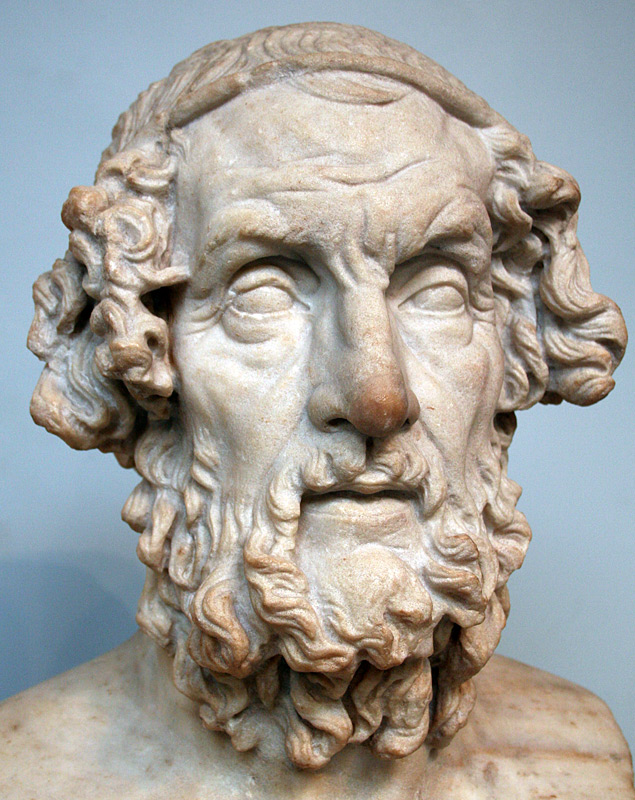
Homer słynne cytaty
„(…) wolooka (czcigodna) Hera (…).”
Boopis (potnia) Here. (gr.)
Iliada
Źródło: 3, 144; 7, 10; 18, 40 i in.
Homer cytaty
„Gdzie wiele rąk, tam łatwa praca.”
Źródło: Wacław Idziak, Biznes, Koszalińskie Wydawnictwo Prasowe, Koszalin 1990, s. 93.
„Muzo! męża wyśpiewaj, co święty gród Troi
Zburzywszy, długo błądził.”
Odyseja
Źródło: I, 1 tłum.L. Siemieński
„Rzeczą człowieka jest walczyć, a rzeczą nieba – dać zwycięstwo.”
Źródło: „Przekrój”, wydania 2898–2914, wyd. Czytelnik, 2001, s. 58.
Źródło: Leksykon złotych myśli, wyboru dokonał K. Nowak, Warszawa 1998.
„Jak los liści na drzewach, taki też los rodu ludzkiego.”
Źródło: Leksykon złotych myśli, wyboru dokonał Krzysztof Nowak, Warszawa 1998.
Homer: Cytaty po angielsku
“I hate saying the same thing over and over again.”
Homér Odyseja
XII. 453–454 (tr. Samuel Butler).
Odyssey (c. 725 BC)
“These things surely lie on the knees of the gods.”
Homér Odyseja
I. 267. Cf. Iliad XVII. 514.
Odyssey (c. 725 BC)
“His cold remains all naked to the sky,
On distant shores unwept, unburied lie.”
Homér Odyseja
XI. 72–73 (tr. Alexander Pope); of Elpenor.
Odyssey (c. 725 BC)
“Easily seen is the strength that is given from Zeus to mortals.”
Homér Iliada
XV. 490 (tr. R. Lattimore).
Iliad (c. 750 BC)
“Then Ulysses rejoiced at finding himself again in his own land, and kissed the bounteous soil.”
Homér Odyseja
XIII. 353–354 (tr. Samuel Butler).
Odyssey (c. 725 BC)
Homér Odyseja
XI. 593–598 (tr. William Broome); of Sisyphus.
Odyssey (c. 725 BC)
Homér Odyseja
XII. 351–352 (tr. Robert Fagles).
Odyssey (c. 725 BC)
Homér Iliada
IV. 350–351 (tr. R. Lattimore).
Iliad (c. 750 BC)
“Shameless they give, who give what's not their own.”
Homér Odyseja
XVII. 451–452 (tr. Alexander Pope).
Odyssey (c. 725 BC)
Homér Odyseja
XII. 342–343 (tr. Robert Fagles).
Odyssey (c. 725 BC)
Homér Iliada
XVI (tr. Samuel Butler); Hector to Patroclus.
Iliad (c. 750 BC)
Homér Iliada
VIII. 306–308 (tr. R. Lattimore); the death of Gorgythion.
Alexander Pope's translation:
: As full-blown poppies, overcharged with rain,
Decline the head, and drooping kiss the plain, —
So sinks the youth; his beauteous head, depressed
Beneath his helmet, drops upon his breast.
Iliad (c. 750 BC)
“But the will of Zeus will always overpower the will of men.”
Homér Iliada
XVI. 688 (tr. Robert Fagles).
Iliad (c. 750 BC)
Homér Iliada
VI. 232–236 (tr. R. Lattimore).
Iliad (c. 750 BC)
“The chief indignant grins a ghastly smile.”
Homér Odyseja
XX. 301–302 (tr. Alexander Pope).
Odyssey (c. 725 BC)
Homér Odyseja
XI. 489–492 (tr. Robert Fagles); Achilles' ghost to Odysseus.
Alexander Pope's translation:
: Rather I'd choose laboriously to bear
A weight of woes, and breathe the vital air,
A slave to some poor hind that toils for bread,
Than reign the sceptred monarch of the dead.
With many a weary step, and many a groan,
Up the high hill he heaves a huge round stone;
The huge round stone, resulting with a bound,
Thunders impetuous down, and smokes along the ground. P. S. Worsley's translation:
: Rather would I, in the sun's warmth divine,
Serve a poor churl who drags his days in grief,
Than the whole lordship of the dead were mine.
Odyssey (c. 725 BC)
Homér Iliada
XXIII. 315–318 (tr. R. Lattimore).
Iliad (c. 750 BC)
“The Fates have given mortals hearts that can endure.”
Homér Iliada
XXIV. 49 (tr. Robert Fagles).
Iliad (c. 750 BC)
“Bad herdsmen waste the flocks which thou hast left behind.”
Homér Odyseja
XVII. 246 (tr. Worsley).
Odyssey (c. 725 BC)
Homér Iliada
XIX. 162–163 (tr. R. Lattimore).
Iliad (c. 750 BC)
Homér Odyseja
IV. 195–198 (tr. Robert Fagles).
Odyssey (c. 725 BC)
Homér Odyseja
XVII. 320–323 (tr. Worsley).
Odyssey (c. 725 BC)
“Lordship for many is no good thing. Let there be one ruler,
one king.”
Homér Iliada
II. 204–205 (tr. R. Lattimore).
Iliad (c. 750 BC)
“Grey-eyed Athene sent them a favourable gale, a fresh West Wind, singing over the wine-dark sea.”
Homér Odyseja
II. 420–421 (tr. S. H. Butcher and Andrew Lang).
Odyssey (c. 725 BC)
“From whose lips the streams of words ran sweeter than honey.”
Homér Iliada
I. 249 (tr. Richmond Lattimore); of Nestor.
Iliad (c. 750 BC)
Homér Iliada
XVI (tr. S. Butler); Patroclus to Hector.
Iliad (c. 750 BC)
Homér Iliada
IX. 63–64 (tr. Alexander Pope).
Iliad (c. 750 BC)


