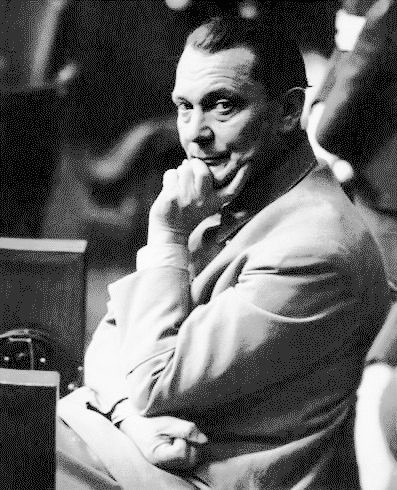
Hermann Göring słynne cytaty
„Jestem tym, kim zawsze byłem: ostatnim człowiekiem Renesansu.”
Źródło: Norbert i Stephan Lebertowie, Noszę jego nazwisko. Rozmowy z dziećmi przywódców III Rzeszy, tłum. Maria Przybyłowska, Janina Szymańska-Kumaniecka, wyd. Świat Książki, Warszawa 2004, ISBN 8373119892, s. 35.
napis przed bramą wjazdową pierwszego obozu koncentracyjnego, za którego powstanie był odpowiedzialny Göring.
Źródło: José María López Ruiz, Tyrani i zbrodniarze. Najwięksi nikczemnicy w dziejach świata, tłum. Agata Ciastek, Dom Wydawniczy Bellona, Warszawa 2006, s. 274
na procesie w Norymberdze.
Źródło: Bogusław Wołoszański, Ten okrutny wiek, op. cit., s. 245.
na procesie norymberskim.
Źródło: Bogusław Wołoszański, Ten okrutny wiek, Wydawnictwo Colori, Warszawa 1995, ISBN 8390497204, s. 246.
Hermann Göring cytaty
Natürlich, das einfache Volk will keinen Krieg (…) Aber schließlich sind es die Führer eines Landes, die die Politik bestimmen, und es ist immer leicht, das Volk zum Mitmachen zu bringen, ob es sich nun um eine Demokratie, eine faschistische Diktatur, um ein Parlament oder eine kommunistische Diktatur handelt. (…) das Volk kann mit oder ohne Stimmrecht immer dazu gebracht werden, den Befehlen der Führer zu folgen. Das ist ganz einfach. Man braucht nichts zu tun, als dem Volk zu sagen, es würde angegriffen, und den Pazifisten ihren Mangel an Patriotismus vorzuwerfen und zu behaupten, sie brächten das Land in Gefahr. Diese Methode funktioniert in jedem Land. (niem.)
słowa wypowiedziane podczas procesu norymberskiego, 18 kwietnia 1946.
„Będę się nazywał Meier, jeżeli nad Niemcami pojawi się chociaż jeden wrogi samolot.”
Ich will Meier heißen, wenn auch nur ein feindliches Flugzeug über Deutschland erscheint. (niem.)
„Adolf Hitler jest prawdziwym duchem świętym, prawdziwym światłem, które nas oświetla.”
Źródło: Roman Bäcker, Partia nowego typu, w: Totalitaryzm. Geneza. Istota. Upadek, Toruń 1992.
na procesie norymberskim po odczytaniu aktu oskarżenia przeciwko wszystkim oskarżonym.
Źródło: Bogusław Wołoszański, Ten okrutny wiek, op. cit., s. 243.
Hermann Göring: Cytaty po angielsku
To Leon Goldensohn (27 May 1946)
The Nuremberg Interviews (2004)
Said by Goering to the President of Czechoslovakia Emile Hácha on March 15, 1939, when Hácha, tired and under heavy pressure from Hitler to sign a document effectively handing his country over to Germany, nonetheless tried to resist signing. Hácha eventually gave up, and the combined pressure that Hitler and Goering had put on him caused Hácha to have a heart attack at 4:00 that morning. As quoted in On Borrowed Time: How World War II Began (1969) by Leonard Mosley, p. 167.
Göring is stated to have said this in Non-Germans Under the Third Reich: The Nazi Judicial and Administrative System in Germany (2003) by Diemut Majer, p. 60, and in other works, but he might have merely been repeating or paraphrasing the statement, Wer a Jud is, bestimm ich (Only I will decide who is a Jew) which in Strangers at Home and Abroad: Recollections of Austrian Jews Who Escaped Hitler (2000) by Adi Wimmer, p. 6, is said to have originated with Vienna mayor Karl Lueger in response to the observation that despite his anti-semitic speeches he still dined with Jews.
Misattributed
“Shoot first and inquire afterwards, and if you make mistakes, I will protect you.”
Instruction to the Prussian police (1933); as quoted in The House that Hitler Built (1937) by Stephen Henry Roberts. p. 63
Interview in Göring's cell (3 January 1946)
Nuremberg Diary (1947)
To Leon Goldensohn (24 May 1946)
The Nuremberg Interviews (2004)
Speech in Frankfurt (3 March 1933), as quoted in Gestapo : Instrument of Tyranny (1956) by Edward Crankshaw, p. 48
To Leon Goldensohn (27 May 1946)
The Nuremberg Interviews (2004)
Letter sent to Reinhard Heydrich, 31 July 1941 http://www.historyplace.com/worldwar2/timeline/order1.htm
Göring's closing statement to the Nuremberg tribunal (31 August 1946)


