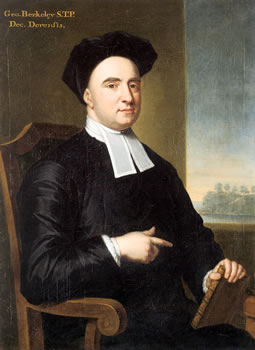
George Berkeley słynne cytaty
Źródło: Jostein Gaarder, Świat Zofii. Cudowna podróż w głąb historii filozofii, Warszawa 1995, tłum. Iwona Zimnicka, s. 304, 305.
George Berkeley: Cytaty po angielsku
“Few men think; yet all have opinions.”
George Berkeley książka Three Dialogues between Hylas and Philonous
Philonous to Hylas. The Second Dialogue. This appears in a passage first added in the third edition, (1734)
Three Dialogues between Hylas and Philonous (1713)
George Berkeley książka Siris
Paragraph 217. Compare: "Cups / That cheer but not inebriate", William Cowper, The Task, book iv, reported in Bartlett's Familiar Quotations, 10th ed. (1919).
Siris (1744)
George Berkeley książka Three Dialogues between Hylas and Philonous
Said by Philonous (Berkeley) to Hylas in the opening of dialog 1 with reference to the recent surge philosophic endeavors (Locke, Newton, et al) that seemed to lead to skepticism about the existence of the world
Three Dialogues between Hylas and Philonous (1713)
George Berkeley książka Three Dialogues between Hylas and Philonous
Philonous to Hylas.
Three Dialogues between Hylas and Philonous (1713)
George Berkeley książka Three Dialogues between Hylas and Philonous
Philonous to Hylas.
Three Dialogues between Hylas and Philonous (1713)
“Our youth we can have but to-day,
We may always find time to grow old.”
Can Love be controlled by Advice?, reported in Bartlett's Familiar Quotations, 10th ed. (1919).
George Berkeley książka Three Dialogues between Hylas and Philonous
Philonous to Hylas. Hylas replies with, "So it seems".
Three Dialogues between Hylas and Philonous (1713)
George Berkeley książka Three Dialogues between Hylas and Philonous
Philonous to Hylas.
Three Dialogues between Hylas and Philonous (1713)
“That we have first rais'd a Dust, and then complain, we cannot see.”
George Berkeley książka A Treatise Concerning the Principles of Human Knowledge
A Treatise Concerning the Principles of Human Knowledge (1710)
On the Prospect of Planting Arts and Learning in America (written in 1726), reported in Bartlett's Familiar Quotations, 10th ed. (1919). Compare: "Westward the star of empire takes its way", Epigraph to Bancroft's History of the United States; "What worlds in the yet unformed Occident / May come refin'd with th' accents that are ours?", Samuel Daniel, Musophilus (1599), Stanza 163.
According to W. Cleon Skousen, the first four empires are the Neo-Babylonian Empire, the Persian Empire, the Macedonian Empire, and the (Western, Eastern, and Holy) Roman Empire (Gospel Diamond Dust, Volume Two, Verity Publishing, 1998).
“Truth is the cry of all, but the game of the few.”
George Berkeley książka Siris
Paragraph 368.
Siris (1744)
George Berkeley książka Three Dialogues between Hylas and Philonous
Philonous to Hylas. The Second Dialogue.
Three Dialogues between Hylas and Philonous (1713)


