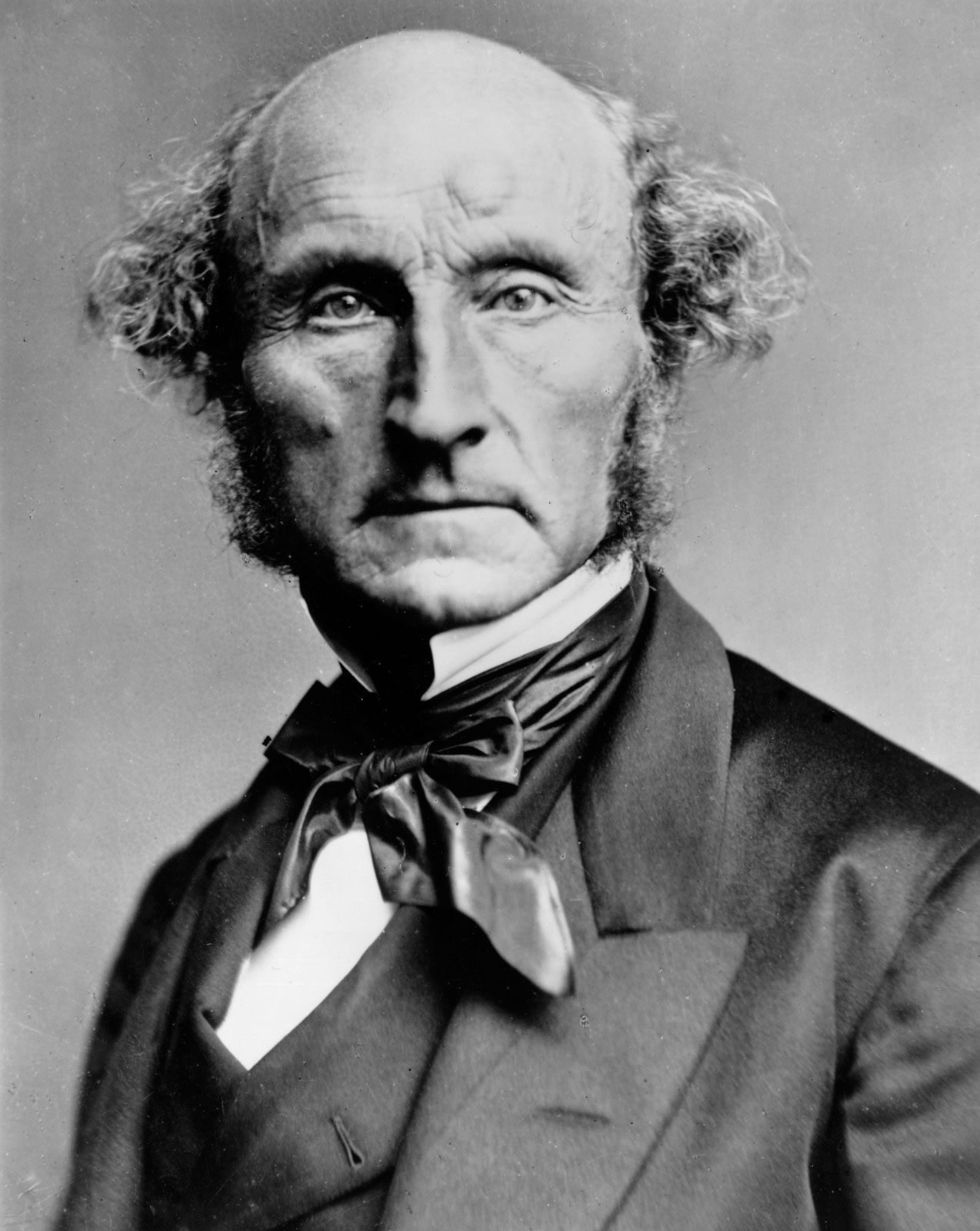
John Stuart Mill citations
Page 5

John Stuart Mill est un philosophe, logicien et économiste britannique. Penseur libéral parmi les plus influents du XIXe siècle, il est un partisan de l'utilitarisme, une théorie éthique préalablement exposée par Jeremy Bentham, dont Mill propose sa compréhension personnelle. En économie, il est l'un des derniers représentants de l'école classique. Précurseur du féminisme, Mill propose en outre un système de logique qui opère la transition entre l'empirisme du XVIIIe siècle et la logique contemporaine. Il est enfin l'auteur du premier grand traité sur la démocratie représentative, Considérations sur le gouvernement représentatif . Wikipedia  

✵ 20. mai 1806 – 8. mai 1873   •   Autres noms J.S Mill, John S. Mill
John Stuart Mill photo
John Stuart Mill: 191   citations 0   J'aime

John Stuart Mill citations célèbres

“Mais ce qu'il y a de particulièrement néfaste à imposer silence à l'expression d'une opinion, c'est que cela revient à voler l'humanité : tant la postérité que la génération présente, les détracteurs de cette opinion davantage encore que ses détenteurs. Si l'opinion est juste, on les prive de l'occasion d'échanger l'erreur pour la vérité; si elle est fausse, ils perdent un bénéfice presque aussi considérable : une perception plus claire et une impression plus vive de la vérité que produit sa confrontation avec l'erreur.”

But the peculiar evil of silencing the expression of an opinion is, that it is robbing the human race; posterity as well as the existing generation; those who dissent from the opinion, still more than those who hold it. If the opinion is right, they are deprived of the opportunity of exchanging error for truth: if wrong, they lose, what is almost as great a benefit, the clearer perception and livelier impression of truth, produced by its collision with error.
en
De la liberté

“Celui qui ne connaît que ses propres arguments connaît mal sa cause.”

He who knows only his own side of the case, knows little of that.
en
De la liberté

“L'utilité même d'une opinion est affaire d'opinion.”

The usefulness of an opinion is itself matter of opinion.
en
De la liberté

“L’histoire nous montre constamment la vérité réduite au silence par la persécution; si elle n’est pas supprimée à tout jamais, elle peut être reculée pour des siècles.”

History teems with instances of truth put down by persecution. If not suppressed forever, it may be thrown back for centuries.
en
De la liberté

“Le génie ne peut respirer librement que dans une atmosphère de liberté.”

Genius can only breathe freely in an atmosphere of freedom.
en
De la liberté

“Que si peu de gens osent maintenant être excentriques, voilà qui révèle le principal danger de notre époque.”

That so few now dare to be eccentric, marks the chief danger of the time.
en
De la liberté

Citations sur les hommes et les garçons de John Stuart Mill

“Ce principe veut que les hommes ne soient autorisés, individuellement ou collectivement, à entraver la liberté d'action de quiconque que pour assurer leur propre protection. La seule raison légitime que puisse avoir une communauté pour user de la force contre un de ses membres est de l'empêcher de nuire aux autres.”

That principle is, that the sole end for which mankind are warranted, individually or collectively, in interfering with the liberty of action of any of their number, is self-protection. That the only purpose for which power can be rightfully exercised over any member of a civilized community, against his will, is to prevent harm to others.
en
De la liberté

“La valeur d'un État, à la longue, c'est la valeur des individus qui le composent; et un État qui sacrifie les intérêts de leur élévation intellectuelle à un peu plus d'art administratif - ou à l'apparence qu'en donne la pratique - dans le détail des affaires; un État qui rapetisse les hommes pour en faire des instruments dociles entre ses mains, même en vue de bienfaits, un tel État s'apercevra qu'avec de petits hommes; rien de grand ne saurait s'accomplir, et que la perfection de la machine à laquelle il a tout sacrifié n'aboutit finalement à rien, faute de cette puissance vitale qu'il lui a plu de proscrire pour faciliter le jeu de la machine.”

The worth of a State, in the long run, is the worth of the individuals composing it; and a State which postpones the interests of their mental expansion and elevation, to a little more of administrative skill, or that semblance of it which practice gives, in the details of business; a State, which dwarfs its men, in order that they may be more docile instruments in its hands even for beneficial purposes, will find that with small men no great thing can really be accomplished; and that the perfection of machinery to which it has sacrificed everything, will in the end avail it nothing, for want of the vital power which, in order that the machine might work more smoothly, it has preferred to banish.
en
De la liberté

“Contraindre quiconque pour son propre bien, physique ou moral, ne constitue pas une justification suffisante. Un homme ne peut pas être légitimement contraint d'agir ou de s'abstenir sous prétexte que ce serait meilleur pour lui, que cela le rendrait plus heureux ou que, dans l'opinion des autres, agir ainsi serait sage ou même juste.”

His own good, either physical or moral, is not a sufficient warrant. He cannot rightfully be compelled to do or forbear because it will be better for him to do so, because it will make him happier, because, in the opinions of others, to do so would be wise, or even right.
en
De la liberté

John Stuart Mill: Citations en anglais

“I have never known any man who could do such ample justice to his best thoughts in colloquial discussion. His perfect command over his great mental resources, the terseness and expressiveness of his language and the moral earnestness as well as intellectual force of his delivery, made him one of the most striking of all argumentative conversers: and he was full of anecdote, a hearty laugher, and, when with people whom he liked, a most lively and amusing companion. It was not solely, or even chiefly, in diffusing his merely intellectual convictions that his power showed itself: it was still more through the influence of a quality, of which I have only since learnt to appreciate the extreme rarity: that exalted public spirit, and regard above all things to the good of the whole, which warmed into life and activity every germ of similar virtue that existed in the minds he came in contact with: the desire he made them feel for his approbation, the shame at his disapproval; the moral support which his conversation and his very existence gave to those who were aiming to the same objects, and the encouragement he afforded to the fainthearted or desponding among them, by the firm confidence which (though the reverse of sanguine as to the results to be expected in any one particular case) he always felt in the power of reason, the general progress of improvement, and the good which individuals could do by judicious effort.”

John Stuart Mill livre Autobiography

Source: https://archive.org/details/autobiography01mill/page/101/mode/1up pp. 101-102

“The practical reformer has continually to demand that changes be made in things which are supported by powerful and widely-spread feelings, or to question the apparent necessity and indefeasibleness of established facts; and it is often an indispensable part of his argument to show, how these powerful feelings had their origin, and how those facts came to seem necessary and indefeasible. There is therefore a natural hostility between him and a philosophy which discourages the explanation of feelings and moral facts by circumstances and association, and prefers to treat them as ultimate elements of human nature; a philosophy which is addicted to holding up favorite doctrines as intuitive truths, and deems intuition to be the voice of Nature and of God, speaking with an authority higher than that of our reason. In particular, I have long felt that the prevailing tendency to regard all the marked distinctions of human character as innate, and in the main indelible, and to ignore the irresistible proofs that by far the greater part of those differences, whether between individuals, races, or sexes, are such as not only might but naturally would be produced by differences in circumstances, is one of the chief hindrances to the rational treatment of great social questions, and one of the greatest stumbling blocks to human improvement.”

John Stuart Mill livre Autobiography

Source: Autobiography (1873), Ch. 7: General View of the Remainder of My Life (p. 192)

“It might be plausibly maintained, that in almost every one of the leading controversies, past or present, in social philosophy, both sides were in the right in what they affirmed, though wrong in what they denied.”

J. S. Mill, Dissertations and discussions: political, philosophical, and historical, Volume 2 http://books.google.gr/books?id=FyfPAAAAMAAJ&dq=, H. Holt, 1864, p. 11.

“A bureaucracy always tends to become a pedantocracy.”

Source: On Representative Government (1861), Ch. VI: Of the Infirmities and Dangers to Which Representative Government Is Liable (p. 234)

“In those days I had seen little further than the old school of political economists into the possibilities of fundamental improvement in social arrangements. Private property, as now understood, and inheritance, appeared to me, as to them, the dernier mot of legislation: and I looked no further than to mitigating the inequalities consequent on these institutions, by getting rid of primogeniture and entails. The notion that it was possible to go further than this in removing the injustice -- for injustice it is, whether admitting of a complete remedy or not -- involved in the fact that some are born to riches and the vast majority to poverty, I then reckoned chimerical, and only hoped that by universal education, leading to voluntary restraint on population, the portion of the poor might be made more tolerable. In short, I was a democrat, but not the least of a Socialist. We were now much less democrats than I had been, because so long as education continues to be so wretchedly imperfect, we dreaded the ignorance and especially the selfishness and brutality of the mass: but our ideal of ultimate improvement went far beyond Democracy, and would class us decidedly under the general designation of Socialists. While we repudiated with the greatest energy that tyranny of society over the individual which most Socialistic systems are supposed to involve, we yet looked forward to a time when society will no longer be divided into the idle and the industrious; when the rule that they who do not work shall not eat, will be applied not to paupers only, but impartially to all; when the division of the produce of labour, instead of depending, as in so great a degree it now does, on the accident of birth, will be made by concert on an acknowledged principle of justice; and when it will no longer either be, or be thought to be, impossible for human beings to exert themselves strenuously in procuring benefits which are not to be exclusively their own, but to be shared with the society they belong to. The social problem of the future we considered to be, how to unite the greatest individual liberty of action, with a common ownership in the raw material of the globe, and an equal participation of all in the benefits of combined labour. We had not the presumption to suppose that we could already foresee, by what precise form of institutions these objects could most effectually be attained, or at how near or how distant a period they would become practicable. We saw clearly that to render any such social transformation either possible or desirable, an equivalent change of character must take place both in the uncultivated herd who now compose the labouring masses, and in the immense majority of their employers. Both these classes must learn by practice to labour and combine for generous, or at all events for public and social purposes, and not, as hitherto, solely for narrowly interested ones. But the capacity to do this has always existed in mankind, and is not, nor is ever likely to be, extinct. Education, habit, and the cultivation of the sentiments, will make a common man dig or weave for his country, as readily as fight for his country. True enough, it is only by slow degrees, and a system of culture prolonged through successive generations, that men in general can be brought up to this point. But the hindrance is not in the essential constitution of human nature. Interest in the common good is at present so weak a motive in the generality not because it can never be otherwise, but because the mind is not accustomed to dwell on it as it dwells from morning till night on things which tend only to personal advantage. When called into activity, as only self-interest now is, by the daily course of life, and spurred from behind by the love of distinction and the fear of shame, it is capable of producing, even in common men, the most strenuous exertions as well as the most heroic sacrifices. The deep-rooted selfishness which forms the general character of the existing state of society, is so deeply rooted, only because the whole course of existing institutions tends to foster it; modern institutions in some respects more than ancient, since the occasions on which the individual is called on to do anything for the public without receiving its pay, are far less frequent in modern life, than the smaller commonwealths of antiquity.”

John Stuart Mill livre Autobiography

Source: Autobiography (1873)
Source: https://archive.org/details/autobiography01mill/page/230/mode/1up pp. 230-233

Auteurs similaires

Karl Marx photo
Karl Marx 69
philosophe, sociologue et économiste allemand
Georg Wilhelm Friedrich Hegel photo
Georg Wilhelm Friedrich Hegel 12
philosophe allemand
Pierre-Joseph Proudhon photo
Pierre-Joseph Proudhon 10
polémiste, journaliste, économiste, philosophe et sociologu…
Arthur Schopenhauer photo
Arthur Schopenhauer 18
philosophe allemand
Friedrich Nietzsche photo
Friedrich Nietzsche 104
philologue, philosophe et poète allemand
Friedrich Engels photo
Friedrich Engels 25
philosophe allemand et théoricien socialiste
Emily Brontë photo
Emily Brontë 18
écrivaine britannique
Lewis Carroll photo
Lewis Carroll 4
romancier, essayiste, photographe et mathématicien britanni…
John Ruskin photo
John Ruskin 3
auteur, poète, artiste et critique d’art britannique