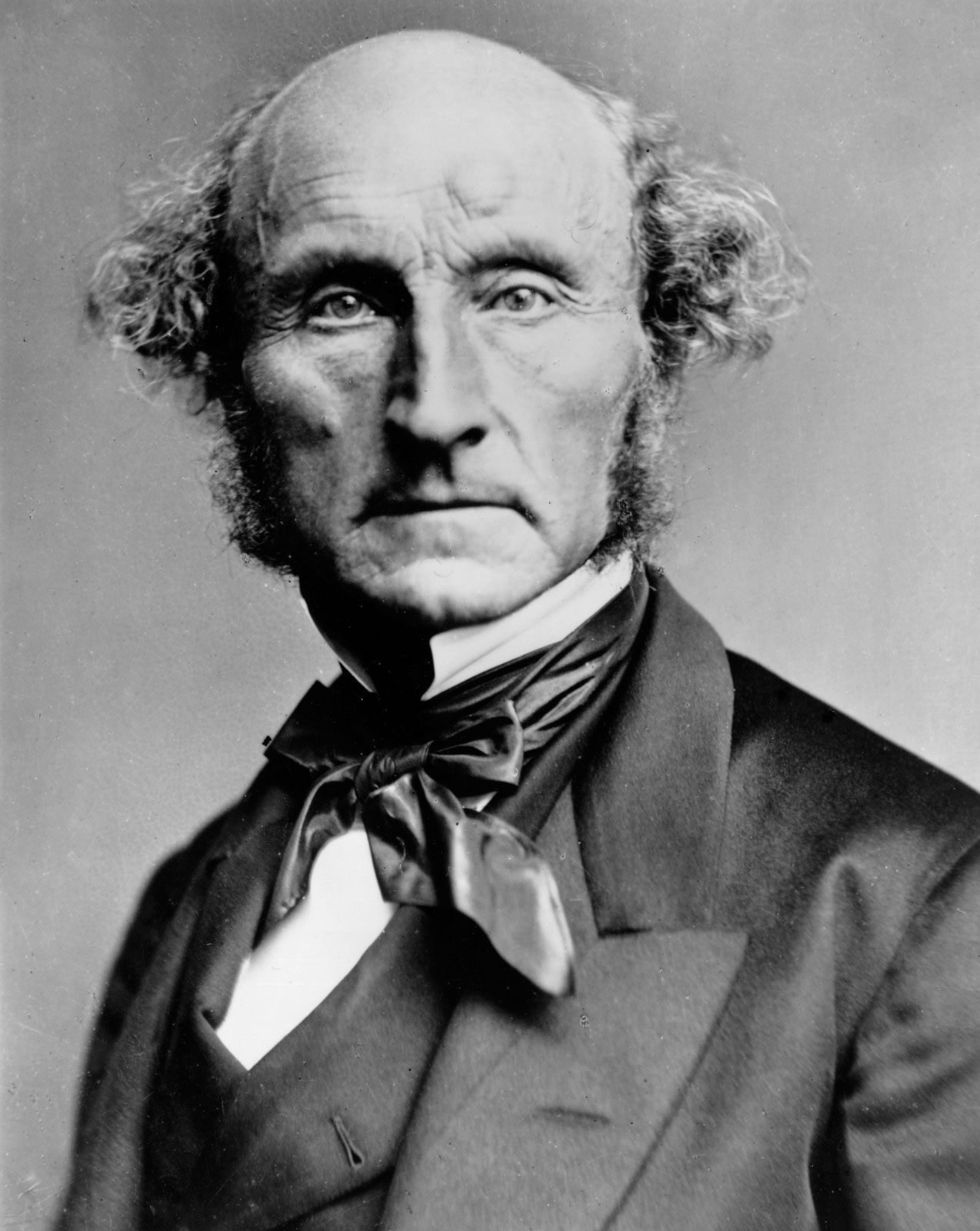
John Stuart Mill citations
Page 6

John Stuart Mill est un philosophe, logicien et économiste britannique. Penseur libéral parmi les plus influents du XIXe siècle, il est un partisan de l'utilitarisme, une théorie éthique préalablement exposée par Jeremy Bentham, dont Mill propose sa compréhension personnelle. En économie, il est l'un des derniers représentants de l'école classique. Précurseur du féminisme, Mill propose en outre un système de logique qui opère la transition entre l'empirisme du XVIIIe siècle et la logique contemporaine. Il est enfin l'auteur du premier grand traité sur la démocratie représentative, Considérations sur le gouvernement représentatif . Wikipedia  

✵ 20. mai 1806 – 8. mai 1873   •   Autres noms J.S Mill, John S. Mill
John Stuart Mill photo
John Stuart Mill: 191   citations 0   J'aime

John Stuart Mill citations célèbres

“Mais ce qu'il y a de particulièrement néfaste à imposer silence à l'expression d'une opinion, c'est que cela revient à voler l'humanité : tant la postérité que la génération présente, les détracteurs de cette opinion davantage encore que ses détenteurs. Si l'opinion est juste, on les prive de l'occasion d'échanger l'erreur pour la vérité; si elle est fausse, ils perdent un bénéfice presque aussi considérable : une perception plus claire et une impression plus vive de la vérité que produit sa confrontation avec l'erreur.”

But the peculiar evil of silencing the expression of an opinion is, that it is robbing the human race; posterity as well as the existing generation; those who dissent from the opinion, still more than those who hold it. If the opinion is right, they are deprived of the opportunity of exchanging error for truth: if wrong, they lose, what is almost as great a benefit, the clearer perception and livelier impression of truth, produced by its collision with error.
en
De la liberté

“Celui qui ne connaît que ses propres arguments connaît mal sa cause.”

He who knows only his own side of the case, knows little of that.
en
De la liberté

“L'utilité même d'une opinion est affaire d'opinion.”

The usefulness of an opinion is itself matter of opinion.
en
De la liberté

“L’histoire nous montre constamment la vérité réduite au silence par la persécution; si elle n’est pas supprimée à tout jamais, elle peut être reculée pour des siècles.”

History teems with instances of truth put down by persecution. If not suppressed forever, it may be thrown back for centuries.
en
De la liberté

“Le génie ne peut respirer librement que dans une atmosphère de liberté.”

Genius can only breathe freely in an atmosphere of freedom.
en
De la liberté

“Que si peu de gens osent maintenant être excentriques, voilà qui révèle le principal danger de notre époque.”

That so few now dare to be eccentric, marks the chief danger of the time.
en
De la liberté

Citations sur les hommes et les garçons de John Stuart Mill

“Ce principe veut que les hommes ne soient autorisés, individuellement ou collectivement, à entraver la liberté d'action de quiconque que pour assurer leur propre protection. La seule raison légitime que puisse avoir une communauté pour user de la force contre un de ses membres est de l'empêcher de nuire aux autres.”

That principle is, that the sole end for which mankind are warranted, individually or collectively, in interfering with the liberty of action of any of their number, is self-protection. That the only purpose for which power can be rightfully exercised over any member of a civilized community, against his will, is to prevent harm to others.
en
De la liberté

“La valeur d'un État, à la longue, c'est la valeur des individus qui le composent; et un État qui sacrifie les intérêts de leur élévation intellectuelle à un peu plus d'art administratif - ou à l'apparence qu'en donne la pratique - dans le détail des affaires; un État qui rapetisse les hommes pour en faire des instruments dociles entre ses mains, même en vue de bienfaits, un tel État s'apercevra qu'avec de petits hommes; rien de grand ne saurait s'accomplir, et que la perfection de la machine à laquelle il a tout sacrifié n'aboutit finalement à rien, faute de cette puissance vitale qu'il lui a plu de proscrire pour faciliter le jeu de la machine.”

The worth of a State, in the long run, is the worth of the individuals composing it; and a State which postpones the interests of their mental expansion and elevation, to a little more of administrative skill, or that semblance of it which practice gives, in the details of business; a State, which dwarfs its men, in order that they may be more docile instruments in its hands even for beneficial purposes, will find that with small men no great thing can really be accomplished; and that the perfection of machinery to which it has sacrificed everything, will in the end avail it nothing, for want of the vital power which, in order that the machine might work more smoothly, it has preferred to banish.
en
De la liberté

“Contraindre quiconque pour son propre bien, physique ou moral, ne constitue pas une justification suffisante. Un homme ne peut pas être légitimement contraint d'agir ou de s'abstenir sous prétexte que ce serait meilleur pour lui, que cela le rendrait plus heureux ou que, dans l'opinion des autres, agir ainsi serait sage ou même juste.”

His own good, either physical or moral, is not a sufficient warrant. He cannot rightfully be compelled to do or forbear because it will be better for him to do so, because it will make him happier, because, in the opinions of others, to do so would be wise, or even right.
en
De la liberté

John Stuart Mill: Citations en anglais

“[My father] impressed upon me from the first, that the manner in which the world came into existence was a subject on which nothing was known: that the question, “Who made me?””

John Stuart Mill livre Autobiography

cannot be answered, because we have no experience or authentic information from which to answer it; and that any answer only throws the difficulty a step further back, since the question immediately presents itself, “Who made God?”
Source: Autobiography (1873), Ch. 2: Moral Influences in Early Youth. My Father's Character and Opinions.

“the correct statement would be, not that I disliked poetry, but that I was theoretically indifferent to it. I disliked any sentiments in poetry which I should have disliked in prose; and that included a great deal. And I was wholly blind to its place in human culture, as a means of educating the feelings. But I was always personally very susceptible to some kinds of it.”

John Stuart Mill livre Autobiography

'Long before I had enlarged in any considerable degree, the basis of my intellectual creed, I had obtained in the natural course of my mental progress, poetic culture of the most valuable kind, by means of reverential admiration for the lives and characters of heroic persons; especially the heroes of philosophy.'
Autobiography (1873)

“Wisdom and contrivance are shown in overcoming difficulties, so there is no place for them in a Being for whom no difficulties exist”

pages 176-177; Early Modern Texts page 16
Three Essays on Religion (posthumous publication), Theism, Part II: Attributes

“landlords... grow richer, as it were in their sleep, without working, risking, or economizing."”

John Stuart Mill livre Principles of Political Economy

Book 5, Chapter 2, Section 5
Principles of Political Economy (1848-1871)

“While fully recognizing the superior excellence of unselfish benevolence and love of justice, we did not expect the regeneration of mankind from any direct action on those sentiments, but from the effect of educated intellect, enlightening the selfish feelings.”

John Stuart Mill livre Autobiography

Autobiography (1873)
Contexte: What we principally thought of, was to alter people's opinions; to make them believe according to evidence, and know what was their real interest, which when they once knew, they would, we thought, by the instrument of opinion, enforce a regard to it upon one another. While fully recognizing the superior excellence of unselfish benevolence and love of justice, we did not expect the regeneration of mankind from any direct action on those sentiments, but from the effect of educated intellect, enlightening the selfish feelings.

Auteurs similaires

Karl Marx photo
Karl Marx 69
philosophe, sociologue et économiste allemand
Georg Wilhelm Friedrich Hegel photo
Georg Wilhelm Friedrich Hegel 12
philosophe allemand
Pierre-Joseph Proudhon photo
Pierre-Joseph Proudhon 10
polémiste, journaliste, économiste, philosophe et sociologu…
Arthur Schopenhauer photo
Arthur Schopenhauer 18
philosophe allemand
Friedrich Nietzsche photo
Friedrich Nietzsche 104
philologue, philosophe et poète allemand
Friedrich Engels photo
Friedrich Engels 25
philosophe allemand et théoricien socialiste
Emily Brontë photo
Emily Brontë 18
écrivaine britannique
Lewis Carroll photo
Lewis Carroll 4
romancier, essayiste, photographe et mathématicien britanni…
John Ruskin photo
John Ruskin 3
auteur, poète, artiste et critique d’art britannique