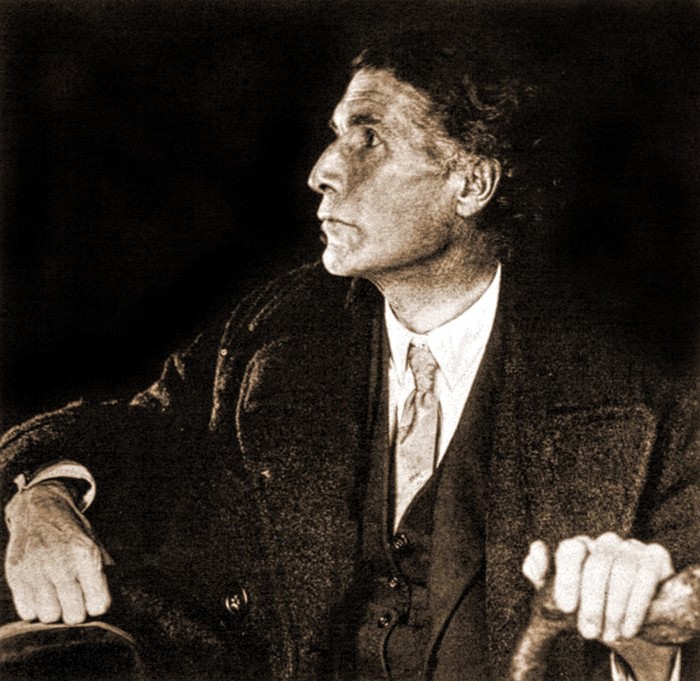
John Cowper Powys citations célèbres
Citations sur la vie de John Cowper Powys
“Ce n'est pas plus la vie que le bruit que nous entendons n'est le port.”
Les Sables de la mer, 1934
Les Sables de la mer, 1934
John Cowper Powys Citations
“Tout le monde le sait, amour et haine sont pile et face.”
La Fosse aux chiens, 1952
“Pour les femmes et le pain, les hommes donneraient leur tête.”
La Fosse aux chiens, 1952
“L'univers est d'une étoffe plus changeante qu'on ne le croit.”
Givre et sang, 1925
“Toujours obéir à sa conscience. Toujours aller son chemin à soi.”
Comme je l'entends, 1919
“Tout le temps qu'on passe à penser c'est du temps perdu pour agir.”
Les Sables de la mer, 1934
“Nous savons ce que nous sommes, mais nous ne savons pas ce que nous pourrions êtres.”
Les Sables de la mer, 1934
“Il vaut mieux couper avec les amours d'antan avant d'en prendre de nouvelles.”
Comme je l'entends, 1919
“Les pensées sont une chose. Les mots en sont une autre.”
La Fosse aux chiens, 1952
John Cowper Powys: Citations en anglais
Source: The Meaning of Culture (1929), pp. 134
Source: The Complex Vision (1920), Chapter I
Contexte: One of the curious psychological facts, in connection with the various ways in which various minds function, is the fact that when in these days we seek to visualize, in some pictorial manner, our ultimate view of life, the images which are called up are geometrical or chemical rather than anthropomorphic. It is probable that even the most rational and logical among us as soon as he begins to philosophize at all is compelled by the necessity of things to form in the mind some vague pictorial representation answering to his conception of the universe.
Most minds see the universe of their mental conception as something quite different from the actual stellar universe upon which we all gaze. Even the most purely rational minds who find the universe in "pure thought" are driven against their rational will to visualize this "pure thought" and to give it body and form and shape and movement.
Source: The Meaning of Culture (1929), p. 222
Contexte: Not the wretchedest man or woman but has a deep secretive mythology with which to wrestle with the material world and to overcome it and pass beyond it. Not the wretchedest human being but has his share in the creative energy that builds the world. We are all creators. We all create a mythological world of our own out of certain shapeless materials.
Source: The Meaning of Culture (1929), p. 170
Contexte: The influence of friendship upon culture differs from that of love, in that it assumes the basic idiosyncrasies of personal taste to be unalterable. Love, in spite of all rational knowledge to the contrary, is always in the mood of believing in miracles.
Source: The Complex Vision (1920), Chapter I
Contexte: My answer to the question "Why do we philosophize?" is as follows. We philosophize for the same reason that we move and speak and laugh and eat and love. In other words, we philosophize because man is a philosophical animal.… We may be as sceptical as we please. Our very scepticism is the confession of an implicit philosophy.
Source: The Complex Vision (1920), Chapter I
Contexte: This swallowing up of life in nothingness, this obliteration of life by nothingness is what the emotion of malice ultimately desires. The eternal conflict between love and malice is the eternal contest between life and death. And this contest is what the complex vision reveals, as it moves from darkness to darkness.
“It is strange how few people make more than a casual cult of enjoying Nature.”
John Cowper Powys livre A Glastonbury Romance
Source: The Meaning of Culture (1929), p. 178
Source: A Glastonbury Romance
Contexte: It is strange how few people make more than a casual cult of enjoying Nature. And yet the earth is actually and literally the mother of us all. One needs no strange spiritual faith to worship the earth.
Source: The Meaning of Culture (1929), p. 19
The Art of Growing Old (1944), p. 13
Source: The Meaning of Culture (1929), p. 175
Letter to his sister (24 September 1938), published in The Letters of John Cowper Powys to Philippa Powys (1996), edited by Anthony Head p. 106
“Ambition is the grand enemy of all peace.”
Source: The Meaning of Culture (1929), p. 140
The Pleasures of Literature (1938), p. 17 <!-- London: Cassell -->
“The love that interferes and knows not how to leave alone is a love alien to Nature's ways.”
Source: The Meaning of Culture (1929), p. 209
John Cowper Powys livre A Glastonbury Romance
A Glastonbury Romance (1932; 1955) p. 849
Source: The Complex Vision (1920), Chapter I
“Man is the animal who weeps and laughs — and writes.”
If the first Prometheus brought fire from heaven in a fennel-stalk, the last will take it back — in a book.
The Pleasures of Literature (1938), p. 17


