
Paul Goodman book Growing Up Absurd
Source: Growing Up Absurd (1956), p. 144.
Paul Goodman was an American novelist, playwright, poet, literary critic, and psychotherapist, although now best known as a social critic and anarchist philosopher. Though often thought of as a sociologist, he vehemently denied being one in a presentation in the Experimental College at San Francisco State in 1964, and in fact said he could not read sociology because it was too often lifeless. The author of dozens of books including Growing Up Absurd and The Community of Scholars, Goodman was an activist on the pacifist Left in the 1960s and a frequently cited inspiration to the student movement of that decade. A lay therapist for a number of years, he was a co-founder of Gestalt therapy in the 1940s and 1950s.
Paul Goodman book Growing Up Absurd
Source: Growing Up Absurd (1956), p. 144.
Paul Goodman book Growing Up Absurd
Source: Growing Up Absurd (1956), p. 179.
Paul Goodman book Growing Up Absurd
Source: Growing Up Absurd (1956), p. 176.
Paul Goodman book Growing Up Absurd
Source: Growing Up Absurd (1956), p. 183.
Paul Goodman book Growing Up Absurd
Source: Growing Up Absurd (1956), p. 152.
Paul Goodman book Growing Up Absurd
Source: Growing Up Absurd (1956), p. 94.
Paul Goodman book Growing Up Absurd
Source: Growing Up Absurd (1956), pp. 42-43.
Paul Goodman book Growing Up Absurd
Source: Growing Up Absurd (1956), p. 13.
Paul Goodman book Growing Up Absurd
Source: Growing Up Absurd (1956), p. 14.
“Perhaps the social message has been communicated clearly to the young men and is unacceptable.”
Paul Goodman book Growing Up Absurd
Source: Growing Up Absurd (1956), pp. 10-11.
Context: Social scientists … have begun to think that “social animal” means “harmoniously belonging.” They do not like to think that fighting and dissenting are proper social functions, nor that rebelling or initiating fundamental change is a social function. Rather, if something does not run smoothly, they say it has been improperly socialized; there has been a failure in communication. … But perhaps there has not been a failure in communication. Perhaps the social message has been communicated clearly to the young men and is unacceptable. … We must ask the question, “Is the harmonious organization to which the young are inadequately socialized perhaps against human nature, or not worthy of human nature, and therefore there is difficulty in growing up?”
Paul Goodman book Growing Up Absurd
Source: Growing Up Absurd (1956), p. 154.
Paul Goodman book Growing Up Absurd
Source: Growing Up Absurd (1956), p. 157.
Paul Goodman book Growing Up Absurd
Source: Growing Up Absurd (1956), pp. 153-154.
as quoted in Commonist Tendencies: Mutual Aid Beyond Communism
Paul Goodman book Growing Up Absurd
(describing the language of the “Beat” generation, p. 175.
Growing Up Absurd (1956)
Paul Goodman book Growing Up Absurd
Source: Growing Up Absurd (1956), p. 38.
Paul Goodman book Growing Up Absurd
Source: Growing Up Absurd (1956), pp. 145-146.
Paul Goodman book Growing Up Absurd
Source: Growing Up Absurd (1956), p. 214.
Paul Goodman book Growing Up Absurd
Source: Growing Up Absurd (1956), pp. 150-151.
“Few great men could pass personnel.”
Paul Goodman book Growing Up Absurd
Source: Growing Up Absurd (1956), p. 153.
Paul Goodman book Growing Up Absurd
Source: Growing Up Absurd (1956), p. 153.
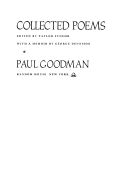
Paul Goodman book Collected Poems
"A Chess Game" St. 1, Collected Poems, Random House, 1973, ISBN 0394483588.
Paul Goodman book Growing Up Absurd
Another large part of stupidity is stubbornness, unconsciously saying, “I won’t. You can’t make me.”
Source: Growing Up Absurd (1956), pp. 71-72.
Paul Goodman book Growing Up Absurd
Source: Growing Up Absurd (1956), pp. 38-39.
Paul Goodman book Growing Up Absurd
Source: Growing Up Absurd (1956), p. xiii.
“When the sciences are supreme, average people lose their feeling of causality.”
Paul Goodman book Growing Up Absurd
Source: Growing Up Absurd (1956), p. 144.
“Not to teach the whole curriculum is to give up on the whole man.”
Paul Goodman book Growing Up Absurd
Source: Growing Up Absurd (1956), p. 83.
Paul Goodman book Growing Up Absurd
Source: Growing Up Absurd (1956), p. x.
Paul Goodman book Growing Up Absurd
Source: Growing Up Absurd (1956), p. 149.
Paul Goodman book Growing Up Absurd
Source: Growing Up Absurd (1956), p. 189.
Paul Goodman book Growing Up Absurd
Source: Growing Up Absurd (1956), p. 37.
Paul Goodman book Growing Up Absurd
Source: Growing Up Absurd (1956), p. 153.
Paul Goodman book Growing Up Absurd
Source: Growing Up Absurd (1956), p. 85.
Paul Goodman book Growing Up Absurd
Source: Growing Up Absurd (1956), p. 42.
Paul Goodman book Growing Up Absurd
Source: Growing Up Absurd (1956), pp. 36-37.
Paul Goodman book Growing Up Absurd
Source: Growing Up Absurd (1956), p. 145.
Paul Goodman book Growing Up Absurd
Source: Growing Up Absurd (1956), p. 156.
Paul Goodman book Growing Up Absurd
Source: Growing Up Absurd (1956), p. 209.
Paul Goodman book Growing Up Absurd
Source: Growing Up Absurd (1956), p. 6.
Paul Goodman book Growing Up Absurd
Source: Growing Up Absurd (1956), pp. 139-140.
“Social scientists … have begun to think that “social animal” means “harmoniously belonging.””
Paul Goodman book Growing Up Absurd
They do not like to think that fighting and dissenting are proper social functions, nor that rebelling or initiating fundamental change is a social function. Rather, if something does not run smoothly, they say it has been improperly socialized; there has been a failure in communication. … But perhaps there has not been a failure in communication. Perhaps the social message has been communicated clearly to the young men and is unacceptable. … We must ask the question, “Is the harmonious organization to which the young are inadequately socialized perhaps against human nature, or not worthy of human nature, and therefore there is difficulty in growing up?”
Source: Growing Up Absurd (1956), pp. 10-11.


