Quotes from book
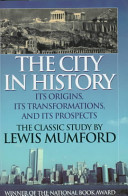
The City in History

The City in History

The City in History: Its Origins, Its Transformations, and Its Prospects is a 1961 National Book Award winner by American historian Lewis Mumford.


Lewis Mumford photo

“Every new baby is a blind desperate vote for survival”

Lewis Mumford book The City in History

Source: The City in History (1961), Ch. 18
Context: Every new baby is a blind desperate vote for survival: people who find themselves unable to register an effective political protest against extermination do so by a biological act.

Lewis Mumford photo
Lewis Mumford photo
Lewis Mumford photo
Lewis Mumford photo

“By fashion and built-in obsolescence the economies of machine production, instead of producing leisure and durable wealth, are duly cancelled out by the mandatory consumption on an even larger scale.”

Lewis Mumford book The City in History

Myth of Megalopolis <!-- p. 545 -->
The City in History (1961)
Context: Unfortunately, once an economy is geared to expansion, the means rapidly turn into an end and "the going becomes the goal." Even more unfortunately, the industries that are favored by such expansion must, to maintain their output, be devoted to goods that are readily consumable either by their nature, or because they are so shoddily fabricated that they must soon be replaced. By fashion and built-in obsolescence the economies of machine production, instead of producing leisure and durable wealth, are duly cancelled out by the mandatory consumption on an even larger scale.

Lewis Mumford photo

“Unfortunately, once an economy is geared to expansion, the means rapidly turn into an end and "the going becomes the goal."”

Lewis Mumford book The City in History

Myth of Megalopolis <!-- p. 545 -->
The City in History (1961)
Context: Unfortunately, once an economy is geared to expansion, the means rapidly turn into an end and "the going becomes the goal." Even more unfortunately, the industries that are favored by such expansion must, to maintain their output, be devoted to goods that are readily consumable either by their nature, or because they are so shoddily fabricated that they must soon be replaced. By fashion and built-in obsolescence the economies of machine production, instead of producing leisure and durable wealth, are duly cancelled out by the mandatory consumption on an even larger scale.

Similar authors

Lewis Mumford photo
Lewis Mumford75
American historian, sociologist, philosopher of technology,… 1895–1990
Walter Benjamin photo
Walter Benjamin70
German literary critic, philosopher and social critic (1892… None
Umberto Eco photo
Umberto Eco120
Italian semiotician, essayist, philosopher, literary critic… None
Fernando Pessoa photo
Fernando Pessoa288
Portuguese poet, writer, literary critic, translator, publi… None
Theodor W. Adorno photo
Theodor W. Adorno90
German sociologist, philosopher and musicologist known for … None
Jean Paul Sartre photo
Jean Paul Sartre321
French existentialist philosopher, playwright, novelist, sc… None
Cesare Pavese photo
Cesare Pavese137
Italian poet, novelist, literary critic, and translator None
Henry Miller photo
Henry Miller187
American novelist None
Martin Heidegger photo
Martin Heidegger69
German philosopher None
Michel Foucault photo
Michel Foucault128
French philosopher None