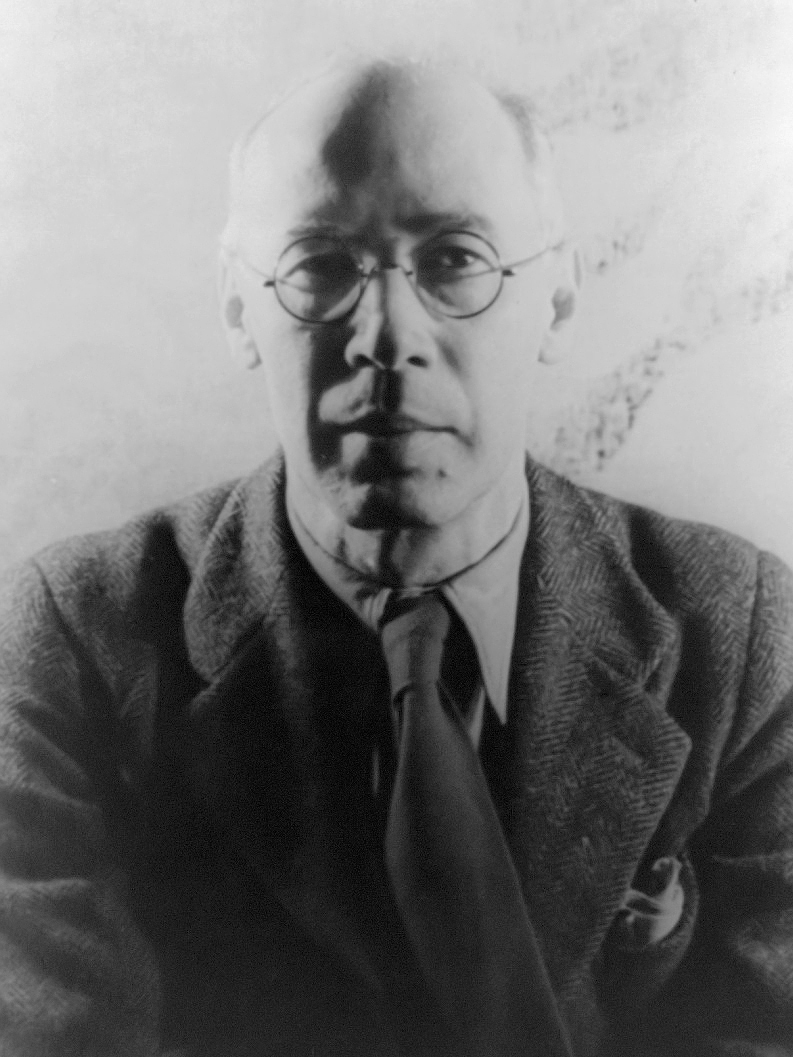
Works


Famous Henry Miller Quotes
“I have no money, no resources, no hopes. I am the happiest man alive.”
Henry Miller book Tropic of Cancer
Source: Tropic of Cancer (1934), Chapter One
“The real leader has no need to lead. He is content to point the way.”
Source: The Wisdom of the Heart (1941), p. 46
Henry Miller Quotes about life
“All I ask of life, he says, is a bunch of books, a bunch of dreams, and a bunch of cunt.”
Henry Miller book Tropic of Cancer
Source: Tropic of Cancer
Henry Miller book Tropic of Capricorn
A fragment of Miller's unfinished book on D. H. Lawrence, originally published in the London literary journal Purpose.
Source: Tropic of Capricorn (1939) "Creative Death", p. 2
Henry Miller Quotes about the world
Henry Miller book Tropic of Cancer
Source: Tropic of Cancer (1934), Chapter One
Context: Well, I'll take these pages and move on. Things are happening elsewhere. Things are always happening. It seems wherever I go there is drama. People are like lice - they get under your skin and bury themselves there. You scratch and scratch until the blood comes, but you can't get permanently deloused. Everywhere I go people are making a mess of their lives. Everyone has his private tragedy. It's in the blood now - misfortune, ennui, grief, suicide. The atmosphere is saturated with disaster, frustration, futility. Scratch and scratch, until there's no skin left. However, the effect upon me is exhilarating. Instead of being discouraged or depressed, I enjoy it. I am crying for more and more disasters, for bigger calamities, grander failures. I want the whole world to be out of whack, I want every one to scratch himself to death.
“I am glad to be a maggot in the corpse which is the world.”
Henry Miller on Writing (1964)
Henry Miller: Trending quotes
Henry Miller book Tropic of Capricorn
Tropic of Capricorn (1939)
Source: Miller, H. (1969). “Creation,” The Henry Miller Reader. New York: New Directions Publishing Corporation. p.33.
Henry Miller Quotes
“One’s destination is never a place, but rather a new way of looking at things.”
Henry Miller book Big Sur and the Oranges of Hieronymus Bosch
Variant: Often misquoted as "One’s destination is never a place, but a new way of seeing things".
Source: Miller, H. (1957). Big Sur and the Oranges of Hieronymus Bosch
“Let me be, was all I wanted. Be what I am, no matter how I am.”
Source: Stand Still Like the Hummingbird
“I have found God, but he is insufficient.”
Henry Miller book Tropic of Cancer
Source: Tropic of Cancer
“Do anything, but let it produce joy. Do anything, but let it yield ecstasy.”
Henry Miller book Tropic of Cancer
Source: Tropic of Cancer
“I made up my mind that I would hold onto nothing, that I would expect nothing.”
Henry Miller book Tropic of Cancer
Source: Tropic of Cancer
“I'm a bit retarded, like most Americans.”
Henry Miller book Tropic of Cancer
Source: Tropic of Cancer
Henry Miller book Sexus
Source: The Rosy Crucifixion I: Sexus (1949), Ch. 9, p. 205
Source: Big Sur and the Oranges of Hieronymus Bosch (1957), p. 400
1945 Source: [Kaufman, Charlie, Inspirational Writing Advice From Charlie Kaufman - On Writing, https://www.youtube.com/watch?v=eRfXcWT_oFs, YouTube, BAFTA Guru, 2017-01-06, 2020-03-09] (at 7:08 of 41:08)
“There's something perverse about women… they're all masochists at heart.”
Henry Miller book Tropic of Cancer
Source: Tropic of Cancer
Variant: It is with the soul that we grasp the essence of another human being, not with the mind, nor even with the heart.
“My hunger and curiosity drive me forward in all directions at once.”
Henry Miller book Plexus
Source: The Rosy Crucifixion II: Plexus (1953), p. 61
“If we have not found heaven within, it is a certainty we will not find it without.”
The Books in My Life (1952) Chapter 11: The Story of My Heart (2nd edition. New York: New Directions Publishing, 1969, p. 192)
“To be generous is to say yes before the man even opens his mouth.”
Henry Miller on Writing (1964)
Henry Miller book The Colossus of Maroussi
The Colossus of Maroussi (1941)
Letters of Henry Miller and Wallace Fowlie (1975)
Henry Miller book The Air-Conditioned Nightmare
With Edgar Varèse in the Gobi Desert http://books.google.com/books?id=jAEY3Kbnj3oC&q="The+new+always+carries+with+it+the+sense+of+violation+of+sacrilege+What+is+dead+is+sacred+what+is+new+that+is+different+is+evil+dangerous+or+subversive"&pg=PA172#v=onepage, The Air-Conditioned Nightmare (1945)
Source: Henry Miller on Writing (1964)
Reflections (1981)
Henry Miller book Tropic of Cancer
Source: Tropic of Cancer (1934), Chapter Two
Reflections (1981)
Henry Miller book Tropic of Capricorn
Source: Tropic of Capricorn (1939) New York: Grove Press, 1961, p. 313
Henry Miller book Tropic of Cancer
Source: Tropic of Cancer (1934), Chapter Four, Pappin
“I'm crazy enough to believe that the happiest man on earth is the man with the fewest needs.”
Henry Miller book The Colossus of Maroussi
Source: The Colossus of Maroussi (1941) Part 2, p. 133
Henry Miller book Sexus
Source: Sexus
Henry Miller book Tropic of Cancer
Source: Tropic of Cancer (1934), Chapter Four, Pappin
Context: I am a free man-and I need my freedom. I need to be alone. I need to ponder my shame and my despair in seclusion. I need sunshine and paving tones of the streets without companions, without conversation, face to face with myself with only the music of my heart for company. What do you want of me? When I have something to say, I put it in print. When I have something to give, I give it. Your prying curiosity turns my stomach! Your compliments humiliate me. Your tea poisons me! I owe nothing to anyone, I would've responsible to God alone-if he exited!
“Everybody says sex is obscene. The only true obscenity is war.”
Henry Miller book Tropic of Cancer
Source: Tropic of Cancer
"The Absolute Collective", an essay first published in The Criterion on The Absolute Collective : A Philosophical Attempt to Overcome Our Broken State by Erich Gutkind, as translated by Marjorie Gabain
The Wisdom of the Heart (1941)
Context: All about us we see a world in revolt; but revolt is negative, a mere finishing-off process. In the midst of destruction we carry with us also our creation, our hopes, our strength, our urge to be fulfilled. The climate changes as the wheel turns, and what is true for the sidereal world is true for man. The last two thousand years have brought about a duality in man such as he never experienced before, and yet the man who dominates this whole period was one who stood for wholeness, one who proclaimed the Holy Ghost. No life in the whole history of man has been so misinterpreted, so woefully misunderstood as Christ's. If not a single Man has shown himself capable of following the example of Christ, and doubtless none ever will for we shall no longer have need of Christs, nevertheless this one profound example has altered our climate. Unconsciously we are moving into a new realm of being; what we have brought to perfection, in our zeal to escape the true reality, is a complete arsenal of destruction; when we have rid ourselves of the suicidal mania for a beyond we shall begin the life of here and now which is reality and which is sufficient unto itself. We shall have no need for art or religion because we shall be in ourselves a work of art. This is how I interpret realistically what Gutkind has set forth philosophically; this is the way in which man will overcome his broken state. If my statements are not precisely in accord with the text of Gutkind's thesis, I nevertheless am thoroughly in accord with Gutkind and his view of things. I have felt it my duty not only to set forth his doctrine, but to launch it, and in launching it to augment it, activate it. Any genuine philosophy leads to action and from action back again to wonder, to the enduring fact of mystery. I am one man who can truly say that he has understood and acted upon this profound thought of Gutkind's —“the stupendous fact that we stand in the midst of reality will always be something far more wonderful than anything we do."
"The Absolute Collective", an essay first published in The Criterion on The Absolute Collective : A Philosophical Attempt to Overcome Our Broken State by Erich Gutkind, as translated by Marjorie Gabain
The Wisdom of the Heart (1941)
Context: All about us we see a world in revolt; but revolt is negative, a mere finishing-off process. In the midst of destruction we carry with us also our creation, our hopes, our strength, our urge to be fulfilled. The climate changes as the wheel turns, and what is true for the sidereal world is true for man. The last two thousand years have brought about a duality in man such as he never experienced before, and yet the man who dominates this whole period was one who stood for wholeness, one who proclaimed the Holy Ghost. No life in the whole history of man has been so misinterpreted, so woefully misunderstood as Christ's. If not a single Man has shown himself capable of following the example of Christ, and doubtless none ever will for we shall no longer have need of Christs, nevertheless this one profound example has altered our climate. Unconsciously we are moving into a new realm of being; what we have brought to perfection, in our zeal to escape the true reality, is a complete arsenal of destruction; when we have rid ourselves of the suicidal mania for a beyond we shall begin the life of here and now which is reality and which is sufficient unto itself. We shall have no need for art or religion because we shall be in ourselves a work of art. This is how I interpret realistically what Gutkind has set forth philosophically; this is the way in which man will overcome his broken state. If my statements are not precisely in accord with the text of Gutkind's thesis, I nevertheless am thoroughly in accord with Gutkind and his view of things. I have felt it my duty not only to set forth his doctrine, but to launch it, and in launching it to augment it, activate it. Any genuine philosophy leads to action and from action back again to wonder, to the enduring fact of mystery. I am one man who can truly say that he has understood and acted upon this profound thought of Gutkind's —“the stupendous fact that we stand in the midst of reality will always be something far more wonderful than anything we do."
Source: Stand Still Like the Hummingbird
“I want to undress you, vulgarize you a bit.”
Source: A Literate Passion: Letters of Anaïs Nin Henry Miller, 1932-1953


