
“No system of balance functions automatically.”
Kenneth N. Waltz book Man, the State, and War
Source: Man, the State, and War (1959), Chapter VII, Some Implications Of The Third Image, p. 210
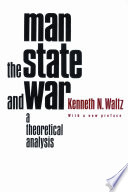
Man, the State, and War is a 1959 book on international relations by realist academic Kenneth Waltz. The book is influential within the field of international relations theory for establishing the three 'images of analysis' used to explain conflict in the international system.
“No system of balance functions automatically.”
Kenneth N. Waltz book Man, the State, and War
Source: Man, the State, and War (1959), Chapter VII, Some Implications Of The Third Image, p. 210
Kenneth N. Waltz book Man, the State, and War
Source: Man, the State, and War (1959), Chapter VII, Some Implications Of The Third Image, p. 188
“Once socialism replaces capitalism, reason will determine the policies of states.”
Kenneth N. Waltz book Man, the State, and War
Source: Man, the State, and War (1959), Chapter V, Some Implications Of The Second Image, p. 150
Kenneth N. Waltz book Man, the State, and War
Source: Man, the State, and War (1959), Chapter IV, The Second Image, p. 81
“War may achieve a redistribution of resources, but labor, not war, creates wealth.”
Kenneth N. Waltz book Man, the State, and War
Source: Man, the State, and War (1959), Chapter VIII, Conclusion, p. 224
Kenneth N. Waltz book Man, the State, and War
Source: Man, the State, and War (1959), Chapter II, The First Image, p. 16
“Each man does seek his own interest, but, unfortunately, not according to the dictates of reason.”
Kenneth N. Waltz book Man, the State, and War
Source: Man, the State, and War (1959), Chapter II, The First Image, p. 23
Kenneth N. Waltz book Man, the State, and War
Source: Man, the State, and War (1959), Chapter VI, The Third Image, p. 186
Kenneth N. Waltz book Man, the State, and War
Source: Man, the State, and War (1959), Chapter III, Some Implications Of The First Image, p. 69
“In anarchy there is no automatic harmony.”
Kenneth N. Waltz book Man, the State, and War
Source: Man, the State, and War (1959), Chapter VI, The Third Image, p. 160
Kenneth N. Waltz book Man, the State, and War
Source: Man, the State, and War (1959), Chapter V, Some Implications Of The Second Image, p. 127
Kenneth N. Waltz book Man, the State, and War
Source: Man, the State, and War (1959), Chapter VII, Some Implications Of The Third Image, p. 204
Kenneth N. Waltz book Man, the State, and War
Source: Man, the State, and War (1959), Chapter III, Some Implications Of The First Image, p. 42
Kenneth N. Waltz book Man, the State, and War
Source: Man, the State, and War (1959), Chapter VI, The Third Image, p. 159
“To build a theory of international relations on accidents of geography and history is dangerous.”
Kenneth N. Waltz book Man, the State, and War
Source: Man, the State, and War (1959), Chapter IV, The Second Image, p. 107
Kenneth N. Waltz book Man, the State, and War
Source: Man, the State, and War (1959), Chapter VI, The Third Image, p. 163
“In a zero-sum game, the problem is entirely one of distribution, not at all one of production.”
Kenneth N. Waltz book Man, the State, and War
Source: Man, the State, and War (1959), Chapter VII, Some Implications Of The Third Image, p. 202
Kenneth N. Waltz book Man, the State, and War
Source: Man, the State, and War (1959), Chapter VIII, Conclusion, p. 238
Kenneth N. Waltz book Man, the State, and War
Source: Man, the State, and War (1959), Chapter VIII, Conclusion, p. 230
“External pressure seems to produce internal unity.”
Kenneth N. Waltz book Man, the State, and War
Source: Man, the State, and War (1959), Chapter V, Some Implications Of The Second Image, p. 149


