
Cyril Connolly book Enemies of Promise
Source: Enemies of Promise (1938), Part 2: The Charlock’s Shade, Ch. 16: Outlook Unsettled (p. 137)
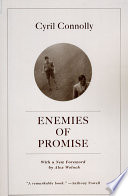
Enemies of Promise is a critical and autobiographical work written by Cyril Connolly first published in 1938.It comprises three parts, the first dedicated to Connolly's observations about English literature and the English literary world of his time, the second a list of adverse elements that affect the ability to be a good writer and the last an account of Connolly's early life. The overarching theme of the book is the search for understanding why Connolly, though he was widely recognised as a leading man of letters and a highly distinguished critic, failed to produce a major work of literature.
Cyril Connolly book Enemies of Promise
Source: Enemies of Promise (1938), Part 2: The Charlock’s Shade, Ch. 16: Outlook Unsettled (p. 137)
“Whom the Gods wish to destroy, they first call promising.”
Cyril Connolly book Enemies of Promise
Source: Enemies of Promise (1938), Part 2: The Charlock’s Shade, Ch. 13: The Poppies (p. 109-110)
Context: Whom the Gods wish to destroy, they first call promising.
Young writers if they are to mature require a period of between three and seven years in which to live down their promise. Promise is like the mediaeval hangman who after settling the noose, pushed his victim off the platform and jumped on his back, his weight acting a drop while his jockeying arms prevented the unfortunate from loosening the rope. When he judged him dead he dropped to the ground.
Cyril Connolly book Enemies of Promise
Source: Enemies of Promise (1938), Part 1: Predicament, Ch. 3: The Challenge of the Mandarins (p. 19)
Cyril Connolly book Enemies of Promise
Source: Enemies of Promise (1938), Part 1: Predicament, Ch. 5: Anatomy of Dandyism (p.38)
Cyril Connolly book Enemies of Promise
Source: Enemies of Promise (1938), Part 3: A Georgian Boyhood, Ch. 24: Vale (p. 258)
Cyril Connolly book Enemies of Promise
Source: Enemies of Promise (1938), Part 3: A Georgian Boyhood, Ch. 18: The Branching Ogham (p. 149)
Cyril Connolly book Enemies of Promise
Source: Enemies of Promise (1938), Part 1: Predicament, Ch. 5: Anatomy of Dandyism (p. 37)
Cyril Connolly book Enemies of Promise
Source: Enemies of Promise (1938), Part 3: A Georgian Boyhood, Ch. 24: Vale (p. 259)
Cyril Connolly book Enemies of Promise
Source: Enemies of Promise (1938), Part 1: Predicament, Ch. 5: Anatomy of Dandyism (p. 36)
Cyril Connolly book Enemies of Promise
Source: Enemies of Promise (1938), Part 3: A Georgian Boyhood, Ch. 24: Vale (p. 253)
Cyril Connolly book Enemies of Promise
Source: Enemies of Promise (1938), Part 1: Predicament, Ch. 4: The Modern Movement (p. 30)
Cyril Connolly book Enemies of Promise
Source: Enemies of Promise (1938), Part 2: The Charlock’s Shade, Ch. 16: Outlook Unsettled (p. 136-137)
Cyril Connolly book Enemies of Promise
Source: Enemies of Promise (1938), Part 1: Predicament, Ch. 2: The Mandarin Dialect (p. 13)
“There is no more sombre enemy of good art than the pram in the hall.”
Cyril Connolly book Enemies of Promise
Source: Enemies of Promise (1938), Part 2: The Charlock’s Shade, Ch. 14: The Charlock’s Shade (p. 116)
“I greet you, my educated fellow bourgeois, whose interests and whose doubts I share.”
Cyril Connolly book Enemies of Promise
Source: Enemies of Promise (1938), Part 1: Predicament, Ch. 1: The Next Ten Years (p. 5)
Cyril Connolly book Enemies of Promise
Source: Enemies of Promise (1938), Part 2: The Charlock’s Shade, Ch. 16: Outlook Unsettled (p. 136)
Cyril Connolly book Enemies of Promise
Source: Enemies of Promise (1938), Part 2: The Charlock’s Shade, Ch. 15: The Slimy Mallows (p. 122-123)
Cyril Connolly book Enemies of Promise
Source: Enemies of Promise (1938), Part 1: Predicament, Ch. 3: The Challenge to the Mandarins (p. 17-18)
Context: The Mandarin style at its best yields the richest and most complete expression of the English language. It is the diction of Donne, Browne, Addison, Johnson, Gibbon, de Quincey, Landor, Carlyle and Ruskin as opposed to that of Bunyan, Dryden, Locke, Defoe, Cowper, Cobbett, Hazlitt, Southey and Newman. It is characterized by long sentences with many dependent clauses, by the use of the subjunctive and conditional, by exclamations and interjections, quotations, allusions, metaphors, long images, Latin terminology, subtlety and conceits. Its cardinal assumption is that neither the writer nor the reader is in a hurry, that both are possessed of a classical education and a private income. It is Ciceronian English.
Cyril Connolly book Enemies of Promise
Source: Enemies of Promise (1938), Part 1: Predicament, Ch. 3: The Challenge to the Mandarins (p. 17-18)
Context: The Mandarin style at its best yields the richest and most complete expression of the English language. It is the diction of Donne, Browne, Addison, Johnson, Gibbon, de Quincey, Landor, Carlyle and Ruskin as opposed to that of Bunyan, Dryden, Locke, Defoe, Cowper, Cobbett, Hazlitt, Southey and Newman. It is characterized by long sentences with many dependent clauses, by the use of the subjunctive and conditional, by exclamations and interjections, quotations, allusions, metaphors, long images, Latin terminology, subtlety and conceits. Its cardinal assumption is that neither the writer nor the reader is in a hurry, that both are possessed of a classical education and a private income. It is Ciceronian English.


