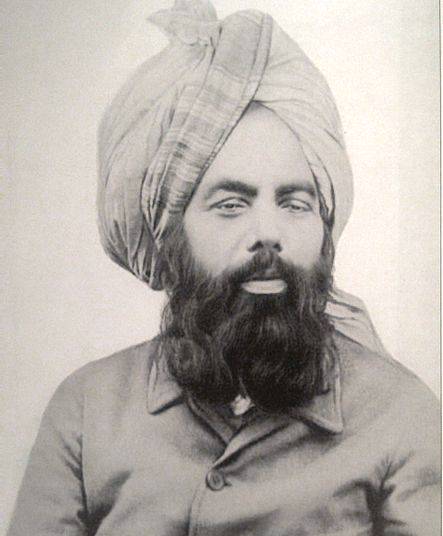
Mirza Gulam Ahmad cytaty

Mirza Ghulam Ahmad – indyjski reformator religijny. Założyciel ahmadijji.

Urodził się w Qadian w Pendżabie na styku obszarów zamieszkiwanych przez wyznawców islamu i hinduizmu, co wywarło silny wpływ na jego późniejszą działalność. Początkowo był uważany za reformatora islamu , jednak gdy ogłosił się Mahdim, nowym mesjaszem i Jezusem, który powrócił, większość uczonych muzułmańskich uznała go za heretyka. Później ogłosił się kolejnym wcieleniem Kryszny, co jeszcze bardziej oburzyło konserwatystów.

Przez wyznawców uważany jest za proroka, bądź reformatora islamu, która to rozbieżność doprowadziła do podziału w łonie ahmadijji. Wikipedia  

✵ 13. Luty 1835 – 26. Maj 1908
Mirza Gulam Ahmad Fotografia
Mirza Gulam Ahmad: 3 cytaty0 Polubień

Mirza Gulam Ahmad: Cytaty po angielsku

“One should try to find out what he is going to gain from the Bai'at and why it is necessary to enter into this pledge. Unless one knows what the advantage of a certain thing is and the value it possesses, one cannot appreciate it. It is just as there are various kinds of articles in the house: money-big and small coins-and wood etc. Everything is placed where it belongs, that is, everything will be cared for and looked after according to its value. Small coins will not receive the same care as the big ones. As for the pieces of wood, they will be thrown in a corner. In short, whatever will be a cause of bigger loss will be cared for more than other things. The most important point in Bai'at is Tauba (repentance)which means turning back. It indicates that condition in which man is closely connected with sin, and it is as if sins are the homeland and he is living in this habitation. Tauba means that he is now leaving this homeland. Turning back (Raju') means to adopt piety (to become pious).Leaving one's homeland is indeed a hard thing to do, and it entails thousands of hardships. When a man leaves his home, he feels it very much, then how much more one must be feeling while leaving one's homeland. He leaves every thing, his household belongings, his streets and his neighbours and bazaars (shops) and goes to another country.He does not come back to his old homeland.This is TAUBA.”

Mirza Ghulam Ahmad książka Malfoozat

When a man is a sinner, his friends are different from those who are going to be his friends when he adopts Taqwa(fear of God).
The mystics have termed this change as 'death'.
Źródło: Malfoozat, Vol.1, p.2

“The method of establishing perfect spiritual relationship with God that the Holy Quran teaches us is Islam, meaning devoting one's whole life to the cause of God and being occupied with the supplications which we have been taught in Surah Fatiha. This is the essence of Islam. Complete surrender to God and the supplication taught in Surah Fatihah are the only methods of meeting God and drinking the water of true salvation.”

Mirza Ghulam Ahmad książka The Philosophy of the Teachings of Islam

The Philosophy of the Teachings of Islam. <br class="br">The Philosophy of the Teachings of Islam <br class="br">Źródło: The Philosophy of the Teachings of Islam https://www.alislam.org/book/philosophy-teachings-islam/ – Alislam https://www.alislam.org/

Podobni autorzy

Aleksander Puszkin Fotografia
Aleksander Puszkin29
poeta rosyjski None
Lew Tołstoj Fotografia
Lew Tołstoj120
pisarz rosyjski None
Fiodor Dostojewski Fotografia
Fiodor Dostojewski100
pisarz rosyjski None
Søren Kierkegaard Fotografia
Søren Kierkegaard72
duński teolog i filozof None
Eugène Delacroix Fotografia
Eugène Delacroix22
malarz francuski None
Śri Ramakryszna Fotografia
Śri Ramakryszna5
Indyjski mnich hinduski i filozof None
Alessandro Manzoni Fotografia
Alessandro Manzoni2
pisarz włoski None
Nathaniel Hawthorne Fotografia
Nathaniel Hawthorne3
amerykański powieściopisarz None
Zygmunt Krasiński Fotografia
Zygmunt Krasiński26
polski poeta i dramatopisarz None
Adam Mickiewicz Fotografia
Adam Mickiewicz58
polski poeta None