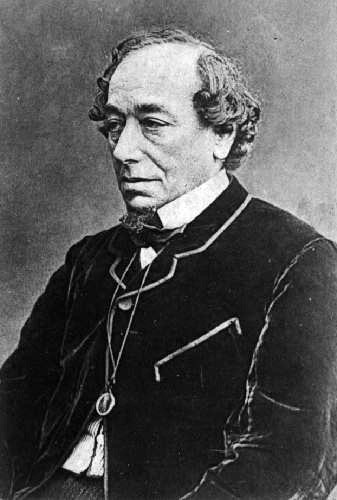
Benjamin Disraeli słynne cytaty
„Człowiek nie jest tworem okoliczności, to okoliczności są tworem człowieka.”
Źródło: M. Podzielska, Nauczyciel-lider. Jak budować autorytet?, WSiP, 2009, s. 38.
Benjamin Disraeli cytaty
Źródło: Horacy Safrin, Przy szabasowych świecach. Wieczór drugi, Wydawnictwo Łódzkie, Łódź 1981, s. 173
Źródło: Geoffrey Wigoder, Słownik biograficzny Żydów, Wydawnictwo Da Capo, 1998, s. 5 (motto).
„Są trzy rodzaje kłamstw: kłamstwa, okropne kłamstwa i statystyki.”
There are three kinds of lies: Lies, Damn Lies, and Statistics. (ang.)
przypisane Disraeliemu przez Marka Twaina.
Źródło: Przykazania etyki prawniczej. Księga myśli, norm i rycin, wyb. Roman Tokarczyk, wyd. Wolters Kluwer Polska, s. 121.
Next to knowing when to seize an opportunity, the most important thing in life is to know when to forgo an advantage. (ang.)
Źródło: „Przekrój”, Wydania 14–26, Krakowskie Wydawnictwo Prasowe, 1999, s. 121.
„Rasowy mężczyzna jest drapieżnikiem, który ściga tylko wielką zwierzynę, władzę lub kobietę.”
Źródło: Małgorzata Subotić, Wino, kobiety i bilard, Presspublica, 1997, s. 269.
Benjamin Disraeli: Cytaty po angielsku
“Action may not always bring happiness but there is no happiness without action.”
Books, Coningsby (1844), Lothair (1870)
Wariant: Action may not always bring happiness; but there is no happiness without action.
“The secret of success is constancy to purpose.”
Źródło: Speech at banquet of the National Union of Conservative and Constitutional Associations, Crystal Palace, London (24 June 1872), cited in "Mr. Disraeli at Sydenham," The Times (25 June 1872), p. 8.
“The magic of first love is our ignorance that it can ever end.”
Book 4, chapter 1. Often misquoted as "The magic of first love is our ignorance that it can never end".
Books, Coningsby (1844), Henrietta Temple (1837)
“Desperation is sometimes as powerful an inspirer as genius.”
Źródło: Books, Coningsby (1844), Endymion (1880), Ch. 8.
“Ignorance never settles a question.”
Źródło: Speech in the House of Commons (14 May 1866)
“Though lions to their enemies they were lambs to their friends.”
The infernal Marriage, part 2, Chapter 4 (1834).
Books
Not Disraeli but La Rochefoucauld; it is Maxim 308 in his Reflections.
Misattributed
Speech http://hansard.millbanksystems.com/commons/1845/mar/17/agricultural-interest in the House of Commons (17 March 1845). <br class="br">1840s
“Despair is the conclusion of fools.”
The Wondrous Tale of Alroy pt. 10, ch. 17.
Books
“Free trade is not a principle; it is an expedient.”
On Import Duties (25 April 1843). Compare: "It is a condition which confronts us, not a theory" (Grover Cleveland, Annual Message, 1887, in reference to the tariff); "Protection is not a principle but an expedient" (below).
1840s
Speech in the House of Commons (28 January 1840), quoted in William Flavelle Monypenny and George Earle Buckle, The Life of Benjamin Disraeli, Earl of Beaconsfield. Volume I. 1804–1859 (London: John Murray, 1929), p. 485
1840s
Speech in Taunton (28 April 1835), quoted in William Flavelle Monypenny and George Earle Buckle, The Life of Benjamin Disraeli, Earl of Beaconsfield. Volume I. 1804–1859 (London: John Murray, 1929), p. 286
1830s
Źródło: Address to the electors of Buckinghamshire (12 December 1832), quoted in William Flavelle Monypenny and George Earle Buckle, The Life of Benjamin Disraeli, Earl of Beaconsfield. Volume I. 1804–1859 (London: John Murray, 1929), p. 225
Address (1 October 1832), quoted in William Flavelle Monypenny and George Earle Buckle, The Life of Benjamin Disraeli, Earl of Beaconsfield. Volume I. 1804–1859 (London: John Murray, 1929), p. 221
1830s
Źródło: Election address; letter to the Lord Lieutenant of Ireland, the Duke of Marlborough (8 March 1880), quoted in The Times (9 March 1880), p. 8
Źródło: Election address; letter to the Lord Lieutenant of Ireland, the Duke of Marlborough (8 March 1880), quoted in The Times (9 March 1880), p. 8
Źródło: Speech in the House of Lords on the agricultural depression (29 April 1879), reported in The Times (30 April 1879), p. 8
Źródło: 'Letter VII. to Lord John Russell' (30 January 1836), The Letters of Runnymede (1836), pp. 60-61
Źródło: Letter to Edward Lytton Bulwer from Constantinople, Turkey (27 December 1830), quoted in William Flavelle Monypenny and George Earle Buckle, The Life of Benjamin Disraeli, Earl of Beaconsfield. Volume I. 1804–1859 (1929), p. 174
Źródło: Letter to Isaac Disraeli (c. 8 September 1826), quoted in William Flavelle Monypenny and George Earle Buckle, The Life of Benjamin Disraeli, Earl of Beaconsfield. Volume. I. 1804–1859 (1929), p. 108
Źródło: Letter to Isaac Disraeli (September 1826), quoted in William Flavelle Monypenny and George Earle Buckle, The Life of Benjamin Disraeli, Earl of Beaconsfield. Volume I. 1804–1859 (1929), p. 107
Źródło: Diary entry while in Aix (c. 16 August 1824), quoted in William Flavelle Monypenny and George Earle Buckle, The Life of Benjamin Disraeli, Earl of Beaconsfield. Volume I. 1804–1859 (1929), pp. 52-53
Źródło: Speech to the National Union of Conservative and Constitutional Associations in Crystal Palace, London (24 June 1872), quoted in Selected Speeches of the Late Right Honourable the Earl of Beaconsfield, Volume II, ed. T. E. Kebbel (1882), pp. 534-535
“There are three kinds of lies: Lies, Damn Lies, and Statistics.”
Attributed to Disraeli by Mark Twain in "Chapters from My Autobiography — XX", North American Review No. DCXVIII (JULY 5, 1907) http://www.gutenberg.org/ebooks/19987. His attribution is considered unreliable, and the actual origin is uncertain, with one of the earliest known publications of such a phrase being that of Leonard H. Courtney: see Lies, damned lies, and statistics. <br class="br">Misattributed
Campaign speech at High Wycombe (27 November 1832), cited in Selected Speeches of the Late Right Honourable the Earl of Beaconsfield, Vol. 1 (1882).
1830s
Kontekst: I am a Conservative to preserve all that is good in our constitution, a Radical to remove all that is bad. I seek to preserve property and to respect order, and I equally decry the appeal to the passions of the many or the prejudices of the few
Speech http://hansard.millbanksystems.com/commons/1845/apr/11/maynooth-college in the House of Commons (11 April 1845). <br class="br">1840s <br class="br">Kontekst: Sir, it is very easy to complain of party Government, and there may be persons capable of forming an opinion on this subject who may entertain a deep objection to that Government, and know to what that objection leads. But there are others who shrug their shoulders, and talk in a slipshod style on this head, who, perhaps, are not exactly aware of what the objections lead to. These persons should understand, that if they object to party Government, they do, in fact, object to nothing more nor less than Parliamentary Government. A popular assembly without parties&mdash;500 isolated individuals&mdash; cannot stand five years against a Minister with an organized Government without becoming a servile Senate.
“I believe that, without party, Parliamentary government is impossible”
Źródło: Speech to the Conservatives of Manchester (3 April 1872), cited in The World's Best Orations from the Earliest Period to the Present Time, Vol. 1 (eds. David Josiah Brewer, Edward Archibald Allen, William Schuyler), pp. 309-338.
Kontekst: Gentl, I am a party man. I believe that, without party, Parliamentary government is impossible. I look upon Parliamentary government as the noblest government in the world, and certainly the one most suited to England.


