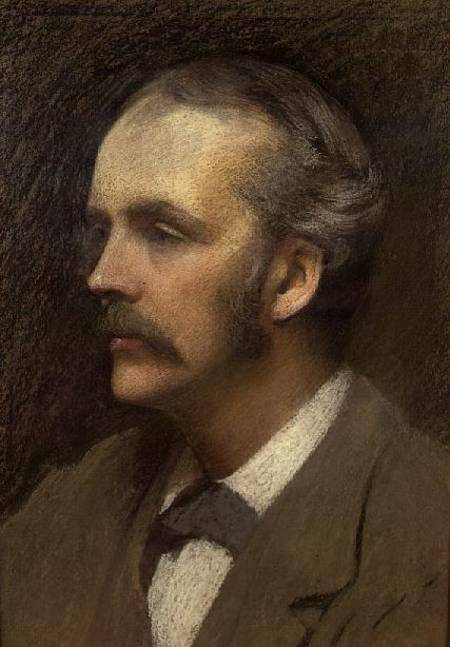
w 1906.
Źródło: Michał Leśniewski, Wojna burska 1899–1902, Warszawa 2001, s. 213.
Arthur Balfour: 49 cytatów0 Polubień
Arthur Balfour cytaty
Arthur Balfour: Cytaty po angielsku
Theism and humanism
Kontekst: Everything that happened, good or bad, would subtract something from the lessening store of useful energy, till a time arrived when nothing could happen any more, and the universe, frozen into eternal repose, would for ever be as if it were not. /.../ The physical course of nature does not merely fail to indicate design, it seems loudly to proclaim its absence.
Theism and humanism
Kontekst: Romantic love goes far beyond race requirements. From this point of view it is as useless as aesthetic emotion itself. And, like aesthetic emotion of the profounder sort, it is rarely satisfied with the definite, the limited, and the immediate. It ever reaches out towards an unrealised infinity. It cannot rest content with the prose of mere fact. It sees visions and dreams dreams which to an unsympathetic world seem no better than amiable follies. Is it from sources like these—the illusions of love and the enthusiasms of ignorance—that we propose to supplement the world-outlook provided for us by sober sense and scientific observation?
Yet why not? Here we have values which by supposition we are reluctant to lose. Neither scientific observation nor sober sense can preserve them. It is surely permissible to ask what will.
“We now know too much about matter to be materialists.”
Theism and humanism
Kontekst: We now know too much about matter to be materialists. The very essence of the physical order of things is that it creates nothing new. Change is never more than a redistribution of that which never changes. But sensibility belongs to the world of consciousness, not to the world of matter.
Theism and humanism
“Biography should be written by an acute enemy.”
Observer (20 January 1927).
A Fragment on Progress (1891)
Theism and humanism
Theism and humanism
Theism and humanism
Letter (2 November 1917) to Lord Rothschild; this letter became known as the Balfour Declaration, quoted in Blanche E. C. Dugdale, Arthur James Balfour, First Earl of Balfour, K.G., O.M., F.R.S., Etc. 1906–1930 (London: Hutchinson & Co. Ltd, 1936), p. 171.
Theism and humanism
Speech to the second meeting of the Washington Naval Conference (1921), quoted in Blanche E. C. Dugdale, Arthur James Balfour, First Earl of Balfour, K.G., O.M., F.R.S., Etc. 1906–1930 (London: Hutchinson & Co. Ltd, 1936), p. 236.
Theism and humanism
Memorandum, 'France's Fear of German Aggression' (28 March 1919), quoted in Blanche E. C. Dugdale, Arthur James Balfour, First Earl of Balfour, K.G., O.M., F.R.S., Etc. 1906–1930 (London: Hutchinson & Co. Ltd, 1936), pp. 204–205.
The Foundations of Belief (1895).
Introduction to Walter Bagehot's The English Constitution (London: Oxford University Press, 1928), p. xxiv.
Theism and humanism
Speech (1921), quoted in Blanche E. C. Dugdale, Arthur James Balfour, First Earl of Balfour, K.G., O.M., F.R.S., Etc. 1906–1930 (London: Hutchinson & Co. Ltd, 1936), p. 230.
Theism and humanism
Theism and humanism
Speech (7 May 1926), reported in The Observer (14 November 1926), quoted in Robert Andrews, The New Penguin Dictionary of Modern Quotations (2003)
/ Lord President of the Council
Quoted by Winston Churchill in his Great Contemporaries (London & New York, 1937) p. 250 http://www.winstonchurchill.org/learn/speeches/quotations/quotes-falsely-attributed
Memorandum, 'France's Fear of German Aggression' (28 March 1919) written for the Paris Peace Conference, quoted in Blanche E. C. Dugdale, Arthur James Balfour, First Earl of Balfour, K.G., O.M., F.R.S., Etc. 1906–1930 (London: Hutchinson & Co. Ltd, 1936), p. 204.
Remarks after the publication of Winston Churchill's book The Aftermath (1929), quoted in Blanche E. C. Dugdale, Arthur James Balfour, First Earl of Balfour, K.G., O.M., F.R.S., Etc. 1906–1930 (London: Hutchinson & Co. Ltd, 1936), p. 248
Lord President of the Council
Speech in the Speaker's Courtyard of Parliament for his 80th birthday ceremony (25 July 1928), quoted in The Times (26 July 1928), p. 16
Lord President of the Council
Speech in the Speaker's Courtyard of Parliament for his 80th birthday ceremony (25 July 1928), quoted in The Times (26 July 1928), p. 16
Lord President of the Council
Speech in the Speaker's Courtyard of Parliament for his 80th birthday ceremony (25 July 1928), quoted in The Times (26 July 1928), p. 16
Lord President of the Council


