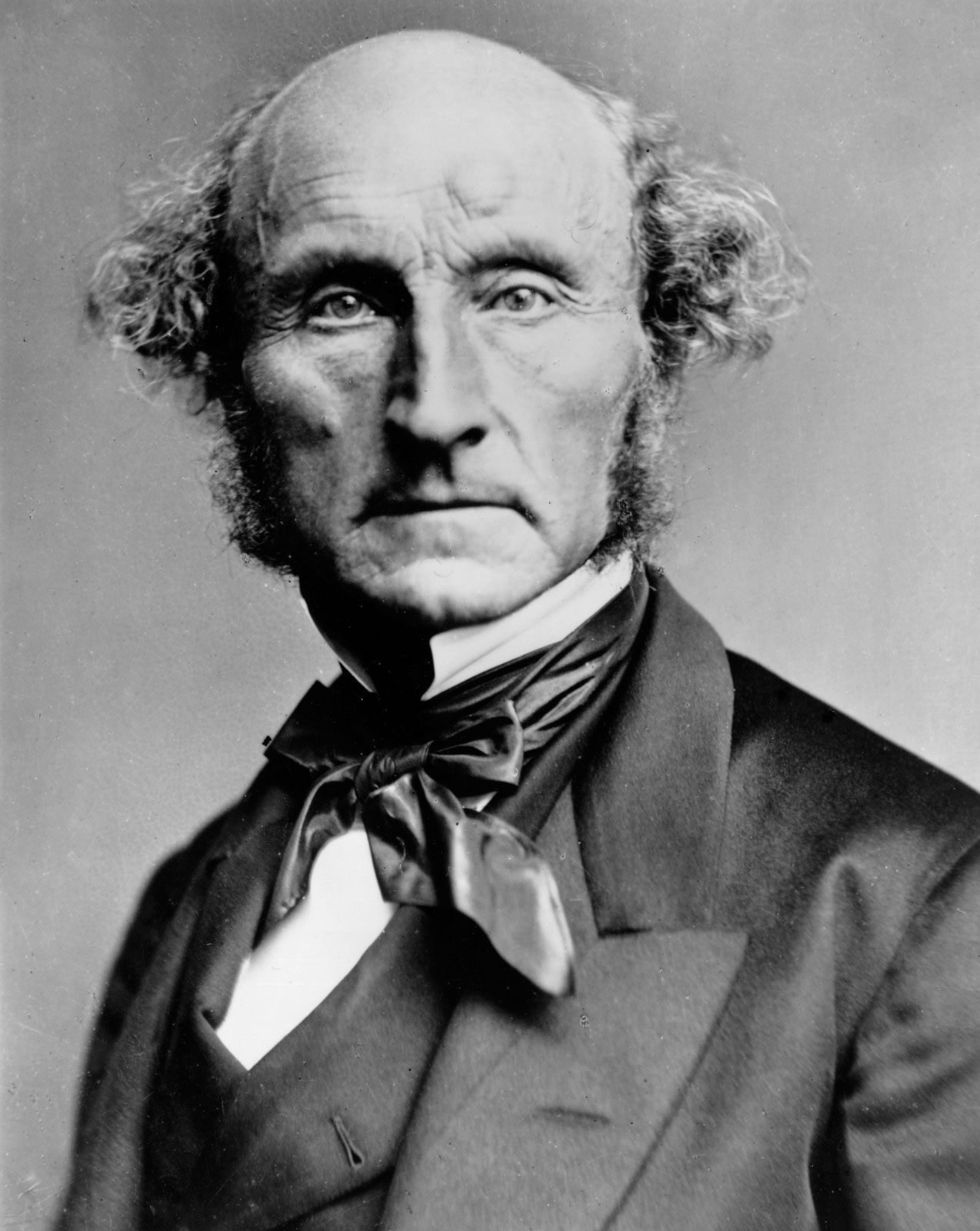
But the peculiar evil of silencing the expression of an opinion is, that it is robbing the human race; posterity as well as the existing generation; those who dissent from the opinion, still more than those who hold it. If the opinion is right, they are deprived of the opportunity of exchanging error for truth: if wrong, they lose, what is almost as great a benefit, the clearer perception and livelier impression of truth, produced by its collision with error.
en
De la liberté
John Stuart Mill citations célèbres
“Celui qui ne connaît que ses propres arguments connaît mal sa cause.”
He who knows only his own side of the case, knows little of that.
en
De la liberté
“L'utilité même d'une opinion est affaire d'opinion.”
The usefulness of an opinion is itself matter of opinion.
en
De la liberté
History teems with instances of truth put down by persecution. If not suppressed forever, it may be thrown back for centuries.
en
De la liberté
“Le génie ne peut respirer librement que dans une atmosphère de liberté.”
Genius can only breathe freely in an atmosphere of freedom.
en
De la liberté
That so few now dare to be eccentric, marks the chief danger of the time.
en
De la liberté
Citations sur les hommes et les garçons de John Stuart Mill
That principle is, that the sole end for which mankind are warranted, individually or collectively, in interfering with the liberty of action of any of their number, is self-protection. That the only purpose for which power can be rightfully exercised over any member of a civilized community, against his will, is to prevent harm to others.
en
De la liberté
The worth of a State, in the long run, is the worth of the individuals composing it; and a State which postpones the interests of their mental expansion and elevation, to a little more of administrative skill, or that semblance of it which practice gives, in the details of business; a State, which dwarfs its men, in order that they may be more docile instruments in its hands even for beneficial purposes, will find that with small men no great thing can really be accomplished; and that the perfection of machinery to which it has sacrificed everything, will in the end avail it nothing, for want of the vital power which, in order that the machine might work more smoothly, it has preferred to banish.
en
De la liberté
His own good, either physical or moral, is not a sufficient warrant. He cannot rightfully be compelled to do or forbear because it will be better for him to do so, because it will make him happier, because, in the opinions of others, to do so would be wise, or even right.
en
De la liberté
John Stuart Mill: Citations en anglais
Source: Autobiography (1873)
Source: https://archive.org/details/autobiography01mill/page/162/mode/1up p. 162
Source: On Representative Government (1861), Ch. VII: Of True and False Democracy; Representation of All, and Representation of the Majority only (p. 247)
“Coleridge”. London and Westminster Review. (March 1840).
Source: Autobiography (1873)
https://archive.org/details/autobiography01mill/page/32/mode/1up pp. 32–33
Source: On Representative Government (1861), Ch. II: The Criterion of a Good Form of Government (p. 167)
Source: https://archive.org/details/autobiography01mill/page/45/mode/1up pp. 45–46
Source: Autobiography (1873), Ch. 1: Childhood and Early Education (pp. 21-22)
Source: Autobiography (1873)
Source: https://archive.org/details/autobiography01mill/page/222/mode/1up p. 222
"The Spirit of the Age, I", Examiner (9 January 1831), p. 20 Full text online http://oll.libertyfund.org/title/256/50650
Source: On Liberty (1859), Ch. III: Of Individuality, As One of the Elements of Well-Being
“A society that will trade a little liberty for a little order will lose both, and deserve neither.”
Also attributed to Thomas Jefferson, this is a modern paraphrase of a statement of Benjamin Franklin: "Those who would give up Essential Liberty to purchase a little Temporary Safety, deserve neither Liberty nor Safety."
Misattributed
Source: Autobiography (1873), Ch. 3: Last Stage of Education and First of Self-Education (pp. 45-46)
Principles of Political Economy (1848), Book IV, Chapter VI, §3, p. 516
Source: On Representative Government (1861), Ch. XVI: Of Nationality, As Connected with Representative Government (p. 382)
Source: A System of Logic (1843), p. 11: Cited in Gaines (1976) "Foundations of fuzzy reasoning" in: International Journal of Man-Machine Studies 8(6), p. 623
Source: Autobiography (1873), Ch. 7: General View of the Remainder of My Life (p. 184)
Principles of Political Economy (1848), Book V, Chapter XI, §13
Source: On Representative Government (1861), Ch. III: The Ideally Best Polity
Source: https://archive.org/details/autobiography01mill/page/74/mode/1up pp. 74-75
Source: Autobiography (1873)
Source: https://archive.org/details/autobiography01mill/page/125/mode/1up p. 125
Source: Autobiography (1873)
https://archive.org/details/autobiography01mill/page/31/mode/1up p. 31
“A pupil from whom nothing is ever demanded which he cannot do never does all he can.”
Source: Autobiography (1873), Ch. 1: Childhood and Early Education (p. 32 http://archive.org/stream/autobiographymil00milluoft#page/32/mode/2up/search/%22a+pupil+from+whom+nothing+is+ever+demanded+which+he+cannot+do+never+does+all+he+can%22)
Source: https://archive.org/details/autobiography01mill/page/59/mode/1up p. 59