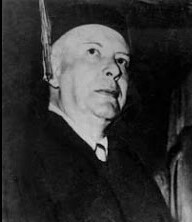
Wallace Stevens Quotes
“The mind can never be satisfied.”
"The Well Dressed Man With a Beard"
Harmonium (1923)
Variant: It can never be satisfied, the mind, never.
Source: The Collected Poems
Context: Out of a thing believed, a thing affirmed:
The form on the pillow humming while one sleeps,
The aureole above the humming house...
It can never be satisfied, the mind, never.
Wallace Stevens book Harmonium
"The Snow Man"
Harmonium (1923)
Context: p>One must have a mind of winter
To regard the frost and the boughs
Of the pine-trees crusted with snow;And have been cold a long time
To behold the junipers shagged with ice,
The spruces rough in the distant glitterOf the January sun; and not to think
Of any misery in the sound of the wind,
In the sound of a few leaves,Which is the sound of the land
Full of the same wind
That is blowing in the same bare placeFor the listener, who listens in the snow,
And, nothing himself, beholds
Nothing that is not there and the nothing that is.</p
“The poem must resist the intelligence
Almost successfully.”
Source: The Collected Poems
“Children picking up our bones
Will never know that these were once
As quick as foxes on the hill;”
Source: The Palm at the End of the Mind: Selected Poems and a Play
"Final Soliloquy of the Interior Paramour"
Collected Poems (1954)
Variant: We make a dwelling in the evening air,
In which being there together is enough.
Context: We say God and the imagination are one...
How high that highest candle lights the dark.
Out of this same light, out of the central mind,
We make a dwelling in the evening air,
In which being there together is enough.
Wallace Stevens book Harmonium
"Thirteen Ways of Looking at a Blackbird"
Harmonium (1923)
Notes Toward a Supreme Fiction (1942), It Must Give Pleasure
Notes Toward a Supreme Fiction (1942), It Must Change
The Necessary Angel (1951), Imagination as Value
Notes Toward a Supreme Fiction (1942), It Must Change
“God is in me or else is not at all (does not exist).”
Opus Posthumous (1955), Adagia
“Perhaps,
The man-hero is not the exceptional monster,
But he that of repetition is most master.”
Notes Toward a Supreme Fiction (1942), It Must Give Pleasure
“A. A violent order is disorder; and
B. A great disorder is an order. These
Two things are one.”
"Connoisseur of Chaos"
Parts of a World (1942)
"Not Ideas About The Thing But The Thing Itself"
Collected Poems (1954)
The Man With the Blue Guitar (1937)
“Twenty men crossing a bridge,
Into a village,
Are
Twenty men crossing a bridge
Into a village.”
Wallace Stevens book Harmonium
"Metaphors of a Magnifico"
Harmonium (1923)
Notes Toward a Supreme Fiction (1942), It Must Be Abstract
Notes Toward a Supreme Fiction (1942), It Must Give Pleasure
Wallace Stevens book Harmonium
"On the Manner of Addressing Clouds"
Harmonium (1923)
“A grandiose subject is not an assurance of a grandiose effect but, most likely, of the opposite.”
Opus Posthumous (1955), Adagia
Notes Toward a Supreme Fiction (1942), It Must Change
“The poem, through candor, brings back a power again
That gives a candid kind to everything.”
Notes Toward a Supreme Fiction (1942), It Must Be Abstract
Notes Toward a Supreme Fiction (1942), It Must Give Pleasure
Journal entry (26 July 1899); as published in Souvenirs and Prophecies: the Young Wallace Stevens (1977) edited by Holly Stevens, Ch. 3
“This will make widows wince. But fictive things
Wink as they will. Wink most when widows wince.”
"A High-Toned Old Christian Woman" (1922)
Journal entry (9 April 1906); as published in Letters of Wallace Stevens (1966) edited by Holly Stevens
Notes Toward a Supreme Fiction (1942), It Must Give Pleasure
Notes Toward a Supreme Fiction (1942), It Must Give Pleasure
Notes Toward a Supreme Fiction (1942), It Must Change
Letter (19 December 1935) as published in Letters of Wallace Stevens (1966) edited by Holly Stevens, (No. 336)
“Abysmal instruments make sounds like pips
Of the sweeping meanings that we add to them.”
Notes Toward a Supreme Fiction (1942), It Must Be Abstract
“My dame, sing for this person accurate songs.”
Notes Toward a Supreme Fiction (1942), It Must Be Abstract
“Of these beginnings, gay and green, propose
The suitable amours. Time will write them down.”
Notes Toward a Supreme Fiction (1942), It Must Change
"The Brave Man"
Ideas of Order (1936)
“A Collect of Philosophy”
Opus Posthumous (1955)


