Works

Theodore Sturgeon: 44 quotes1 like
Famous Theodore Sturgeon Quotes
“Why must we love where the lightning strikes, and not where we choose?”
Theodore Sturgeon book E Pluribus Unicorn
Source: E Pluribus Unicorn
Venture Science Fiction (March 1958) The original expression of this has often been declared to have been "Sure, ninety percent of science fiction is crud. That's because ninety percent of everything is crud." According to Philip Klass Sturgeon made the remark during a talk at New York University around 1951. It has also commonly appeared in variant forms such as "Ninety percent of everything is crap" and is often referred to as "Sturgeon's Law" — though he himself gave that title to another phrase:
Variant: Ninety percent of everything is crud.
Context: I repeat Sturgeon's Revelation, which was wrung out of me after twenty years of wearying defense of science fiction against attacks of people who used the worst examples of the field for ammunition, and whose conclusion was that ninety percent of it is crud.
The Revelation: Ninety percent of everything is crud.
Corollary 1: The existence of immense quantities of trash in science fiction is admitted and it is regrettable; but it is no more unnatural than the existence of trash anywhere.
Corollary 2: The best science fiction is as good as the best fiction in any field.
As quoted in an interview with David Duncan http://www.physics.emory.edu/~weeks/misc/duncan.html <br class="br">Context: Science fiction, outside of poetry, is the only literary field which has no limits, no parameters whatsoever. You can go not only into the future, but into that wonderful place called "other", which is simply another universe, another planet, another species.
Theodore Sturgeon Quotes about people
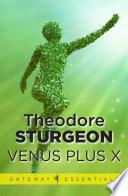
Theodore Sturgeon book Venus Plus X
Section 43 (pp. 131-132)
Venus Plus X (1960)
Theodore Sturgeon book More Than Human
Source: More Than Human (1953), Chapter 1, p. 60
Theodore Sturgeon book More Than Human
Source: More Than Human (1953), Chapter 3, p. 181
“A pig among people is a pig, he tells himself, but a pig among pigs is people.”
Theodore Sturgeon book Venus Plus X
Section 38 (p. 118)
Venus Plus X (1960)
Theodore Sturgeon book Venus Plus X
Section 11 (p. 33)
Venus Plus X (1960)
Source: Short fiction, The Martian and the Moron (1949), p. 44
Theodore Sturgeon Quotes about the trip
Theodore Sturgeon book Venus Plus X
Section 41 (p. 126)
Venus Plus X (1960)
Theodore Sturgeon book More Than Human
Source: More Than Human (1953), Chapter 3 “Morality”, p. 146
Theodore Sturgeon book Venus Plus X
Section 36 (p. 115)
Venus Plus X (1960)
Theodore Sturgeon book Venus Plus X
Source: Venus Plus X (1960), Section 32 (p. 101)
“An ethic isn’t a fact you can look up. It’s a way of thinking.”
Theodore Sturgeon book More Than Human
Source: More Than Human (1953), Chapter 3, p. 183
Theodore Sturgeon Quotes
“We don’t believe anything we don’t want to believe.”
Theodore Sturgeon book More Than Human
Source: More Than Human (1953), Chapter 2 “Baby is Three”, p. 94
Context: That’s fairly common. We don’t believe anything we don’t want to believe.
“The idiot heard the sounds, but they had no meaning for him.”
Theodore Sturgeon book More Than Human
Source: More Than Human (1953), Chapter 1 “The Fabulous Idiot”, p. 1
Context: The idiot heard the sounds, but they had no meaning for him. He lived inside somewhere, apart, and the little link between word and significance hung broken.
His explanation of the meaning of a small symbol he used when writing his signature, as quoted in an interview with David Duncan (with an image of his signature) http://www.physics.emory.edu/~weeks/misc/duncan.html. <br class="br">Variant: Ask the next question. And the one after that. <br class="br">Context: It means "Ask the next question." Ask the next question, and the one that follows that, and the one that follows that. It's the symbol of everything humanity has ever created, and is the reason it has been created. This guy is sitting in a cave and he says, "Why can't man fly?" Well, that's the question. The answer may not help him, but the question now has been asked.<br>The next question is what? How? And so all through the ages, people have been trying to find out the answer to that question. We've found the answer, and we do fly. This is true of every accomplishment, whether it's technology or literature, poetry, political systems or anything else. That is it. Ask the next question. And the one after that.
“There’s this about a farm: when the market’s good there’s money, and when it’s bad there’s food.”
Theodore Sturgeon book More Than Human
Source: More Than Human (1953), Chapter 1, p. 34
“It's the Simple things that are really effective. Try to remember that.”
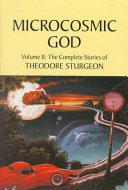
Theodore Sturgeon book Microcosmic God
Professor Thaddeus MacIlhainy Nudnick, in "Two Percent Inspiration", first published in Astounding Science-Fiction (October 1941); also published in Microcosmic God : Volume II : The Complete Stories of Theodore Sturgeon (1995), edited by Paul Williams, p. 322 ISBN 1556433018
Theodore Sturgeon book More Than Human
Source: More Than Human (1953), Chapter 3, p. 184
As quoted in The Issue at Hand: Studies in Contemporary Magazine Science Fiction (1964) by James Blish, p. 14
Theodore Sturgeon book More Than Human
Source: More Than Human (1953), Chapter 3, p. 186
Theodore Sturgeon book Venus Plus X
Source: Venus Plus X (1960), Section 13 (p. 40)
Theodore Sturgeon book More Than Human
Source: More Than Human (1953), Chapter 2, p. 97
“That Heel. That lousy wart on the nose of progress.”
Theodore Sturgeon book Microcosmic God
Character Hughie McCauley, quoting fictional space-opera hero Captain Jaundess, in "Two Percent Inspiration", first published in Astounding Science-Fiction (October 1941); also published in Microcosmic God : Volume II : The Complete Stories of Theodore Sturgeon (1995), edited by Paul Williams, p. 322 ISBN 1556433018
Theodore Sturgeon book Venus Plus X
Section 36 (p. 114)
Venus Plus X (1960)
“As Adam said when his wife fell out of the tree—Eve’s dropping again.”
Theodore Sturgeon book Venus Plus X
Section 24 (p. 71)
Venus Plus X (1960)
“Morals: They’re nothing but a coded survival instinct!”
Theodore Sturgeon book More Than Human
Source: More Than Human (1953), Chapter 3, p. 175
Theodore Sturgeon book Venus Plus X
Section 41 (p. 123)
Venus Plus X (1960)
Theodore Sturgeon book Venus Plus X
Section 41 (p. 125)
Venus Plus X (1960)
“If All Men Were Brothers, Would You Let One Marry Your Sister?”
Title of story about the incest taboo and social pathologies in the anthology Dangerous Visions (1967) by Harlan Ellison.
“God," he cries, dying on Mars, "God, we made it!”
published in the Magazine of Fantasy and Science Fiction, October 1959
The Man Who Lost The Sea
Theodore Sturgeon book Venus Plus X
Section 19 (p. 59)
Venus Plus X (1960)
Theodore Sturgeon book Venus Plus X
Section 41 (p. 130)
Venus Plus X (1960)
Theodore Sturgeon book More Than Human
Source: More Than Human (1953), Chapter 3, p. 169
How to Avoid a Hole in the Head in Marvel Science Stories https://en.wikipedia.org/wiki/Marvel_Science_Stories (May 1951), p. 115
Well, that's the question. The answer may not help him, but the question now has been asked.<br>The next question is what? How? And so all through the ages, people have been trying to find out the answer to that question. We've found the answer, and we do fly. This is true of every accomplishment, whether it's technology or literature, poetry, political systems or anything else. That is it. Ask the next question. And the one after that.<br><br>His explanation of the meaning of a small symbol he used when writing his signature, as quoted in an interview with David Duncan (with an image of his signature) http://www.physics.emory.edu/~weeks/misc/duncan.html, sometime around 1980.
“Now how can you like a man without wanting him?”
Theodore Sturgeon book Venus Plus X
she demands of herself aloud.
There is no answer. It is an article of faith with her. If you like a man, it has to be because you want him. Whoever heard of it any other way?
Section 32 (p. 101)
Venus Plus X (1960)
Source: Short fiction, The Martian and the Moron (1949), p. 37


