Source: The Great Book of Amber
Works
Roger Zelazny: 112 quotes2 likes
Famous Roger Zelazny Quotes
“Death is the only god that comes when you call.”
Roger Zelazny book Frost & Fire
24 Views of Mt. Fuji, by Hokusai (1985) - Review of 24 views, with images http://www.stmoroky.com/reviews/gallery/hokusai/24views.htm <br class="br">Source: Frost & Fire
Roger Zelazny Quotes about time
“To paraphrase Oedipus, Hamlet, Lear, and all those guys, "I wish I had known this some time ago.”
Roger Zelazny book Sign of the Unicorn
Source: Sign of the Unicorn
Phlogiston interview (1995)
Roger Zelazny Isle of the Dead
Source: Isle of the Dead (1969), Chapter 1 (p. 6)
Roger Zelazny Isle of the Dead
Source: Isle of the Dead (1969), Chapter 3 (p. 62)
Roger Zelazny: Trending quotes
“The fact remains that you would be dealing, and dealing constantly, with the abnormal.”
Roger Zelazny book He Who Shapes
He Who Shapes (1965)
Context: The fact remains that you would be dealing, and dealing constantly, with the abnormal. The power of a neurosis is unimaginable to ninety-nine point et cetera percent of the population, because we can never adequately judge the intensity of our own — let alone those of others, when we only see them from the outside. That is why no neuroparticipant will ever undertake to treat a fullblown psychotic. The few pioneers in that area are all themselves in therapy today. It would be like driving into a maelstrom. If the therapist loses the upper hand in an intense session he becomes the Shaped rather than the Shaper. The synapses respond like a fission reaction when nervous impulses are artificially augmented. The transference effect is almost instantaneous.
“You don’t know what it’s like to be cut off from a whole area of stimuli!”
Roger Zelazny book He Who Shapes
He Who Shapes (1965)
Context: You don’t know what it’s like to be cut off from a whole area of stimuli! To know that a Mongoloid idiot can experience something you can never know — and that he cannot appreciate it because, like you, he was condemned before birth in a court of biological happenstance, in a place where there is no justice — only fortuity, pure and simple.
On how he would like to be remembered (1994)
Context: Oh, I don't know — that's a hell of a question — I don't tend to look at my stuff that way. I just look at it a book at a time. Something like the Amber books are in a different class. I try not to anticipate. I don't know what I'll be writing a few years from now. I have some ideas — I have lots of different things I want to try. I almost don't really care what history thinks. I like the way I'm being treated right now.
Roger Zelazny Quotes
"A Conversation With Roger Zelazny" (8 April 1978), talking with Terry Dowling and Keith Curtis in Science Fiction Vol. 1, #2 (June 1978) http://web.archive.org/web/20070701010155/zelazny.corrupt.net/19780408int.html#2 <br class="br">Context: Yeah, the mythology is kind of a pattern. I'm very taken by mythology. I read it at a very early age and kept on reading it. Before I discovered science fiction I was reading mythology. And from that I got interested in comparative religion and folklore and related subjects. And when I began writing, it was just a fertile area I could use in my stories.<br>I was saying at the convention in Melbourne that after a time I got typed as a writer of mythological science fiction, and at a convention I'd go to I'd invariably wind up on a panel with the title "Mythology and Science Fiction". I felt a little badly about this, I was getting considered as exclusively that sort of writer. So I intentionally tried to break away from it with things like Doorways in the Sand and those detective stories which came out in the book My Name Is Legion, and other things where I tried to keep the science more central.<br>But I do find the mythological things are creeping in. I worked out a book which I thought was just straight science fiction -- with everything pretty much explained, and suddenly I got an idea which I thought was kind of neat for working in a mythological angle. I'm really struggling with myself. It would probably be a better book if I include it, but on the other hand I don't always like to keep reverting to it. I think what I'm going to do is vary my output, do some straight science fiction and some straight fantasy that doesn't involve mythology, and composites.
"A Conversation With Roger Zelazny" (8 April 1978), talking with Terry Dowling and Keith Curtis in Science Fiction Vol. 1, #2 (June 1978) http://web.archive.org/web/20070701010155/zelazny.corrupt.net/19780408int.html#2 <br class="br">Context: Yeah, the mythology is kind of a pattern. I'm very taken by mythology. I read it at a very early age and kept on reading it. Before I discovered science fiction I was reading mythology. And from that I got interested in comparative religion and folklore and related subjects. And when I began writing, it was just a fertile area I could use in my stories.<br>I was saying at the convention in Melbourne that after a time I got typed as a writer of mythological science fiction, and at a convention I'd go to I'd invariably wind up on a panel with the title "Mythology and Science Fiction". I felt a little badly about this, I was getting considered as exclusively that sort of writer. So I intentionally tried to break away from it with things like Doorways in the Sand and those detective stories which came out in the book My Name Is Legion, and other things where I tried to keep the science more central.<br>But I do find the mythological things are creeping in. I worked out a book which I thought was just straight science fiction -- with everything pretty much explained, and suddenly I got an idea which I thought was kind of neat for working in a mythological angle. I'm really struggling with myself. It would probably be a better book if I include it, but on the other hand I don't always like to keep reverting to it. I think what I'm going to do is vary my output, do some straight science fiction and some straight fantasy that doesn't involve mythology, and composites.
Phlogiston interview (1995)
Context: When I started writing my first novel,... And Call Me Conrad, they always say: "Write about what you know" and I said "Well, if I get a nice sort of combination SF and Fantasy with these resonances from Greek Mythology it might be pretty good. It would also give me a chance to start filling in my background on all those things I don't know much about but should if I want to be an SF writer."
So I sat down and made a list of everything I felt I should know more about. Astrophysics, oceanography, marine biology, genetics... Then when I'd finished the list I read one book in each of these areas. When I'd finished I went back and read a second book until I'd read ten books in each area. I thought that it wouldn't turn me into a terrific, fantastic expert but I'd at least have enough material there to know if I was saying something wrong. And I'd also know where to turn to get the information I want to make it right.
While I was doing this, to keep the words and cheques flowing I wrote books involving mythology. And once I started picking up things involving astrophysics I'd write stories that played with those sorts of things. So that's why I started out with mythology.
and then you just write. You fill up the page and the next page. But you have a certain minimum so that at the end of the day, you can say "Hey I wrote four times today, three sentences, a dozen sentences. Each sentence is maybe twenty word long. That's 240 words which is a page of copy, so at least I didn't goof off completely today. I got a page for my efforts and tomorrow it might be easier because I've moved as far as I have".
Phlogiston interview (1995)
On how he would like to be remembered (1994)
Context: Oh, I don't know — that's a hell of a question — I don't tend to look at my stuff that way. I just look at it a book at a time. Something like the Amber books are in a different class. I try not to anticipate. I don't know what I'll be writing a few years from now. I have some ideas — I have lots of different things I want to try. I almost don't really care what history thinks. I like the way I'm being treated right now.
Phlogiston interview (1995)
Context: Well, I decided that as a teenager that I really didn't know enough to describe character well and I was wasting my time. I'd learned as much as I could about story telling techniques and it wasn't a matter of technique any more. It was a matter of substance. As a result I said I was going to wait until I was a lot older and had more experience. So it was that after I got out of college I'd been away from SF for about four years. I'd read SF steadily from when I was eleven until I started college. When I started college I said, "I'm not going to read that while I'm here, I'm going to learn poetry and other things of that sort" in fact I wrote a lot of poetry then.
“Nobody steals books but your friends.”
Roger Zelazny book The Guns of Avalon
Source: The Guns of Avalon
“There's no such thing as civilization. The word just means the art of living in cities.”
Source: The Great Book of Amber
Roger Zelazny Isle of the Dead
Source: Isle of the Dead (1969), Chapter 1 (pp. 29-30)
“The universe did not invent justice. Man did. Unfortunately, man must reside in the universe.”
Roger Zelazny book The Dream Master
He Who Shapes (1965)
Source: The Dream Master
Roger Zelazny Isle of the Dead
Source: Isle of the Dead (1969), Chapter 6 (pp. 137-138)
“The stars blazed like the love of God, cold and distant.”
Roger Zelazny Isle of the Dead
Source: Isle of the Dead (1969), Chapter 4 (p. 87)
“So do not speak to me of souls when you have never seen one, man.”
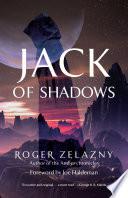
Roger Zelazny book Jack of Shadows
Source: Jack of Shadows (1971), Chapter 6 (p. 63)
Roger Zelazny book A Night in the Lonesome October
October 22 (p. 160)
A Night in the Lonesome October (1993)
Roger Zelazny Isle of the Dead
Source: Isle of the Dead (1969), Chapter 2 (pp. 58-59)
Roger Zelazny Isle of the Dead
Source: Isle of the Dead (1969), Chapter 8 (p. 187)
Roger Zelazny Isle of the Dead
Source: Isle of the Dead (1969), Chapter 5 (pp. 119-120)
Roger Zelazny Isle of the Dead
Source: Isle of the Dead (1969), Chapter 4 (p. 72)
"A Conversation With Roger Zelazny" (8 April 1978), talking with Terry Dowling and Keith Curtis in Science Fiction Vol. 1, #2 (June 1978)
Home is the Hangman (1975)
Roger Zelazny book Jack of Shadows
Source: Jack of Shadows (1971), Chapter 6 (p. 63)
Roger Zelazny Isle of the Dead
Source: Isle of the Dead (1969), Chapter 8 (p. 174)
Roger Zelazny Isle of the Dead
Source: Isle of the Dead (1969), Chapter 7 (p. 154)
“Symbols, by their very nature, conceal as well as indicate, damn them!”
Roger Zelazny Isle of the Dead
Source: Isle of the Dead (1969), Chapter 1 (p. 29)
Roger Zelazny Isle of the Dead
Source: Isle of the Dead (1969), Chapter 2 (p. 45)
“I have noted, too, that when it comes to matters of security the laws are considerably relaxed.”
Roger Zelazny book Jack of Shadows
Source: Jack of Shadows (1971), Chapter 8 (p. 85)
In the introduction for the short-story collection Unicorn Variations (1983)
Introduction to Passion Play (1962)
Roger Zelazny book He Who Shapes
He Who Shapes (1965)
“The function of criticism should not be confused with the function of reform.”
Home is the Hangman (1975)
Roger Zelazny book Unicorn Variation
"Oh, that," Tlingel replied.
Unicorn Variation (1982)
First lines of Zelazny's first published short story, Passion Play (1962)
Roger Zelazny Isle of the Dead
Source: Isle of the Dead (1969), Chapter 7 (pp. 147-148)
“I wasn’t disappointed, inasmuch as I expected nothing.”
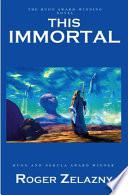
Roger Zelazny book This Immortal
Source: This Immortal (1965), p. 29
“Never trust a cat, anyway. All they’re good for is stringing tennis racquets.”
Roger Zelazny book A Night in the Lonesome October
October 6 (p. 28)
A Night in the Lonesome October (1993)


