Primo Levi book If This Is a Man
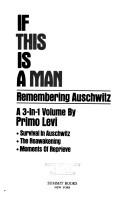
If This Is a Man (1947)
Source: If This Is a Man / The Truce
Primo Michele Levi was an Italian chemist, partisan, writer, and Jewish Holocaust survivor. He was the author of several books, collections of short stories, essays, poems and one novel. His best-known works include If This Is a Man , his account of the year he spent as a prisoner in the Auschwitz concentration camp in Nazi-occupied Poland; and The Periodic Table , a collection of mostly autobiographical short stories each named after a chemical element as it played a role in each story, which the Royal Institution named the best science book ever written.Levi died in 1987 from injuries sustained in a fall from a third-story apartment landing. His death was officially ruled a suicide, but some, after careful consideration, have suggested that the fall was accidental because he left no suicide note, there were no witnesses, and he was on medication that could have affected his blood pressure and caused him to fall accidentally.
Wikipedia

Primo Levi book If This Is a Man
If This Is a Man (1947)
Source: If This Is a Man / The Truce
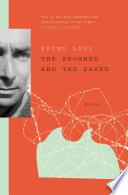
Primo Levi book The Drowned and the Saved
The Drowned and the Saved (1986)
Context: In countries and epochs in which communication is impeded, soon all other liberties wither; discussion dies by inanition, ignorance of the opinion of others becomes rampant, imposed opinions triumph. The well-known example of this is the crazy genetics preached in the USSR by Lysenko, which in the absence of discussion (his opponents were exiled to Siberia) compromised the harvests for twenty years. Intolerance is inclined to censor, and censorship promotes ignorance of the arguments of others and thus intolerance itself: a rigid, vicious circle that is hard to break.
Primo Levi book The Drowned and the Saved
Source: The Drowned and the Saved
Primo Levi book If This Is a Man
If This Is a Man (1947)
Context: Sooner or later in life everyone discovers that perfect happiness is unrealizable, but there are few who pause to consider the antithesis: that perfect unhappiness is equally unattainable. The obstacles preventing the realization of both these extreme states are of the same nature: they derive from our human condition, which is opposed to everything infinite. Our ever-insufficient knowledge of the future opposes it: and this is called, in the one instance, hope, and and in the other, uncertainty of the following day. The certainty of death opposes it: for it places a limit on every joy, but also on every grief. The inevitable material cares oppose it: for as they poison every lasting happiness, they equally assiduously distract us from our misfortunes and make our consciousness of them intermittent and hence supportable.
“The aims of life are the best defense against death.”
Primo Levi book The Drowned and the Saved
The Drowned and the Saved (1986)
Primo Levi book Other People's Trades
"News from the Sky"
Other People's Trades (1985)
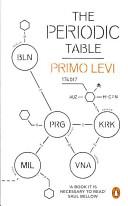
Primo Levi book The Periodic Table
"Hydrogen"
The Periodic Table (1975)
Primo Levi book The Periodic Table
"Zinc"
The Periodic Table (1975)
“Perfection belongs to narrated events, not to those we live.”
Primo Levi book The Periodic Table
Source: The Periodic Table
"Bear Meat" in The New Yorker (8 January 2007) http://www.newyorker.com/fiction/features/2007/01/08/070108fi_fiction_levi?currentPage=all <br class="br">Context: I read somewhere — and the person who wrote this was not a mountaineer but a sailor — that the sea’s only gifts are harsh blows and, occasionally, the chance to feel strong. Now, I don’t know much about the sea, but I do know that that’s the way it is here. And I also know how important it is in life not necessarily to be strong but to feel strong, to measure yourself at least once, to find yourself at least once in the most ancient of human conditions, facing blind, deaf stone alone, with nothing to help you but your own hands and your own head.
“Nothing can be said: nothing sure, nothing probable, nothing honest.”
Primo Levi book The Wrench
The Wrench (1978)
Context: Nothing can be said: nothing sure, nothing probable, nothing honest. Better to err through omission than through commission: better to refrain from steering the fate of others, since it is already so difficult to navigate one's own.
As quoted in "Primo Levi and Translation" http://www.leeds.ac.uk/bsis/98/98pltrn.htm by David Mendel http://findarticles.com/p/articles/mi_qn4158/is_20070320/ai_n18738601/print, in Bulletin of the Society for Italian Studies (1998) <br class="br">Context: Translation is difficult work because the barriers between languages are higher than is generally thought … knowing how to avoid the traps is not enough to make a good translator. The task is more arduous; it is a matter of transferring from one language to another the expressive force of the text, and this is a superhuman task, so much so that some celebrated translations (for example that of the Odyssey into Latin and the Bible into German) have marked transformations in the history of our civilisation.<br>Nonetheless, since writing results from a profound interaction between the creative talent of the writer and the language in which he expresses himself, to each translation is coupled an inevitable loss, comparable to the loss of changing money. This diminution varies in degree, great or small according to the ability of the translator and the nature of the original text. As a rule it is minimal for technical or scientific texts (but in this case the translator, in addition to knowing the two languages, needs to understand what he is translating; possess, that is to say, a third competence). It is maximal for poetry...
Primo Levi book The Drowned and the Saved
The Drowned and the Saved (1986)
Context: In countries and epochs in which communication is impeded, soon all other liberties wither; discussion dies by inanition, ignorance of the opinion of others becomes rampant, imposed opinions triumph. The well-known example of this is the crazy genetics preached in the USSR by Lysenko, which in the absence of discussion (his opponents were exiled to Siberia) compromised the harvests for twenty years. Intolerance is inclined to censor, and censorship promotes ignorance of the arguments of others and thus intolerance itself: a rigid, vicious circle that is hard to break.
Primo Levi book The Periodic Table
"Nitrogen"
The Periodic Table (1975)
Context: The trade of chemist (fortified, in my case, by the experience of Auschwitz), teaches you to overcome, indeed to ignore, certain revulsions that are neither necessary or congenital: matter is matter, neither noble nor vile, infinitely transformable, and its proximate origin is of no importance whatsoever. Nitrogen is nitrogen, it passes miraculously from the air into plants, from these into animals, and from animals into us; when its function in our body is exhausted, we eliminate it, but it still remains nitrogen, aseptic, innocent.
“I am constantly amazed by man's inhumanity to man.”
Primo Levi book If This Is a Man
Source: If This Is a Man / The Truce
“Those who deny Auschwitz would be ready to remake it.”
Interview with Daniel Toaff, Sorgenti di Vita (25 March 1983); translated by Mirto Stone
Primo Levi book The Drowned and the Saved
The Drowned and the Saved (1986)
Primo Levi book Other People's Trades
"The Irritable Chess-Players"
Other People's Trades (1985)
Primo Levi book The Mirror Maker
"The Premise," The Mirror Maker (1986)
Primo Levi book Collected Poems
"The Survivor" (1984)
Collected Poems (1984)
“What to do now? How to detach yourself?
With every work that’s born you die a little.”
Primo Levi book Collected Poems
"The Work" (1983)
Collected Poems (1984)
Interview http://www.inch.com/~ari/levi1.html with Daniel Toaff, Sorgenti di Vita (Springs of Life), a program on the Unione Comunita Israelitiche Italiane, Radiotelevisione Italiana [RAI] (25 March 1983); translated by Mirto Stone
Primo Levi book Other People's Trades
"Ex-Chemist"
Other People's Trades (1985)
“It is not at all an idle matter trying to define what a human being is.”
Primo Levi book Other People's Trades
Other People's Trades (1985)
As quoted in The Age of Extremes: The Short Twentieth Century, 1914-1991 (1994) by Eric J. Hobsbawm
Primo Levi book The Periodic Table
On the structure of alloxan, in "Nitrogen".
The Periodic Table (1975)
Primo Levi book The Drowned and the Saved
The Drowned and the Saved (1986)
Primo Levi book The Drowned and the Saved
The Drowned and the Saved (1986)
Primo Levi book The Periodic Table
"Iron"
The Periodic Table (1975)
“I am not even alive enough to know how to kill myself.”
Primo Levi book If This Is a Man
If This Is a Man (1947)
“If he believes time has run its course,
A man is a sad thing too.”
Primo Levi book Collected Poems
"January 17, 1946"
Collected Poems (1984)


