
“A great civilization is not conquered from without until it has destroyed itself within.”
Will Durant book The Story of Civilization
Epilogue: "Why Rome Fell", p. 665
The Story of Civilization (1935–1975), III - Caesar and Christ (1944)
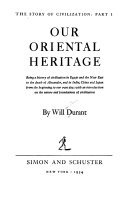
The Story of Civilization, by husband and wife Will and Ariel Durant, is an 11-volume set of books covering Western history for the general reader.
“A great civilization is not conquered from without until it has destroyed itself within.”
Will Durant book The Story of Civilization
Epilogue: "Why Rome Fell", p. 665
The Story of Civilization (1935–1975), III - Caesar and Christ (1944)
Will Durant book The Story of Civilization
Source: The Story of Civilization (1935–1975), III - Caesar and Christ (1944), Chapter 4, Part 6
Will Durant book The Story of Civilization
Source: The Story of Civilization (1935–1975), I - Our Oriental Heritage (1935), Ch. III : The Political Elements of Civilization, p. 21
Context: If the average man had had his way there would probably never have been any state. Even today he resents it, classes death with taxes, and yearns for that government which governs least. If he asks for many laws it is only because he is sure that his neighbor needs them; privately he is an unphilosophical anarchist, and thinks laws in his own case superfluous. In the simplest societies there is hardly any government. Primitive hunters tend to accept regulation only when they join the hunting pack and prepare for action. The Bushmen usually live in solitary families; the Pygmies of Africa and the simplest natives of Australia admit only temporarily of political organization, and then scatter away to their family groups; the Tasmanians had no chiefs, no laws, no regular government; the Veddahs of Ceylon formed small circles according to family relationship, but had no government; the Kubus of Sumatra "live without men in authority" every family governing itself; the Fuegians are seldom more than twelve together; the Tungus associate sparingly in groups of ten tents or so; the Australian "horde" is seldom larger than sixty souls. In such cases association and cooperation are for special purposes, like hunting; they do not rise to any permanent political order.
“The Islamic conquest of India is probably the bloodiest story in history.”
Will Durant book The Story of Civilization
Will Durant, The Story of Civilization: Our Oriental Heritage page 459.
The Story of Civilization (1935–1975), I - Our Oriental Heritage (1935)
Context: The Islamic conquest of India is probably the bloodiest story in history. It is a discouraging tale, for its evident moral is that civilization is a precious good, whose delicate complex of order and freedom, culture and peace, can at any moment be overthrown by barbarians invading from without or multiplying within.
“In the end, nothing is lost. Every event, for good or evil, has effects forever.”
Will Durant book The Story of Civilization
Source: The Story of Civilization
Will Durant book The Story of Civilization
Preface
The Story of Civilization (1935–1975), VI - The Reformation (1957)
Will Durant book The Story of Civilization
Source: The Story of Civilization (1935–1975), VI - The Reformation (1957), p.g. 14
Will Durant book The Story of Civilization
The Story of Civilization (1935–1975), I - Our Oriental Heritage (1935)
Will Durant book The Story of Civilization
Source: The Story of Civilization (1935–1975), III - Caesar and Christ (1944), Chapter 30, part 1, p. 652.
Will Durant book The Story of Civilization
Source: The Story of Civilization (1935–1975), VI - The Reformation (1957), p.g. 8
Will Durant book The Story of Civilization
As quoted in Midnight by Dean Koontz
The Story of Civilization (1935–1975), XI - The Age of Napoleon (1975)
“No man who is in a hurry is quite civilized.”
Will Durant book The Story of Civilization
Source: The Story of Civilization (1935–1975), II - Life of Greece (1939), Ch. XII : Work and Wealth in Athens, p. 277 http://books.google.com/books?id=l2wgAAAAMAAJ&q=%22no+man+who+is+in+a+hurry+is+quite+civilized%22&pg=PA277#v=onepage
Will Durant book The Story of Civilization
Preface
The Story of Civilization (1935–1975), VI - The Reformation (1957)
Context: I feel for all faiths the warm sympathy of one who has come to learn that even the trust in reason is a precarious faith, and that we are all fragments of darkness groping for the sun. I know no more about the ultimates than the simplest urchin in the streets.
Will Durant book The Story of Civilization
Source: The Story of Civilization (1935–1975), VI - The Reformation (1957), Chapter 6, p. 229
Will Durant book The Story of Civilization
Source: The Story of Civilization (1935–1975), III - Caesar and Christ (1944), Chapter 28, Part 5 (Footnote 2)


