
“There are no happy endings in history, only crisis points that pass.”
Isaac Asimov book The Gods Themselves
Section 3, Chapter 19, p. 287
Source: The Gods Themselves (1972)
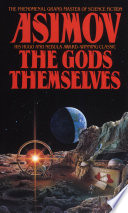
The Gods Themselves is a 1972 science fiction novel written by Isaac Asimov. It won the Nebula Award for Best Novel in 1972, and the Hugo Award for Best Novel in 1973.The book is divided into three main parts, which were first published in Galaxy Magazine and Worlds of If as three consecutive stories.
“There are no happy endings in history, only crisis points that pass.”
Isaac Asimov book The Gods Themselves
Section 3, Chapter 19, p. 287
Source: The Gods Themselves (1972)
“The easiest way to solve a problem is to deny it exists.”
Isaac Asimov book The Gods Themselves
Section 3, Chapter 10, p. 236
The Gods Themselves (1972)
“To Mankind
And the hope that the war against folly may someday be won, after all.”
Isaac Asimov book The Gods Themselves
Dedication, p. 5; this refers to the quotation of Friedrich Schiller from which Asimov derived the title of this novel: "Against stupidity the gods themselves contend in vain."
The Gods Themselves (1972)
“I don’t like anything that’s got to be. I want to know why.”
Isaac Asimov book The Gods Themselves
Section 2, Chapter 2a, p. 93
The Gods Themselves (1972)
Isaac Asimov book The Gods Themselves
Section 2 “...the gods themselves...”, Chapter 1b, p. 82
The Gods Themselves (1972)
Isaac Asimov book The Gods Themselves
Section 1, Chapter 7, p. 56; the book is set in the year 2100.
The Gods Themselves (1972)
“Those creatures from the para-Universe are trying to make themselves understood.”
Isaac Asimov book The Gods Themselves
Section 1 “Against stupidity...”, Chapter 6, p. 12
The Gods Themselves (1972)
Context: "Don't finish, Pete. I've heard it all before. All I have to do is decipher the thinking of a non-human intelligence."
"A better-than-human intelligence. Those creatures from the para-Universe are trying to make themselves understood."
"That may be," sighed Bronowski, "but they're trying to do it through my intelligence, which is better than human I sometimes think, but not much. Sometimes, in the dark of the night, I lie awake and wonder if different intelligences can communicate at all; or, if I've had a particularly bad day, whether the phrase 'different intelligences' has meaning at all."
"It does," said Lamont savagely, his hands clearly bailing into fists within his lab coat pockets. "It means Hallam and me. It means that fool-hero, Dr. Frederick Hallam and me. We're different intelligences because when I talk to him he doesn't understand. His idiot face gets redder and his eyes bulge and his ears block. I'd say his mind stops functioning, but lack the proof of any other state from which it might stop."
Isaac Asimov book The Gods Themselves
Section 3 “...contend in vain?”, Chapter 3 (p. 187)
The Gods Themselves (1972)
Isaac Asimov book The Gods Themselves
The Gods Themselves (1972)
Context: "Don't finish, Pete. I've heard it all before. All I have to do is decipher the thinking of a non-human intelligence."
"A better-than-human intelligence. Those creatures from the para-Universe are trying to make themselves understood."
"That may be," sighed Bronowski, "but they're trying to do it through my intelligence, which is better than human I sometimes think, but not much. Sometimes, in the dark of the night, I lie awake and wonder if different intelligences can communicate at all; or, if I've had a particularly bad day, whether the phrase 'different intelligences' has meaning at all."
"It does," said Lamont savagely, his hands clearly bailing into fists within his lab coat pockets. "It means Hallam and me. It means that fool-hero, Dr. Frederick Hallam and me. We're different intelligences because when I talk to him he doesn't understand. His idiot face gets redder and his eyes bulge and his ears block. I'd say his mind stops functioning, but lack the proof of any other state from which it might stop."
Section 1 “Against stupidity...”, Chapter 6, p. 12


