
“Music's golden tongue
Flatter'd to tears this aged man and poor.”
John Keats The Eve of St. Agnes
Stanza 3
Poems (1820), The Eve of St. Agnes
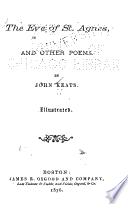
The Eve of St. Agnes is a Romantic narrative poem of 42 Spenserian stanzas set in the Middle Ages. It was written by John Keats in 1819 and published in 1820. The poem was considered by many of Keats' contemporaries and the succeeding Victorians to be one of his finest and was influential in 19th-century literature.The title comes from the day before the feast of Saint Agnes . St. Agnes, the patron saint of virgins, died a martyr in 4th century Rome. The eve falls on 20 January; the feast day on the 21st. The divinations referred to by Keats in this poem are referred to by John Aubrey in his Miscellanies as being associated with St. Agnes' night.
“Music's golden tongue
Flatter'd to tears this aged man and poor.”
John Keats The Eve of St. Agnes
Stanza 3
Poems (1820), The Eve of St. Agnes
“As though a rose should shut and be a bud again.”
John Keats The Eve of St. Agnes
Stanza 27
Poems (1820), The Eve of St. Agnes
“And lucent syrops, tinct with cinnamon.”
John Keats The Eve of St. Agnes
Stanza 30
Poems (1820), The Eve of St. Agnes
“The silver snarling trumpets 'gan to chide.”
John Keats The Eve of St. Agnes
Stanza 4
Poems (1820), The Eve of St. Agnes
“The music, yearning like a God in pain.”
John Keats The Eve of St. Agnes
Stanza 7
Poems (1820), The Eve of St. Agnes
“And they are gone: ay, ages long ago
These lovers fled away into the storm.”
John Keats The Eve of St. Agnes
Stanza 42
Poems (1820), The Eve of St. Agnes
“A poor, weak, palsy-stricken, churchyard thing.”
John Keats The Eve of St. Agnes
Stanza 18
Poems (1820), The Eve of St. Agnes
“He play'd an ancient ditty long since mute,
In Provence call'd "La belle dame sans mercy."”
John Keats The Eve of St. Agnes
Stanza 33
Poems (1820), The Eve of St. Agnes
“And still she slept an azure-lidded sleep,
In blanched linen, smooth, and lavender’d.”
John Keats The Eve of St. Agnes
Stanza 30
Poems (1820), The Eve of St. Agnes


