Quotes from bookThe Discovery of India
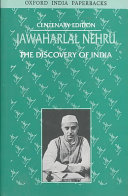
The Discovery of India was written by India's first Prime Minister Pandit Jawaharlal Nehru during his imprisonment in 1942–1946 at Ahmednagar fort in Maharashtra, India by the British during the British Raj before the independence of India. Some claim that The Discovery of India is an honour paid to the rich cultural heritage of India, its history and its philosophy as seen through the eyes of a patriot fighting for the independence of his country. The book was written in 1944 but published in 1946 as per ground sources.

“She is a myth and an idea, a dream and a vision, and yet very real and present and pervasive.”
Jawaharlal Nehru book The Discovery of India
The Discovery of India (1946)
Context: The discovery of India — what have I discovered? It was presumptuous of me to imagine that I could unveil her and find out what she is today and what she was in the long past. Today she is four hundred million separate individual men and women, each differing from the other, each living in a private universe of thought and feeling. If this is so in the present, how much more so to grasp that multitudinous past of innumerable successions of human beings. Yet something has bound them together and binds them still. India is a geographical and economic entity, a cultural unity amidst diversity, a bundle of contradictions held together by strong but invisible threads. Overwhelmed again and again her spirit was never conquered, and today when she appears to be a plaything of a proud conqueror, she remains unsubdued and unconquered. About her there is the elusive quality of a legend of long ago; some enchantment seems to have held her mind. She is a myth and an idea, a dream and a vision, and yet very real and present and pervasive.
Jawaharlal Nehru book The Discovery of India
The Discovery of India (1946)
Context: The world of today has achieved much, but for all its declared love for humanity, it has based itself far more on hatred and violence than on the virtues that make one human. War is the negation of truth and humanity. War may be unavoidable sometimes, but its progeny are terrible to contemplate. Not mere killing, for man must die, but the deliberate and persistent propagation of hatred and falsehood, which gradually become the normal habits of the people. It is dangerous and harmful to be guided in our life's course by hatreds and aversions, for they are wasteful of energy and limit and twist the mind and prevent it from perceiving truth.
“History is almost always written by the victors and conquerors and gives their view.”
Jawaharlal Nehru book The Discovery of India
The Discovery of India (1946), pp. 287-8.
Jawaharlal Nehru book The Discovery of India
The Discovery of India (1946)
Context: The world of today has achieved much, but for all its declared love for humanity, it has based itself far more on hatred and violence than on the virtues that make one human. War is the negation of truth and humanity. War may be unavoidable sometimes, but its progeny are terrible to contemplate. Not mere killing, for man must die, but the deliberate and persistent propagation of hatred and falsehood, which gradually become the normal habits of the people. It is dangerous and harmful to be guided in our life's course by hatreds and aversions, for they are wasteful of energy and limit and twist the mind and prevent it from perceiving truth.
“The discovery of India — what have I discovered?”
Jawaharlal Nehru book The Discovery of India
The Discovery of India (1946)
Context: The discovery of India — what have I discovered? It was presumptuous of me to imagine that I could unveil her and find out what she is today and what she was in the long past. Today she is four hundred million separate individual men and women, each differing from the other, each living in a private universe of thought and feeling. If this is so in the present, how much more so to grasp that multitudinous past of innumerable successions of human beings. Yet something has bound them together and binds them still. India is a geographical and economic entity, a cultural unity amidst diversity, a bundle of contradictions held together by strong but invisible threads. Overwhelmed again and again her spirit was never conquered, and today when she appears to be a plaything of a proud conqueror, she remains unsubdued and unconquered. About her there is the elusive quality of a legend of long ago; some enchantment seems to have held her mind. She is a myth and an idea, a dream and a vision, and yet very real and present and pervasive.


