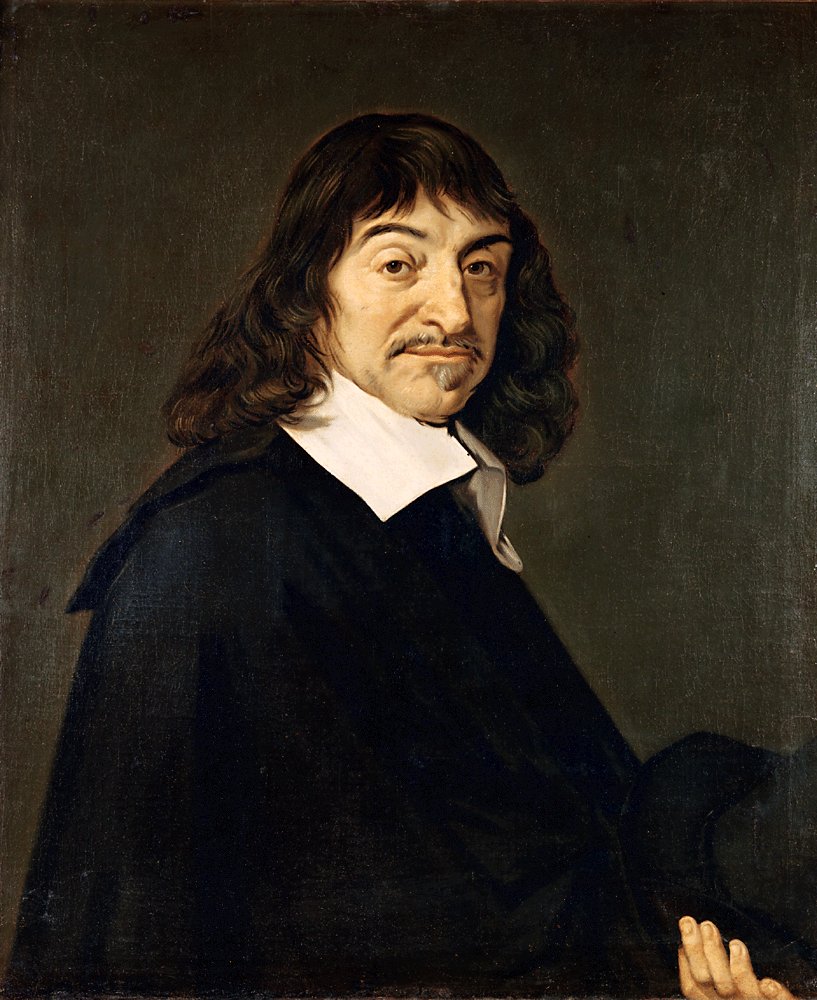
Cogito ergo sum. (łac.)
Zasady filozoficzne
Źródło: 1, 7, 10
Kartezjusz: 81 cytatów19 Polubień
Kartezjusz słynne cytaty
Źródło: Przykazania etyki prawniczej: księga myśli, norm i rycin, oprac. Roman Tokarczyk, wyd. Wolters Kluwer Polska, s. 50.
Kartezjusz cytaty
„Bardzo powinny być nam podejrzane sądy przyjaciół, kiedy padają na naszą korzyść.”
Źródło: Pisma. Antologia literatury francuskiej, wyb. Tadeusz Boy-Żeleński, PIW, s. 134.
De omnibus dubitandum est. (łac.) <br class="br">ulubiona dewiza Karola Marksa. <br class="br">Źródło: Władysław Kopaliński, Słownik wyrazów obcych i zwrotów obcojęzycznych http://www.slownik-online.pl/kopalinski/FD32BED5578B265F412565B80004C46E.php <br class="br">Źródło: Medytacja o pierwszej filozofii (1641)
Zasady filozoficzne
Kartezjusz książka Rozprawa o metodzie
Źródło: Rozprawa o metodzie, tłum. Tadeusz Boy-Żeleński
Kartezjusz: Cytaty po angielsku
“With me, everything turns into mathematics.”
Mais apud me omnia fiunt Mathematicè in Natura More closely translated as: but in my opinion, all things in nature occur mathematically. Note: "Mais" is French for "but" and the "but in my opinion" comes from the context of the original conversation. apud me omnia fiunt Mathematicè in Natura is in latin. Sometimes the Latin version is incorrectly quoted as Omnia apud me mathematica fiunt. Sources: Correspondence with Mersenne http://fr.wikisource.org/wiki/Page%3aDescartes_-_%C5%92uvres,_%C3%A9d._Adam_et_Tannery,_III.djvu/48 note for line 7 (1640), page 36, Die Wiener Zeit http://books.google.com/books?id=9Xh3fVZLCycC&pg=PA532&lpg=PA532&dq=%22Omnia+apud+me+mathematica+fiunt%22+original+zitat&source=bl&ots=CgQOrveRiM&sig=WFHwIK20r5vRZ66FwCaxo857LCU&hl=de&sa=X&ei=_Wf2UcHlJYbfsgaf1IHABg#v=onepage&q=%22Omnia%20apud%20me%20mathematica%20fiunt%22%20original%20zitat&f=false page 532 (2008); StackExchange Math Q/A Where did Descartes write... http://math.stackexchange.com/questions/454599/where-did-descartes-write-with-me-everything-turns-into-mathematics?noredirect=1#comment978229_454599
“I doubt, therefore I think, therefore I am.”
Cogito, ergo sum.
Wariant: Dubito, ergo cogito, ergo sum.
(English: "I doubt, therefore I think, therefore I am")
Letter to Marin Mersenne (end of Feb., 1634) as quoted by Amir Aczel, Pendulum: Leon Foucault and the Triumph of Science (2003)
René Descartes książka La Géométrie
First Book
La Géométrie (1637)
Me tenant comme je suis, un pied dans un pays et l’autre en un autre, je trouve ma condition très heureuse, en ce qu’elle est libre.
Letter to Elisabeth of Bohemia, Princess Palatine (Paris, June/July 1648)
René Descartes książka Rules for the Direction of the Mind
Rules for the Direction of the Mind: IV
Rules for the Direction of the Mind in Key Philosophical Writings (1997), pp. 29-30 http://books.google.com/books?id=jjWPe-9NPoEC&pg=PA29
Letter to Marin Mersenne (1637) as quoted by D. E. Smith & M. L. Latham Tr. The Geometry of René Descartes (1925)
“With me, everything turns into mathematics.
More closely translated as: but in my opinion, all things in nature occur mathematically.”
Mais apud me omnia fiunt Mathematicè in Natura
""Mais"" is French for ""but"" and the ""but in my opinion"" comes from the context of the original conversation. apud me omnia fiunt Mathematicè in Natura is in latin.<br>Sometimes the Latin version is incorrectly quoted as Omnia apud me mathematica fiunt.<br>Sources: Correspondence with Mersenne http://fr.wikisource.org/wiki/Page%3aDescartes_-_%C5%92uvres,_%C3%A9d._Adam_et_Tannery,_III.djvu/48 note for line 7 (1640), page 36, Die Wiener Zeit http://books.google.com/books?id=9Xh3fVZLCycC&pg=PA532&lpg=PA532&dq=%22Omnia+apud+me+mathematica+fiunt%22+original+zitat&source=bl&ots=CgQOrveRiM&sig=WFHwIK20r5vRZ66FwCaxo857LCU&hl=de&sa=X&ei=_Wf2UcHlJYbfsgaf1IHABg#v=onepage&q=%22Omnia%20apud%20me%20mathematica%20fiunt%22%20original%20zitat&f=false page 532 (2008); StackExchange Math Q/A Where did Descartes write... http://math.stackexchange.com/questions/454599/where-did-descartes-write-with-me-everything-turns-into-mathematics?noredirect=1#comment978229_454599
René Descartes książka La Géométrie
Second Book
La Géométrie (1637)
Letter to Marin Mersenne (July 27, 1638) as quoted by Florian Cajori, A History of Mathematics (1893) letter dated in The Philosophical Writings of Descartes Vol. 3, The Correspondence (1991) ed. John Cottingham, Robert Stoothoff, Dugald Murdoch


