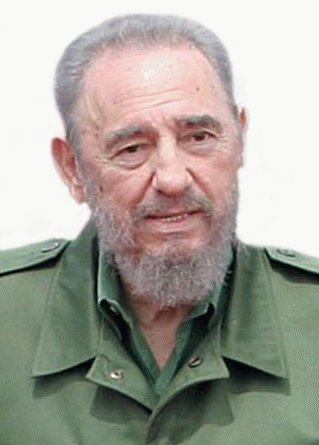
krytykując prezydenta Mahmuda Ahmadineżada za politykę wobec Izraela.
Fidel Castro: 117 cytatów5 Polubień
Fidel Castro słynne cytaty
„Ci, którzy nie wyrzekną się nawyku picia rumu, będą musieli drogo płacić za ten napój.”
Źródło: PAP, 6 grudnia 2002
Źródło: Historia mnie uniewinni, 1953
Fidel Castro Cytaty o czasie
Autorka: Yoani Sánchez
Źródło: Alessandro Scotti, Blogerka z Hawany, „Courrier International”, tłum. „Forum”, 23 sierpnia 2010.
wypowiedziane w czasie wizyty w stolicy południowo-wschodniej prowincji Kuby, 26 maja 2002.
wypowiedziane w czasie wizyty w stolicy południowo-wschodniej prowincji Kuby, 26 maja 2002.
Autorka: Yoani Sánchez
o powrocie Fidela Castro do życia publicznego po czterech latach nieobecności.
Źródło: Alessandro Scotti, Blogerka z Hawany, „Courrier International”, tłum. „Forum”, 23 sierpnia 2010.
Źródło: serwis www.yahoo.com, 18 lipca 2005
w czasie demonstracji w Hawanie, 30 czerwca 2004.
Fidel Castro Cytaty o śmierci
Autorzy: Jean-François Fogel, Bertrand Rosentahal, Fin de Siglo en La Habana, TM Editores, Madryt 1995.
podsumowanie działalności Kennedy’ego zaraz po jego śmierci.
Fidel Castro cytaty
Źródło: Artur Domosławski, Gorączka latynoamerykańska, op. cit., s. 23.
wspominając wychowanie odebrane w katolickiej szkole.
Źródło: Artur Domosławski, Gorączka latynoamerykańska, op. cit., s. 22.
odpowiadając na oskarżenia, że ma zagraniczne konta, a na nich 900 mln dolarów.
Źródło: O rewolucji kubańskiej. Wybór przemówień
do Natalii Fernández, swojej kochanki
Źródło: Erich Schaake, Kobiety dyktatorów, tłum. Roman Niedballa, wyd. Videograf II, Katowice 2004, s. 145.
Autorka: Ewita Spieglanin, Fidel – życie po życiu http://www.krytykapolityczna.pl/artykuly/ameryka-lacinska/20161203/fidel-zycie-po-zyciu, krytykapolityczna.pl, 3 grudnia 2016.
Autorka: Ewita Spieglanin, Fidel – życie po życiu http://www.krytykapolityczna.pl/artykuly/ameryka-lacinska/20161203/fidel-zycie-po-zyciu, krytykapolityczna.pl, 3 grudnia 2016.
La historia me absolverá. (hiszp.)
z przemówienia w sądzie we własnej obronie w procesie ataku na koszary Moncada, 1953.
Źródło: Historia mnie uniewinni
„Model kubański nie działa już nawet dla nas.”
zaraz po publikacji wywiadu, Castro oświadczył, że został źle zrozumiany: wprost.pl, 10 września 2010 http://www.wprost.pl/ar/208986/Castro-zle-mnie-zrozumiano/ <br class="br">Źródło: PAP, 9 września 2010 http://www.pap.pl/palio/html.run?_Instance=cms_www.pap.pl&_PageID=1&s=depesza&dz=swiat&dep=24453&data=depeszadepesza&_CheckSum=-701969527
przemówienie pierwszomajowe wygłoszone na placu Rewolucji w Hawanie 1 maja 2004.
Źródło: Green Left Weekly, 28 lutego 2005
„Słońca nie można zakryć palcem.”
latem 1968, decydując się na pojednanie z Moskwą i kończąc 10-letni okres tzw. „herezji kubańskiej”.
Źródło: Artur Domosławski, Gorączka latynoamerykańska, op. cit., s. 32.
Źródło: film dokumentalny Comandante, 21 lutego 2003
„Nie mogą być prowokatorami ludzie pragnący doczekać się ziszczenia swoich marzeń.”
Źródło: O rewolucji kubańskiej. Wybór przemówień
Źródło: Artur Domosławski, Gorączka latynoamerykańska, op. cit., s. 32–33.
„Wyobrażam sobie Kubę jako wielką moralną potęgę. Z bardzo wielką godnością.”
Źródło: program telewizyjny Diego Maradony
Źródło: w przemówieniu na uniwersytecie w Hawanie.
„Socjalizm pozostanie jedyną nadzieją na pokój i przetrwanie naszego gatunku.”
Źródło: BBC News, 6 grudnia 2004
„USA zaczną z nami rozmawiać, gdy ich prezydentem będzie Murzyn, a papieżem Latynos.”
do dziennikarzy w 1973.
Źródło: Zabójcze puenty, „Forum” nr 16, 7–20 sierpnia 2015, s. 82.
w 1963, kpiąc z radzieckich komunistów.
Źródło: Artur Domosławski, Gorączka latynoamerykańska, wyd. Świat Książki, Warszawa 2010, s. 30.
Fidel Castro: Cytaty po angielsku
University of Havana address (2005)
Kontekst: Man is born egotistical, a result of the conditioning of nature. Nature fills us with instincts; it is education that fills us with virtues. Nature makes us do things instinctively; one of these is the instinct for survival which can lead to infamy, while on the other side, our conscience can lead us to great acts of heroism. It doesn’t matter what each one of us is like, how different we are from each other, but when we unite we become one.
It is amazing that in spite of the differences between human beings, they can become as one in a single instant or they can be millions, and they can be a million strong just through their ideas. Nobody followed the Revolution as a cult to anyone or because they felt personal sympathy with any one person. It is only by embracing certain values and ideas that an entire people can develop the same willingness to make sacrifices of any one of those who loyally and sincerely try to lead them toward their destiny.
University of Havana address (2005)
Kontekst: Here is a conclusion I’ve come to after many years: among all the errors we may have committed, the greatest of them all was that we believed that someone really knew something about socialism, or that someone actually knew how to build socialism. It seemed to be a sure fact, as well-known as the electrical system conceived by those who thought they were experts in electrical systems. Whenever they said: “That’s the formula”, we thought they knew. Just as if someone is a physician. You are not going to debate anemia, or intestinal problems, or any other condition with a physician; nobody argues with the physician. You can think that he is a good doctor or a bad one, you can follow his advice or not, but you won’t argue with him. Which of us would argue with a doctor, or a mathematician, or a historian, or an expert in literature or in any other subject? But we must be idiots if we think, for example, that economy is an exact and eternal science and that it existed since the days of Adam and Eve, and I offer my apologies to the thousands of economists in our country.
“After a week, I decided religion wasn't for me.”
As quoted in The Atheist's Bible (2007) edited by Joan Konner, p. 62
Kontekst: When I was a young boy, my father taught me that to be a good Catholic, I had to confess at church if I ever had impure thoughts about a girl. That very evening, I had to rush to confess my sin. And the next night, and the next. After a week, I decided religion wasn't for me.
University of Havana address (2005)
Kontekst: I would dare say that today this species is facing a very real and true danger of extinction, and no one can be sure, listen to this well, no one can be sure that it will survive this danger.
Well, the fact that the species would not survive was discussed about 2,000 years ago. I remember that when I was a student I heard of the Apocalypse, a book of prophesy in the Bible. Apparently, 2000 years ago someone realized that this weak species could one day disappear.
“I feel my belief in sacrifice and struggle getting stronger.”
Letter from prison (19 December 1953)
Kontekst: I feel my belief in sacrifice and struggle getting stronger. I despise the kind of existence that clings to the miserly trifles of comfort and self-interest. I think that a man should not live beyond the age when he begins to deteriorate, when the flame that lighted the brightest moment of his life has weakened.
Fidel Castro Reader, pp. 238
Words to Intellectuals (1961)
“Capitalism—and I say it with such gusto—capitalism is so obsolete that it is dying by itself.”
Comments on Latin American Debt (15 September 1985) http://info.lanic.utexas.edu/la/cb/cuba/castro/1985/19850915 <br class="br">Kontekst: Let us yield a bit. Let us grant socialism a few more years. Socialism is so obsolete, it is dying by itself.… Did I say socialism? I assure you on my honor this was not a mental slip. This was a slip of the tongue. Do not forget that. Capitalism—and I say it with such gusto—capitalism is so obsolete that it is dying by itself.
“Revolution is the sense of the historical moment; it is changing everything that must be changed”
As quoted in Speech by Dr. Fidel Castro Ruz, President of the Republic of Cuba, at the mass rally called by the Cuban youths, students and workers on the occasion of the International Labor Day at the Revolution Square http://www.fidelcastro.cu/en/discursos/speech-mass-rally-called-cuban-youths-students-and-workers-revolution-square-occasion (May 1, 2000) <br class="br">Kontekst: Revolution is the sense of the historical moment; it is changing everything that must be changed; it is full equality and freedom; it is being treated and treating others like human beings; it is emancipating ourselves, by ourselves and with our very own efforts; it is challenging the dominant powerful forces within and outside of the social and national arena; it is defending the values one believes in at the cost of any sacrifice; it is modesty, selflessness, altruism, solidarity and heroism; it is fighting with audacity, intelligence and realism; it is never telling a lie or violating ethical principles; it is the profound conviction that there is no force on earth that can crush truth and ideas. Revolution is unity, it is independence, it is fighting for our dreams of justice for Cuba and the world that is the basis of our patriotism, our socialism and our internationalism.
University of Havana address (2005)
Kontekst: Man is born egotistical, a result of the conditioning of nature. Nature fills us with instincts; it is education that fills us with virtues. Nature makes us do things instinctively; one of these is the instinct for survival which can lead to infamy, while on the other side, our conscience can lead us to great acts of heroism. It doesn’t matter what each one of us is like, how different we are from each other, but when we unite we become one.
It is amazing that in spite of the differences between human beings, they can become as one in a single instant or they can be millions, and they can be a million strong just through their ideas. Nobody followed the Revolution as a cult to anyone or because they felt personal sympathy with any one person. It is only by embracing certain values and ideas that an entire people can develop the same willingness to make sacrifices of any one of those who loyally and sincerely try to lead them toward their destiny.
University of Havana address (2005)
Kontekst: All sense of dialectics is lost when someone believes that today’s economy is identical to the economy 50 or 100 or 150 years ago, or that it is identical to the one in Lenin’s day or to the time when Karl Marx lived. Revisionism is a thousand miles away from my mind and I truly revere Marx, Engels and Lenin.
“The important thing is the revolution!”
Speech at the memorial service http://www.cuba.cu/gobierno/discursos/1967/esp/f181067e.html of Che Guevara (8 October 1967) <br class="br">Kontekst: Warfare is a means and not an end. Warfare is a tool of revolutionaries. The important thing is the revolution! The important thing is the revolutionary cause, revolutionary ideas, revolutionary objectives, revolutionary sentiments, revolutionary virtues!
Speech on the second anniversary of the triumph of the revolution (2 January 1961) http://www.cuba.cu/gobierno/discursos/1961/esp/f020161e.html
Speech at the International Conference on Financing for Development (March 2002) http://www.cuba.cu/gobierno/discursos/2002/ing/f210302i.html
The Second Declaration of Havana (1962)
Original Spanish: "Compañeros obreros y campesinos, esta es la Revolución socialista y democrática de los humildes, con los humildes y para los humildes. Y por esta Revolución de los humildes, por los humildes y para los humildes estamos dispuestos a dar la vida."
On 16 April 1961, in a funeral oration in Vedado for victims of the air raids the day before, Fidel Castro referring to the January 1959 Cuban Revolution. Quoted in José Ramón Fernández. 2001. Playa Giron/Bay of Pigs: Washington's First Military Defeat in the Americas, p. 56
The Second Declaration of Havana (1962)
Words to Intellectuals (1961)
On Behalf of the Movement of Nonaligned Countries (1979)
Speech after Raul was re-elected as head of the Communist party http://www.cbsnews.com/news/fidel-castro-gives-speech-saying-hes-nearing-the-end-of-his-life/
“I am a Marxist-Leninist, and I will be a Marxist-Leninist until the last days of my life.”
Speech on the anniversary of the Granma landing (2 December 1961) <br class="br">Variant translation: I am a Marxist-Leninist and will be one until the day I die. <br class="br">As quoted in "Chavez Would Abolish Presidential Term Limit" in The Washington Post (11 January 2007) http://www.washingtonpost.com/wp-dyn/content/article/2007/01/10/AR2007011000468.html
“Condemn me, it does not matter: history will absolve me.”
History Will Absolve Me (1954) http://www.marxists.org/history/cuba/archive/castro/1953/10/16.htm, a summary of arguments Castro made in the trial of the Moncada Barracks attack
Speech at the Conference on Foreign Debt in Latin America and the Caribbean (3 August 1985) http://www.cuba.cu/gobierno/discursos/1985/esp/f030885e.html
Words to Intellectuals (1961)
Speech in Havana (8 January 1959) http://www.cuba.cu/gobierno/discursos/1959/esp/f080159e.html
19 April 1971 in Havana, according to 20 April 1971 New York Times article https://www.nytimes.com/1971/04/20/archives/castro-rejects-new-ties-to-us-premier-in-havana-speech-also.html
Words to Intellectuals (1961)
On Behalf of the Movement of Nonaligned Countries (1979)


