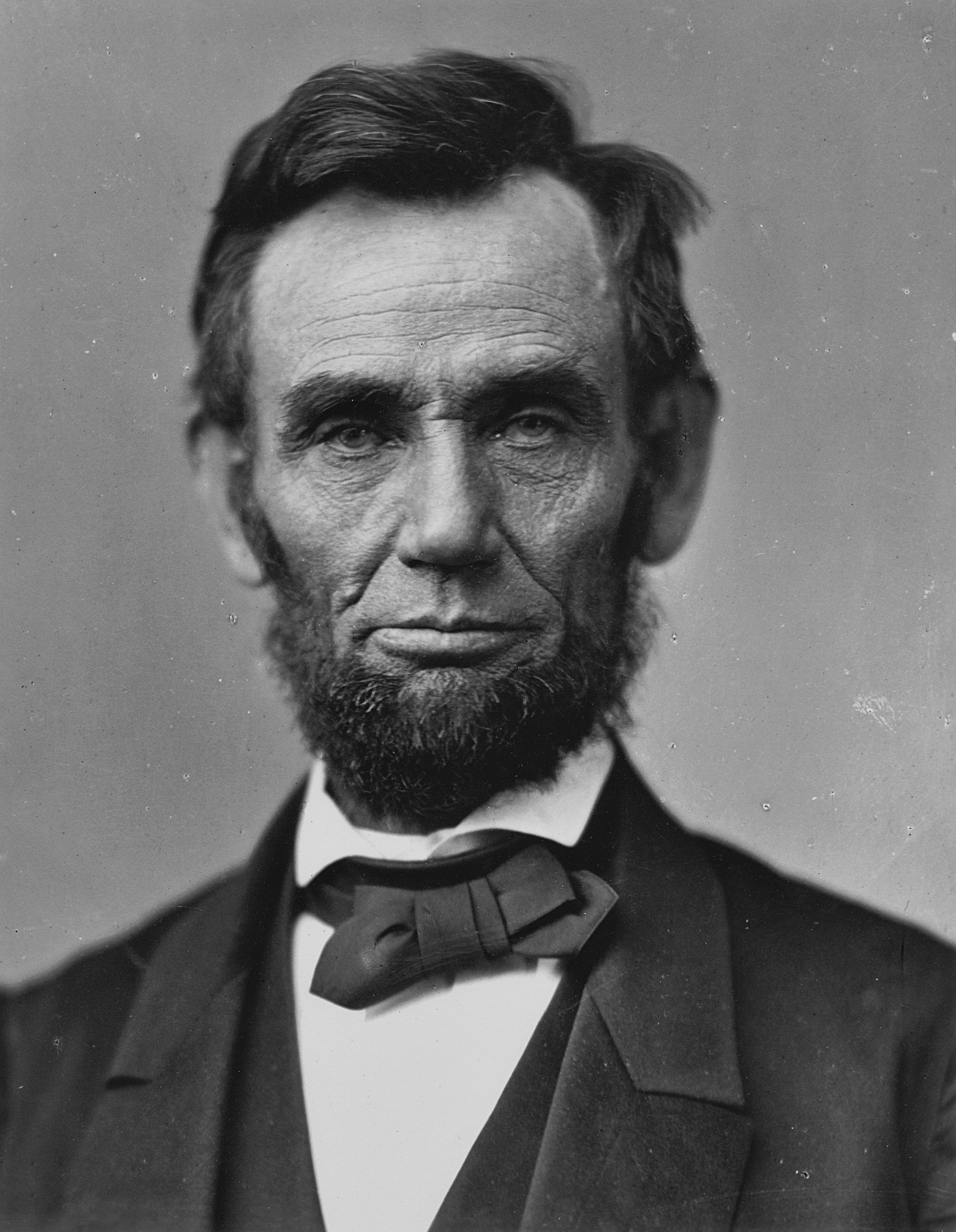
Abraham Lincoln citations célèbres
I will say, then, that I am not nor have ever been in favor of bringing about in any way the social and political equality of the black and white races, that I am not, nor ever have been, in favor of making voters or jurors of negroes, nor of qualifying them to hold office, nor to intermarry with White people; and I will say in addition to this that there is a physical difference between the White and black races which will ever forbid the two races living together on terms of social and political equality. And inasmuch as they cannot so live, while they do remain together, there must be the position of
Speeches and Writings, 1832-1858
IT IS RATHER FOR US TO BE HERE DEDICATED TO THE GREAT TASK REMAINING BEFORE US~THAT FROM THESE HONORED DEAD WE TAKE INCREASED DEVOTION TO THAT CAUSE FOR WHICH THEY GAVE THE LAST FULL MEASURE OF DEVOTION~THAT WE HERE HIGHLY RESOLVE THAT THESE DEAD SHALL NOT HAVE DIED IN VAIN~THAT THIS NATION UNDER GOD SHALL HAVE A NEW BIRTH OF FREEDOM~AND THAT GOVERNMENT OF THE PEOPLE BY THE PEOPLE FOR THE PEOPLE SHALL NOT PERISH FROM THE EARTH •
en
Adresse de Gettysburg : gouvernement du peuple, par le peuple, pour le peuple, 1863
Abraham Lincoln: Citations en anglais
1860s, Fourth of July Address to Congress (1861)
1860s, Speech at Hartford (1860)
1860s, Fourth of July Address to Congress (1861)
At the end of the Civil War, asking that a military band play "Dixie" (10 April 1865) as quoted in Dan Emmett and the Rise of Early Negro Minstrelsy (1962) by Hans Nathan. Variant account: "I have always thought "Dixie" one of the best tunes I have ever heard. Our adversaries over the way attempted to appropriate it, but I insisted yesterday that we fairly captured it... I now request the band to favor me with its performance".
1860s
1860s, Speeches to Ohio Regiments (1864), Speech to One Hundred Forty-eighth Ohio Regiment (1864)
Its direct consequences are, comparatively speaking, but a small evil, and much of its danger consists in the proneness of our minds to regard its direct as its only consequences.
1830s, The Lyceum Address (1838)
“Without slavery the rebellion could never have existed; without slavery it could not continue.”
1860s, Second State of the Union address (1862)
1850s, Speech at Peoria, Illinois (1854)
1860s, Letter to James C. Conkling (1863)
1850s, Address before the Wisconsin State Agricultural Society (1859)
1860s, Second State of the Union address (1862)
1860s, Speech at Hartford (1860)
Speech to Illinois legislature (January 1837); This is "Lincoln's First Reported Speech", found in the Sangamo Journal (28 January 1837) according to McClure's Magazine (March 1896); also in Lincoln's Complete Works (1905) ed. by Nicolay and Hay, Vol. 1, p. 24
1830s
1830s, The Lyceum Address (1838)
1860s, "If Slavery Is Not Wrong, Nothing Is Wrong" (1864)
When asked if he was an abolitionist (1837) https://books.google.com/books?id=oERgfRqL2vUC&pg=PA124&dq=mighty <br class="br">1830s
Attributed at an unspecified date when Lincoln was a young lawyer, apparently first reported in the Prairie Farmer (March 13, 1886), Volume 58, p. 176. The quote, taken as a whole, has been explained to mean that Lincoln was giving a negative character reference, implying that the subject of that reference was not financially stable, and prone to let details slip.
Posthumous attributions
I do not believe any compromise, embracing the maintenance of the Union, is now possible. All I learn, leads to a directly opposite belief. The strength of the rebellion, is its military — its army. That army dominates all the country, and all the people, within its range. Any offer of terms made by any man or men within that range, in opposition to that army, is simply nothing for the present; because such man or men, have no power whatever to enforce their side of a compromise, if one were made with them.
1860s, Letter to James C. Conkling (1863)
1860s, Letter to Horace Greeley (1862)
They knew that this Government desired to keep the garrison in the fort, not to assail them, but merely to maintain visible possession, and thus to preserve the Union from actual and immediate dissolution, trusting, as hereinbefore stated, to time, discussion, and the ballot box for final adjustment; and they assailed and reduced the fort for precisely the reverse object — to drive out the visible authority of the Federal Union, and thus force it to immediate dissolution. That this was their object the Executive well understood; and having said to them in the inaugural address, "You can have no conflict without being yourselves the aggressors," he took pains not only to keep this declaration good, but also to keep the case so free from the power of ingenious sophistry as that the world should not be able to misunderstand it. By the affair at Fort Sumter, with its surrounding circumstances, that point was reached. Then and thereby the assailants of the Government began the conflict of arms, without a gun in sight or in expectancy to return their fire, save only the few in the fort, sent to that harbor years before for their own protection, and still ready to give that protection in whatever was lawful. In this act, discarding all else, they have forced upon the country the distinct issue, "Immediate dissolution or blood."
1860s, Fourth of July Address to Congress (1861)
“A house divided against itself cannot stand.”
I believe this government cannot endure, permanently half slave and half free. I do not expect the Union to be dissolved — I do not expect the house to fall — but I do expect it will cease to be divided. It will become all one thing or all the other.
In this famous statement, Lincoln is quoting the response of Jesus Christ to those who accused him of being able to cast out devils because he was empowered by the Prince of devils, recorded in Matthew 12:25: "And Jesus knew their thoughts, and said unto them, Every kingdom divided against itself is brought to desolation; and every city or house divided against itself shall not stand".
1850s, The House Divided speech (1858)
Let those materials be moulded into general intelligence, sound morality, and in particular, a reverence for the constitution and laws: and, that we improved to the last; that we remained free to the last; that we revered his name to the last; that, during his long sleep, we permitted no hostile foot to pass over or desecrate his resting place; shall be that which to learn the last trump shall awaken our WASHINGTON.
Upon these let the proud fabric of freedom rest, as the rock of its basis; and as truly as has been said of the only greater institution, "the gates of hell shall not prevail against it".
1830s, The Lyceum Address (1838)
Having ever regarded Government as their deadliest bane, they make a jubilee of the suspension of its operations; and pray for nothing so much, as its total annihilation. While, on the other hand, good men, men who love tranquillity, who desire to abide by the laws and enjoy their benefits, who would gladly spill their blood in the defense of their country, seeing their property destroyed, their families insulted, and their lives endangered, their persons injured, and seeing nothing in prospect that forebodes a change for the better, become tired of and disgusted with a government that offers them no protection, and are not much averse to a change in which they imagine they have nothing to lose. Thus, then, by the operation of this mobocratic spirit which all must admit is now abroad in the land, the strongest bulwark of any government, and particularly of those constituted like ours, may effectually be broken down and destroyed — I mean the attachment of the people.
1830s, The Lyceum Address (1838)
Letter to Mrs. Orville H. Browning (1 April 1838) http://quod.lib.umich.edu/l/lincoln/lincoln1/1:134?rgn=div1;view=fulltext, Collected Works, vol. 1. p. 119 <br class="br">1830s
1850s, Speech at Chicago (1858)
“More rogues than honest men find shelter under habeas corpus”
1820s Gold treasure United States, 1860s
1860s, Speech at Hartford (1860)


