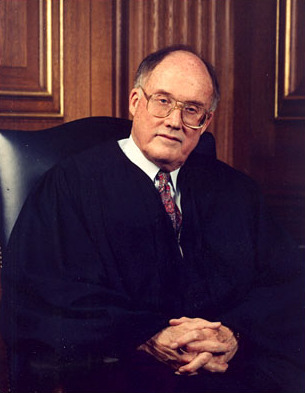
William H. Rehnquist Quotes

William Hubbs Rehnquist was an American jurist and lawyer who served on the Supreme Court of the United States for 33 years, first as an Associate Justice from 1972 to 1986 and then as the 16th Chief Justice from 1986 until his death in 2005. Considered a conservative, Rehnquist favored a conception of federalism that emphasized the Tenth Amendment's reservation of powers to the states. Under this view of federalism, the court, for the first time since the 1930s, struck down an act of Congress as exceeding its power under the Commerce Clause.

Rehnquist grew up in Milwaukee, Wisconsin, and served in the U.S. Army Air Forces during the final years of World War II. After the war's end in 1945, Rehnquist studied political science at Stanford University and Harvard University, then earned a law degree from the Stanford Law School. He clerked for Associate Justice Robert H. Jackson during the Supreme Court's 1952–1953 term, then entered private practice in Phoenix, Arizona. He served as a legal adviser for Republican presidential nominee Barry Goldwater in the 1964 election, and in 1969 President Richard Nixon appointed Rehnquist as Assistant Attorney General of the Office of Legal Counsel. In 1971, Nixon nominated Rehnquist to succeed Associate Justice John Marshall Harlan II, and Rehnquist won Senate confirmation that same year. Rehnquist quickly established himself as the most conservative member of the Burger Court. In 1986, President Ronald Reagan nominated Rehnquist to succeed retiring Chief Justice Warren Burger, and Rehnquist again won Senate confirmation.

Rehnquist served as Chief Justice for nearly 19 years, making him the fourth-longest-serving Chief Justice, and the eighth-longest-serving Justice. He became an intellectual and social leader of the Rehnquist Court, earning respect even from the Justices who frequently opposed his opinions. Though he remained a member of the conservative wing of the court, Associate Justices Antonin Scalia and Clarence Thomas were often regarded as more conservative. As Chief Justice, Rehnquist presided over the impeachment trial of President Bill Clinton.

Rehnquist wrote the majority opinions in United States v. Lopez and United States v. Morrison , holding in both cases that Congress had exceeded its power under the Commerce Clause. He opposed the court's Roe v. Wade decision and continued to argue that Roe had been incorrectly decided in Planned Parenthood v. Casey . In Bush v. Gore , he voted with the court's majority to end the Florida recount. Wikipedia  

✵ 1. October 1924 – 3. September 2005
William H. Rehnquist photo
William H. Rehnquist: 32 quotes0 likes

Famous William H. Rehnquist Quotes

“Actually, the Swedish genealogists were so good that I found out more than I wanted to about my Swedish ancestors: one of them in the 17th century was executed for having embezzled funds from an estate for which he was the steward.”

William H. Rehnquist

Address http://www.supremecourtus.gov/publicinfo/speeches/sp_04-09-01.html at a Swedish Colonial Society luncheon in Philadelphia (9 April 2001). <br class="br">Books, articles, and speeches

“The considered professional judgment of the Air Force is that the traditional outfitting of personnel in standardized uniforms encourages the subordination of personal preferences and identities in favor of the overall group mission.”

William H. Rehnquist

Goldman v. Weinberger, 475 U.S. 503 (1986) (majority opinion); the ruling upheld the military's prohibition of a Jewish officer from wearing a yarmulke indoors while in uniform.
Judicial opinions

“Somewhere "out there," beyond the walls of the courthouse, run currents and tides of public opinion which lap at the courtroom door.”

William H. Rehnquist

Address at Suffolk University Law School; quoted in The New York Times (17 April 1986).
Books, articles, and speeches

“I want to put to rest the speculation and unfounded rumors of my imminent retirement… I am not about to announce my retirement. I will continue to perform my duties as chief justice as long as my health permits.”

William H. Rehnquist

Written statement reacting to speculation that he might retire from the US Supreme Court after Sandra Day O'Connor declared that she would. (July 2005).
Books, articles, and speeches

“If you could say of any one individual that the court as an institution is the length and shadow of that individual, surely it would be John Marshall.”

William H. Rehnquist

Booknotes http://www.booknotes.org/Transcript/index_print.asp?ProgramID=1107 television interview (July 5, 1992)

William H. Rehnquist Quotes about thinking

“Well, I think it's a very good job. One of the most appealing things about it is that… it enables you to participate in some way and to some extent in the way the country is governed but you're able to maintain a private life as well.”

William H. Rehnquist

As quoted in BBC article http://news.bbc.co.uk/1/hi/world/americas/4212570.stm on his death. (4 September 2005). <br class="br">Books, articles, and speeches

“I've often started off with a lawyer joke, a complete caricature of a lawyer who's been nasty, greedy, and unethical. But I've stopped that practice. I gradually realized that the lawyers in the audience didn't think the jokes were funny and the non-lawyers didn't know they were jokes.”

William H. Rehnquist

1997 speech at University of Virginia Law School, as quoted in Marc Galanter, Lowering the Bar: Lawyer Jokes and Legal Culture (2006), p. 3.
Books, articles, and speeches

William H. Rehnquist Quotes

“An oft-heard description of the Supreme Court is that it is the ultimate protector in our society of the liberties of the individual. This phrase describes an important role of the Supreme Court, but by ignoring other equally important functions of the Court, it has a potential for mischief.”

William H. Rehnquist

The Supreme Court: How it Was, How it Is (1987).
Books, articles, and speeches
Context: An oft-heard description of the Supreme Court is that it is the ultimate protector in our society of the liberties of the individual. This phrase describes an important role of the Supreme Court, but by ignoring other equally important functions of the Court, it has a potential for mischief. It is a fairly short leap from this language to a feeling that the US Constitution is somehow "vindicated" every time a claim of individual right against government is upheld, and is not vindicated whenever such a claim is not upheld. But this, of course, cannot be the case. The role of the Supreme Court is to uphold those claims of individual liberty that it finds are well-founded in the Constitution, and to reject other claims against the government that it concludes are not well-founded. Its role is no more to exclusively uphold the claims of the individual than it is to exclusively uphold the claims of the government: It must hold the constitutional balance true between these claims.

“It is about time the Court faced the fact that the white people in the South don't like the colored people;”

William H. Rehnquist

Memo written to , as cited in &quot;The Partisan&quot; http://www.nytimes.com/1985/03/03/magazine/the-partisan.html, in the New York Times, March 3, 1985 <br class="br">Judicial opinions <br class="br">Context: It is about time the Court faced the fact that the white people in the South don&#x27;t like the colored people; the Constitution restrains them from effecting this dislike through state action, but it most assuredly did not appoint the Court as a sociological watchdog to rear up every time private discrimination raises its admittedly ugly head. To the extent that this decision advances the frontier of state action and &#x27;social gain,&#x27; it pushes back the frontier of freedom of association and majority rule.

“This result [… ] will daily stand as a veritable sword of Damocles over every succeeding president and his advisers.”

William H. Rehnquist

Nixon v. Administrator of General Services, 433 U.S. 425 (1977) (dissent); the court ruled 7&ndash;2 that Congress could seize Richard Nixon’s presidential papers.
Judicial opinions

“The role of the Supreme Court is to uphold those claims of individual liberty that it finds are well-founded in the Constitution, and to reject other claims against the government that it concludes are not well-founded. Its role is no more to exclusively uphold the claims of the individual than it is to exclusively uphold the claims of the government: It must hold the constitutional balance true between these claims.”

William H. Rehnquist

The Supreme Court: How it Was, How it Is (1987).
Books, articles, and speeches
Context: An oft-heard description of the Supreme Court is that it is the ultimate protector in our society of the liberties of the individual. This phrase describes an important role of the Supreme Court, but by ignoring other equally important functions of the Court, it has a potential for mischief. It is a fairly short leap from this language to a feeling that the US Constitution is somehow "vindicated" every time a claim of individual right against government is upheld, and is not vindicated whenever such a claim is not upheld. But this, of course, cannot be the case. The role of the Supreme Court is to uphold those claims of individual liberty that it finds are well-founded in the Constitution, and to reject other claims against the government that it concludes are not well-founded. Its role is no more to exclusively uphold the claims of the individual than it is to exclusively uphold the claims of the government: It must hold the constitutional balance true between these claims.

“It is, I believe, impossible to justify the sacrifice of even a portion of our historic individual freedom for a purpose such as [giving blacks, Latinos and Jews the right to be served in local motels, hotels and restaurants].”

William H. Rehnquist

Letter to the Phoenix, Arizona city council, as cited in The Rehnquist Court : Bill Rehnquist Was Once Considered An Extremist. Now His Views Almost Always Become The Law Of The Land. http://articles.latimes.com/1991-09-29/magazine/tm-4832_1_rehnquist-court/4, by David G. Savage, in the LA Times, September 29 1991

“A public library does not acquire Internet terminals in order to create a public forum for Web publishers to express themselves, any more than it collects books in order to provide a public forum for the authors of books to speak.”

William H. Rehnquist

United States v. American Library Association, 539 U.S. 194 (2003) (plurality opinion); the case concerned whether Congress could require libraries receiving Federal subsidies for Internet connectivity to install filtering software.
Judicial opinions

“No amount of repetition of historical errors in judicial opinions can make the errors true. The "wall of separation between church and State" is a metaphor based on bad history, a metaphor which has proved useless as a guide to judging. It should be frankly and explicitly abandoned.”

William H. Rehnquist

Wallace v. Jaffree, 472 U.S. 38 (1985) ( dissenting opinion http://straylight.law.cornell.edu/supct/html/historics/USSC_CR_0472_0038_ZD2.html). <br class="br">Judicial opinions

“A judge who is a 'strict constructionist' in constitutional matters will generally not be favorably inclined toward claims of either criminal defendants or civil rights plaintiffs—the latter two groups having been the principal beneficiaries of the Supreme Court's 'broad constructionist' reading of the Constitution.”

William H. Rehnquist

As quoted in The Rehnquist Choice: The Untold Story of the Nixon Appointment That Redefined the Supreme Court (2001) by John Dean; quoted in an article http://slate.msn.com/id/117140/ at Slate. <br class="br">Books, articles, and speeches

“The Constitution requires that Congress treat similarly situated persons similarly, not that it engage in gestures of superficial equality.”

William H. Rehnquist

Rostker v. Goldberg, 453 U.S. 57 at 80 (1981) (majority opinion); this ruling upheld a military draft for males only.
Judicial opinions

“The Supreme Court is an institution far more dominated by centrifugal forces, pushing toward individuality and independence, than it is by centripetal forces pulling for hierarchical ordering and institutional unity.”

William H. Rehnquist

Address at the University of Minnesota Law School; quoted in The New York Times (20 October 1984).
Books, articles, and speeches

“Well, it's just a sense of personal satisfaction. Just like taking a good photograph or painting a picture or playing a good golf game or something, it's the thing in itself that justifies it.”

William H. Rehnquist

On writing. <br class="br"> Booknotes http://www.booknotes.org/Transcript/index_print.asp?ProgramID=1107 television interview (July 5, 1992)

“Pregnancy is of course confined to women, but it is in other ways significantly different from the typical covered disease or disability.”

William H. Rehnquist

General Electric Co. v. Gilbert, 429 U.S. 125 (1976) (majority opinion); the ruling allowed GE's employee disability insurance plan to exclude conditions arising from pregnancy.
Judicial opinions

Similar authors

John F. Kennedy photo
John F. Kennedy469
35th president of the United States of America None
Donald J. Trump photo
Donald J. Trump904
45th President of the United States of America None
Franklin D. Roosevelt photo
Franklin D. Roosevelt190
32nd President of the United States None
George S. Patton photo
George S. Patton77
United States Army general None
Ben Carson photo
Ben Carson191
17th and current United States Secretary of Housing and Urb… None
Eleanor Roosevelt photo
Eleanor Roosevelt148
American politician, diplomat, and activist, and First Lady… None
Amartya Sen photo
Amartya Sen31
Indian economist None
Dwight D. Eisenhower photo
Dwight D. Eisenhower173
American general and politician, 34th president of the Unit… None
Arthur Miller photo
Arthur Miller147
playwright from the United States None
Augusto Pinochet photo
Augusto Pinochet28
Former dictator of the republic of Chile None