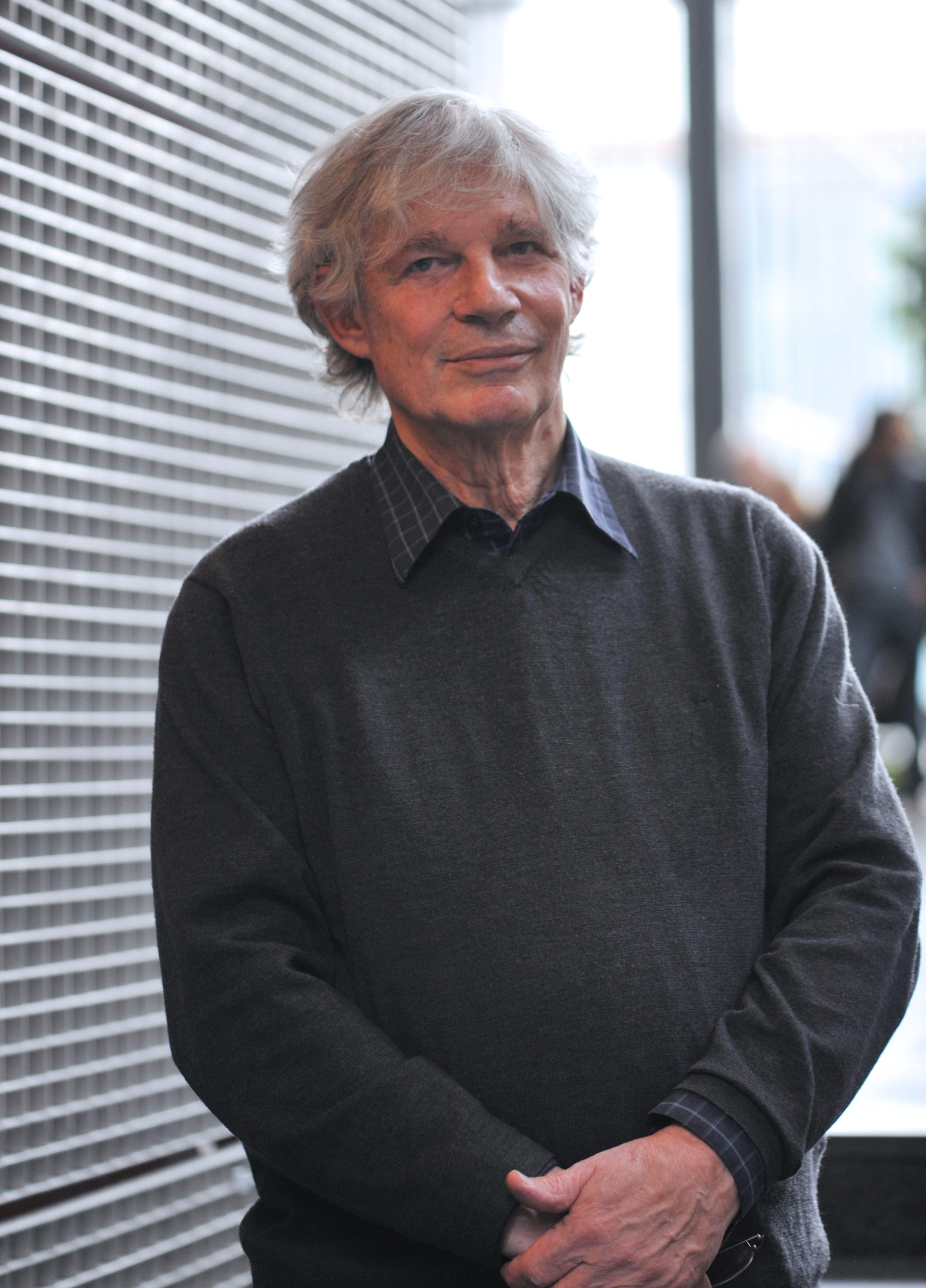
Stuart Kauffman Quotes

Stuart Alan Kauffman is an American medical doctor, theoretical biologist, and complex systems researcher who studies the origin of life on Earth. He was a professor at the University of Chicago, University of Pennsylvania, and University of Calgary. He is currently emeritus professor of biochemistry at the University of Pennsylvania and affiliate faculty at the Institute for Systems Biology. He has a number of awards including a MacArthur Fellowship and a Wiener Medal.

He is best known for arguing that the complexity of biological systems and organisms might result as much from self-organization and far-from-equilibrium dynamics as from Darwinian natural selection as discussed in his book Origins of Order . In 1967 and 1969 he used random boolean networks to investigate generic self-organizing properties of gene regulatory networks, proposing that cell types are dynamical attractors in gene regulatory networks and that cell differentiation can be understood as transitions between attractors. Recent evidence suggests that cell types in humans and other organisms are attractors. In 1971 he suggested that a zygote may not be able to access all the cell type attractors in its gene regulatory network during development and that some of the developmentally inaccessible cell types might be cancer cell types. This suggested the possibility of "cancer differentiation therapy". He also proposed the self-organized emergence of collectively autocatalytic sets of polymers, specifically peptides, for the origin of molecular reproduction, which have found experimental support. Wikipedia  

✵ 28. September 1939
Stuart Kauffman photo
Stuart Kauffman: 14 quotes0 likes

Famous Stuart Kauffman Quotes

“It is not necessary that a specific set of 2000 enzymes be assembled… Whenever a collection of chemicals contains enough different kinds of molecules, a metabolism will crystallize from the broth.”

Stuart Kauffman

Source: At Home in the Universe: The Search for the Laws of Self-Organization and Complexity (1996), p.45 as cited in: Gert Korthof (1998) "Kauffman at home in the Universe: The secret of life is auto-catalysis". Book review, 20 Oct 1998 ( online http://home.wxs.nl/~gkorthof/kortho32.htm)

Stuart Kauffman Quotes

“Life does not depend on the magic of Watson-Crick base pairing or any other specific template-replicating machinery. Life lies … in the property of catalytic closure among a collection of molecular species”

Stuart Kauffman

Source: At Home in the Universe: The Search for the Laws of Self-Organization and Complexity (1996), p.50 as cited in: Gert Korthof (1998)

“One of the most important presuppositions of Darwin's entire thesis is gradualism, the idea that mutations to the genome can cause minor variations in the organism's properties, which can be accumulated piecemeal, bit by bit, over the eons to create the complex order found in the organisms we observe.”

Stuart Kauffman

Source: At Home in the Universe: The Search for the Laws of Self-Organization and Complexity (1996), p.151. as cited in: A. Kay (2006) The Dynamics of Public Policy: Theory and Evidence. p.43

“It would be a triumph to find universal laws of organization for life, ecosystems, and biospheres. The candidate criticality law is emergent and not reducible to physics alone.”

Stuart Kauffman

Stuart A. Kauffman (2010) Reinventing the Sacred: A New View of Science, Reason, and Religion. p.40

“Stephen Jay Gould is extremely bright, inventive. He thoroughly understands paleontology; he thoroughly understands evolutionary biology. He has performed an enormous service in getting people to think about punctuated equilibrium, because you see the process of stasis/sudden change, which is a puzzle. It's the cessation of change for long periods of time. Since you always have mutations, why don't things continue changing? You either have to say that the particular form is highly adapted, optimal, and exists in a stable environment, or you have to be very puzzled. Steve has been enormously important in that sense. Talking with Steve, or listening to him give a talk, is a bit like playing tennis with someone who's better than you are. It makes you play a better game than you can play. For years, Steve has wanted to find, in effect, what accounts for the order in biology, without having to appeal to selection to explain everything—that is, to the evolutionary "just-so stories." You can come up with some cockamamie account about why anything you look at was formed in evolution because it was useful for something. There is no way of checking such things. We're natural allies, because I'm trying to find sources of that natural order without appealing to selection, and yet we all know that selection is important.”

Stuart Kauffman

Kauffman in: John Brockman, ed. (1995) The Third Culture: Beyond the Scientific Revolution, p. 64-65. ( online http://www.edge.org/documents/ThirdCulture/i-Ch.2.html)

“Living systems exist in the solid regime near the edge of chaos, and natural selection achieves and sustains such a poised state.”

Stuart Kauffman

Source: The origins of order: Self-organization and selection in evolution (1993), p.232

Similar authors

Toni Morrison photo
Toni Morrison184
American writer None
Albert A. Michelson photo
Albert A. Michelson5
American physicist None
Tennessee Williams photo
Tennessee Williams139
American playwright None
Robert Fulghum photo
Robert Fulghum82
American writer None
Robert Frost photo
Robert Frost265
American poet None
Neale Donald Walsch photo
Neale Donald Walsch69
American writer None
 M. Scott Peck photo
M. Scott Peck26
American psychiatrist None
Martin Lewis Perl photo
Martin Lewis Perl9
American scientist None
John Steinbeck photo
John Steinbeck366
American writer None
Theodore Schultz photo
Theodore Schultz15
American economist None