

“She loved to walk down the street with a book under her arm. It differentiated her from the others”
Milan Kundera book The Unbearable Lightness of Being
Source: The Unbearable Lightness of Being
Explore Milan Kundera's profound quotes on love, friendship, and human nature. Each quote offers wisdom, leaving readers with a fresh perspective on life.
Milan Kundera was a Czech-French novelist known for his novel "The Unbearable Lightness of Being." He moved to France in 1975 and became a French citizen in 1981. Despite facing censorship from the Communist Party of Czechoslovakia before the Velvet Revolution, Kundera achieved international recognition and received numerous awards, including the Jerusalem Prize and the Austrian State Prize for European Literature. In 2019, he regained his Czech citizenship after it had been revoked in 1979. Kundera led a private life and was rarely seen in public or interviewed by the media. His works showcased his background in music, incorporating musical influences and references throughout.
Born in 1929 in Brno, Czechoslovakia, Milan Kundera came from a middle-class family. His father was an esteemed musicologist and pianist, while his mother worked as an educator. Influenced by his father's musical talents, Kundera learned to play the piano and pursued musicology and composition studies. However, his musical aspirations were hindered due to familial circumstances. At the age of eighteen, he joined the Communist Party of Czechoslovakia but was later expelled in 1950. Kundera then pursued studies at the Film and TV School of the Academy of Performing Arts in Prague but lost his job after the Warsaw Pact invasion of Czechoslovakia in 1968.
Despite facing challenges throughout his life, Milan Kundera's literary works continue to resonate with readers worldwide.

“She loved to walk down the street with a book under her arm. It differentiated her from the others”
Milan Kundera book The Unbearable Lightness of Being
Source: The Unbearable Lightness of Being
“The eye… the point where a person's identity is concentrated.”
Milan Kundera book Identity
Identity (1998), pg 63
“A single metaphor can give birth to love.”
Milan Kundera book The Unbearable Lightness of Being
pg 10
Variant: Metaphors are not to be trifled with. A single metaphor can give birth to love.
Source: The Unbearable Lightness of Being (1984), Part One: Lightness and Weight
“Love is the longing for the half of ourselves we have lost.”
Milan Kundera book The Unbearable Lightness of Being
pg 233
Source: The Unbearable Lightness of Being (1984), Part Five: Lightness and Weight
“In the love poetry of every age, the woman longs to be weighed down by the man's body.”
Milan Kundera book The Unbearable Lightness of Being
Pg 5
The Unbearable Lightness of Being (1984), Part One: Lightness and Weight
Milan Kundera book The Unbearable Lightness of Being
Variant: He suddenly recalled from Plato's Symposium: People were hermaphrodites until God split then in two, and now all the halves wander the world over seeking one another. Love is the longing for the half of ourselves we have lost.
Source: The Unbearable Lightness of Being
Milan Kundera book The Unbearable Lightness of Being
Source: The Unbearable Lightness of Being
“There is no perfection only life”
Milan Kundera book The Unbearable Lightness of Being
Source: The Unbearable Lightness of Being
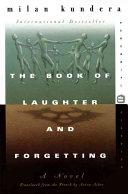
Milan Kundera book The Book of Laughter and Forgetting
Source: The Book of Laughter and Forgetting
Milan Kundera book The Book of Laughter and Forgetting
Part Four: Lost Letters (p. 106)
Source: The Book of Laughter and Forgetting (1979)
Context: The proliferation of mass graphomania among politicians, cab drivers, women on the delivery table, mistresses, murderers, criminals, prostitutes, police chiefs, doctors, and patients proves to me that every individual without exception bears a potential writer within himself and that all mankind has every right to rush out into the streets with a cry of "We are all writers!"
The reason is that everyone has trouble accepting the fact that he will disappear unheard of and unnoticed in an indifferent universe, and everyone wants to make himself into a universe of words before it's too late.
Once the writer in every individual comes to life (and that time is not far off), we are in for an age of universal deafness and lack of understanding.
Milan Kundera book The Unbearable Lightness of Being
Source: The Unbearable Lightness of Being (1984), Part Five: Lightness and Weight
As quoted in The Canine Hiker's Bible (2000) by Doug Gelbert, p. 8
“But when the strong were too weak to hurt the weak, the weak had to be strong enough to leave.”
Milan Kundera book The Unbearable Lightness of Being
pg 71
Source: The Unbearable Lightness of Being (1984), Part Two: Soul and Body
“In the sunset of dissolution, everything is illuminated by the aura of nostalgia.”
Milan Kundera book The Unbearable Lightness of Being
Source: The Unbearable Lightness of Being (1984), Part One: Lightness and Weight, p. 4
“A person who longs to leave the place where he lives is an unhappy person.”
Milan Kundera book The Unbearable Lightness of Being
pg 27
Source: The Unbearable Lightness of Being (1984), Part One: Lightness and Weight
“I want you to be weak. As weak as I am.”
Milan Kundera book The Unbearable Lightness of Being
Source: The Unbearable Lightness of Being
Interview with Christian Salmon (Fall 1983), Writers at Work: The Paris Review Interviews, Series Seven [Viking, 1988, ], pp. 217-218
Context: Do you realize that people don't know how to read Kafka simply because they want to decipher him? Instead of letting themselves be carried away by his unequaled imagination, they look for allegories — and come up with nothing but clichés: life is absurd (or it is not absurd), God is beyond reach (or within reach), etc. You can understand nothing about art, particularly modern art, if you do not understand that imagination is a value in itself.
Milan Kundera book The Unbearable Lightness of Being
The Unbearable Lightness of Being (1984), Part Two: Soul and Body, p. 59
“What is unique about the "I" hides itself exactly in what is unimaginable about a person.”
Milan Kundera book The Unbearable Lightness of Being
The Unbearable Lightness of Being (1984), Part Five: Lightness and Weight
Context: What is unique about the "I" hides itself exactly in what is unimaginable about a person. All we are able to imagine is what makes everyone like everyone else, what people have in common. The individual "I" is what differs from the common stock, that is, what cannot be guessed at or calculated, what must be unveiled, uncovered, conquered.
“Do you realize that people don't know how to read Kafka simply because they want to decipher him?”
Interview with Christian Salmon (Fall 1983), Writers at Work: The Paris Review Interviews, Series Seven [Viking, 1988, ], pp. 217-218
Context: Do you realize that people don't know how to read Kafka simply because they want to decipher him? Instead of letting themselves be carried away by his unequaled imagination, they look for allegories — and come up with nothing but clichés: life is absurd (or it is not absurd), God is beyond reach (or within reach), etc. You can understand nothing about art, particularly modern art, if you do not understand that imagination is a value in itself.
“People are always shouting they want to create a better future. It's not true.”
Milan Kundera book The Book of Laughter and Forgetting
Part I: Lost Letters (p. 22)
The Book of Laughter and Forgetting (1979)
Context: People are always shouting they want to create a better future. It's not true. The future is an apathetic void of no interest to anyone. The past is full of life, eager to irritate us, provoke and insult us, tempt us to destroy or repaint it. The only reason people want to be masters of the future is to change the past. They are fighting for access to the laboratories where photographs are retouched and biographies and histories rewritten.
Milan Kundera book The Unbearable Lightness of Being
The Unbearable Lightness of Being (1984), Part Five: Lightness and Weight
Context: Whenever a single political movement corners power, we find ourselves in the realm of totalitarian kitsch. When I say “totalitarian,” what I mean is that everything that infringes on kitsch must be banished for life: every display of individualism (because a deviation from the collective is a spit in the eye of the smiling brotherhood); every doubt (because anyone who starts doubting details will end by doubting life itself); all irony (because in the realm of kitsch everything must be taken quite seriously); and the mother who abandons her family or the man who prefers men to women, thereby calling into question the holy decree “Be fruitful and multiply.”
Milan Kundera book The Book of Laughter and Forgetting
Part I: Lost Letters (p. 22)
The Book of Laughter and Forgetting (1979)
Context: People are always shouting they want to create a better future. It's not true. The future is an apathetic void of no interest to anyone. The past is full of life, eager to irritate us, provoke and insult us, tempt us to destroy or repaint it. The only reason people want to be masters of the future is to change the past. They are fighting for access to the laboratories where photographs are retouched and biographies and histories rewritten.
“In the realm of totalitarian kitsch, all answers are given in advance and preclude any questions.”
Milan Kundera book The Unbearable Lightness of Being
The Unbearable Lightness of Being (1984), Part Five: Lightness and Weight
Context: In the realm of totalitarian kitsch, all answers are given in advance and preclude any questions. It follows, then, that the true opponent of totalitarian kitsch is the person who asks questions. A question is like a knife that slices through the stage backdrop and gives us a look at what lies hidden behind it.
“When we ignore the body, we are more easily victimized by it.”
Milan Kundera book The Unbearable Lightness of Being
The Unbearable Lightness of Being (1984), Part Two: Soul and Body, pg 37
“Suspending moral judgment is not the immorality of the novel; it is its morality.”
Testaments Betrayed (1995), p. 7
Context: Suspending moral judgment is not the immorality of the novel; it is its morality. The morality that stands against the ineradicable human habit of judging instantly, ceaselessly, and everyone; of judging before, and in the absence of, understanding. From the viewpoint of the novel’s wisdom, that fervid readiness to judge is the most detestable stupidity, the most pernicious evil.
“loves are like empires: when the idea they are founded on crumbles, they, too, fade away.”
Milan Kundera book The Unbearable Lightness of Being
Source: The Unbearable Lightness of Being
“And what can life be worth if the first rehearsal for life is life itself?”
Milan Kundera book The Unbearable Lightness of Being
pg 8
Source: The Unbearable Lightness of Being (1984), Part One: Lightness and Weight
“Flirting is a promise of sexual intercourse without a guarantee.”
Milan Kundera book The Unbearable Lightness of Being
Source: The Unbearable Lightness of Being
“Physical love is unthinkable without violence.”
Milan Kundera book The Unbearable Lightness of Being
pg 111
Source: The Unbearable Lightness of Being (1984), Part Three: Words Misunderstood
“Chance and chance alone has a message for us… Only chance can speak to us.”
Milan Kundera book The Unbearable Lightness of Being
Source: The Unbearable Lightness of Being (1984), Part Two: Soul and Body, pg 48
“Yes, it's a well-known fact about you: you're like death, you take everything.”
Milan Kundera book Laughable Loves
Source: Laughable Loves
“The struggle of man against power is the struggle of memory against forgetting”
Milan Kundera book The Book of Laughter and Forgetting
Source: The Book of Laughter and Forgetting
Milan Kundera book The Unbearable Lightness of Being
Source: The Unbearable Lightness of Being (1984), Part Three: Words Misunderstood
“To laugh is to live profoundly.”
Milan Kundera book The Book of Laughter and Forgetting
Source: The Book of Laughter and Forgetting
“Yes, it's crazy. Love is either crazy or it's nothing at all.”
Source: Life is Elsewhere
“On the surface, an intelligible lie; underneath, the unintelligible truth.”
Milan Kundera book The Unbearable Lightness of Being
Source: The Unbearable Lightness of Being
“To rebel against being born a woman seemed as foolish to her as to take pride in it.”
Milan Kundera book The Unbearable Lightness of Being
Source: The Unbearable Lightness of Being
“But isn't it true that an author can write only about himself?”
Milan Kundera book The Unbearable Lightness of Being
Source: The Unbearable Lightness of Being


