“Genteel in personage,
Conduct, and equipage;
Noble by heritage,
Generous and free.”
The Contrivances (1715), Act i. Sc. 2.
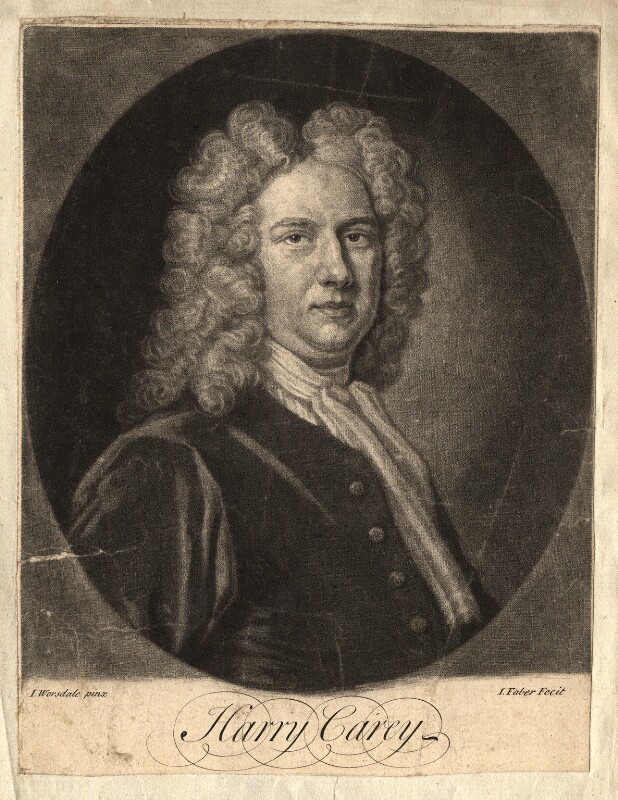
Henry Carey was an English poet, dramatist and songwriter. He is remembered as an anti-Walpolean satirist and also as a patriot. Several of his melodies continue to be sung today, and he was widely praised in the generation after his death. Because he worked in anonymity, selling his own compositions to others to pass off as their own, contemporary scholarship can only be certain of some of his poetry, and a great deal of the music he composed was written for theatrical incidental music. However, under his own name and hand, he was a prolific songwriter and balladeer, and he wrote the lyrics for almost all of these songs. Further, he wrote numerous operas and plays. His life is illustrative of the professional author in the early 18th century. Without inheritance or title or governmental position, he wrote for all of the remunerative venues, and yet he also kept his own political point of view and was able to score significant points against the ministry of the day. Further, he was one of the leading lights of the new "Patriotic" movement in drama. Wikipedia
“Genteel in personage,
Conduct, and equipage;
Noble by heritage,
Generous and free.”
The Contrivances (1715), Act i. Sc. 2.
“The king shall eat, though all mankind be starved.”
Henry Carey Chrononhotonthologos
Act ii. Sc. 4.
Chrononhotonthologos (1734)
“God save our gracious king!
Long live our noble king!
God save the king!”
"God Save the King" (1730).
Henry Carey Chrononhotonthologos
Act i. Sc. 1.
Chrononhotonthologos (1734)
“To thee, and gentle Rigdom Funnidos,
Our gratulations flow in streams unbounded.”
Henry Carey Chrononhotonthologos
Act i. Sc. 3.
Chrononhotonthologos (1734)
“Of all the girls that are so smart,
There's none like pretty Sally.”
Sally in our Alley (c. 1725). Compare: "Of all the girls that e’er was seen, There's none so fine as Nelly", Jonathan Swift, Ballad on Miss Nelly Bennet.
“His cogitative faculties immersed
In cogibundity of cogitation.”
Henry Carey Chrononhotonthologos
Act i. Sc. 1.
Chrononhotonthologos (1734)
“Aldeborontiphoscophornio!
Where left you Chrononhotonthologos?”
Henry Carey Chrononhotonthologos
Act i. Sc. 1.
Chrononhotonthologos (1734)


