
“Action may not always bring happiness but there is no happiness without action.”
Books, Coningsby (1844), Lothair (1870)
Variant: Action may not always bring happiness; but there is no happiness without action.
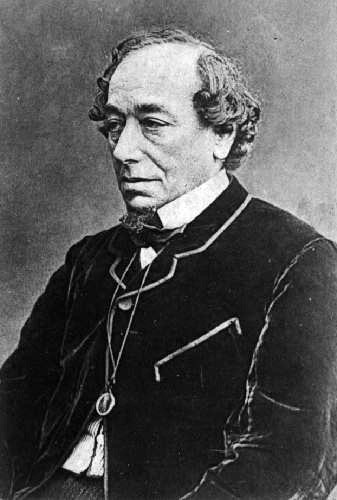
Benjamin Disraeli, 1st Earl of Beaconsfield, was a British politician of the Conservative Party who twice served as Prime Minister of the United Kingdom. He played a central role in the creation of the modern Conservative Party, defining its policies and its broad outreach. Disraeli is remembered for his influential voice in world affairs, his political battles with the Liberal Party leader William Ewart Gladstone, and his one-nation conservatism or "Tory democracy". He made the Conservatives the party most identified with the glory and power of the British Empire. He is the only British prime minister to have been of Jewish birth. He was also a novelist, publishing works of fiction even as prime minister.
Disraeli was born in Bloomsbury, then a part of Middlesex. His father left Judaism after a dispute at his synagogue; young Benjamin became an Anglican at the age of 12. After several unsuccessful attempts, Disraeli entered the House of Commons in 1837. In 1846 the Prime Minister at the time, Sir Robert Peel, split the party over his proposal to repeal the Corn Laws, which involved ending the tariff on imported grain. Disraeli clashed with Peel in the House of Commons. Disraeli became a major figure in the party. When Lord Derby, the party leader, thrice formed governments in the 1850s and 1860s, Disraeli served as Chancellor of the Exchequer and Leader of the House of Commons.
Upon Derby's retirement in 1868, Disraeli became Prime Minister briefly before losing that year's general election. He returned to the Opposition, before leading the party to winning a majority in the 1874 general election. He maintained a close friendship with Queen Victoria, who in 1876 appointed him Earl of Beaconsfield. Disraeli's second term was dominated by the Eastern Question—the slow decay of the Ottoman Empire and the desire of other European powers, such as Russia, to gain at its expense. Disraeli arranged for the British to purchase a major interest in the Suez Canal Company . In 1878, faced with Russian victories against the Ottomans, he worked at the Congress of Berlin to obtain peace in the Balkans at terms favourable to Britain and unfavourable to Russia, its longstanding enemy. This diplomatic victory over Russia established Disraeli as one of Europe's leading statesmen.
World events thereafter moved against the Conservatives. Controversial wars in Afghanistan and South Africa undermined his public support. He angered British farmers by refusing to reinstitute the Corn Laws in response to poor harvests and cheap imported grain. With Gladstone conducting a massive speaking campaign, his Liberals defeated Disraeli's Conservatives at the 1880 general election. In his final months, Disraeli led the Conservatives in Opposition. He had throughout his career written novels, beginning in 1826, and he published his last completed novel, Endymion, shortly before he died at the age of 76. Wikipedia
“Action may not always bring happiness but there is no happiness without action.”
Books, Coningsby (1844), Lothair (1870)
Variant: Action may not always bring happiness; but there is no happiness without action.
“The magic of first love is our ignorance that it can ever end.”
Book 4, chapter 1. Often misquoted as "The magic of first love is our ignorance that it can never end".
Books, Coningsby (1844), Henrietta Temple (1837)
“The secret of success is constancy to purpose.”
Source: Speech at banquet of the National Union of Conservative and Constitutional Associations, Crystal Palace, London (24 June 1872), cited in "Mr. Disraeli at Sydenham," The Times (25 June 1872), p. 8.
“Ignorance never settles a question.”
Source: Speech in the House of Commons (14 May 1866)
Speech http://hansard.millbanksystems.com/commons/1845/mar/17/agricultural-interest in the House of Commons (17 March 1845). <br class="br">1840s
Source: Speech to the National Union of Conservative and Constitutional Associations in Crystal Palace, London (24 June 1872), quoted in Selected Speeches of the Late Right Honourable the Earl of Beaconsfield, Volume II, ed. T. E. Kebbel (1882), pp. 534-535
Source: Election address; letter to the Lord Lieutenant of Ireland, the Duke of Marlborough (8 March 1880), quoted in The Times (9 March 1880), p. 8
Source: Election address; letter to the Lord Lieutenant of Ireland, the Duke of Marlborough (8 March 1880), quoted in The Times (9 March 1880), p. 8
Source: Address to the electors of Buckinghamshire (12 December 1832), quoted in William Flavelle Monypenny and George Earle Buckle, The Life of Benjamin Disraeli, Earl of Beaconsfield. Volume I. 1804–1859 (London: John Murray, 1929), p. 225
Source: Letter to Lord Grey de Wilton (3 October 1873), cited in William Flavelle Monypenny and George Earle Buckle, The Life of Benjamin Disraeli, Earl of Beaconsfield, Vol. 5 (1920), p. 262.
Not Disraeli but La Rochefoucauld; it is Maxim 308 in his Reflections.
Misattributed
Source: Letter to Edward Lytton Bulwer from Constantinople, Turkey (27 December 1830), quoted in William Flavelle Monypenny and George Earle Buckle, The Life of Benjamin Disraeli, Earl of Beaconsfield. Volume I. 1804–1859 (1929), p. 174
Speech in Taunton (28 April 1835), quoted in William Flavelle Monypenny and George Earle Buckle, The Life of Benjamin Disraeli, Earl of Beaconsfield. Volume I. 1804–1859 (London: John Murray, 1929), p. 286
1830s
“Though lions to their enemies they were lambs to their friends.”
The infernal Marriage, part 2, Chapter 4 (1834).
Books
“Despair is the conclusion of fools.”
The Wondrous Tale of Alroy pt. 10, ch. 17.
Books
“Desperation is sometimes as powerful an inspirer as genius.”
Source: Books, Coningsby (1844), Endymion (1880), Ch. 8.
“Free trade is not a principle; it is an expedient.”
On Import Duties (25 April 1843). Compare: "It is a condition which confronts us, not a theory" (Grover Cleveland, Annual Message, 1887, in reference to the tariff); "Protection is not a principle but an expedient" (below).
1840s
Speech in the House of Commons (28 January 1840), quoted in William Flavelle Monypenny and George Earle Buckle, The Life of Benjamin Disraeli, Earl of Beaconsfield. Volume I. 1804–1859 (London: John Murray, 1929), p. 485
1840s
Address (1 October 1832), quoted in William Flavelle Monypenny and George Earle Buckle, The Life of Benjamin Disraeli, Earl of Beaconsfield. Volume I. 1804–1859 (London: John Murray, 1929), p. 221
1830s
Source: Speech in the House of Lords on the agricultural depression (29 April 1879), reported in The Times (30 April 1879), p. 8
Source: 'Letter VII. to Lord John Russell' (30 January 1836), The Letters of Runnymede (1836), pp. 60-61
Source: Letter to Isaac Disraeli (c. 8 September 1826), quoted in William Flavelle Monypenny and George Earle Buckle, The Life of Benjamin Disraeli, Earl of Beaconsfield. Volume. I. 1804–1859 (1929), p. 108
Source: Letter to Isaac Disraeli (September 1826), quoted in William Flavelle Monypenny and George Earle Buckle, The Life of Benjamin Disraeli, Earl of Beaconsfield. Volume I. 1804–1859 (1929), p. 107
Source: Diary entry while in Aix (c. 16 August 1824), quoted in William Flavelle Monypenny and George Earle Buckle, The Life of Benjamin Disraeli, Earl of Beaconsfield. Volume I. 1804–1859 (1929), pp. 52-53
“There are three kinds of lies: Lies, Damn Lies, and Statistics.”
Attributed to Disraeli by Mark Twain in "Chapters from My Autobiography — XX", North American Review No. DCXVIII (JULY 5, 1907) http://www.gutenberg.org/ebooks/19987. His attribution is considered unreliable, and the actual origin is uncertain, with one of the earliest known publications of such a phrase being that of Leonard H. Courtney: see Lies, damned lies, and statistics. <br class="br">Misattributed
Campaign speech at High Wycombe (27 November 1832), cited in Selected Speeches of the Late Right Honourable the Earl of Beaconsfield, Vol. 1 (1882).
1830s
Context: I am a Conservative to preserve all that is good in our constitution, a Radical to remove all that is bad. I seek to preserve property and to respect order, and I equally decry the appeal to the passions of the many or the prejudices of the few
Speech http://hansard.millbanksystems.com/commons/1845/apr/11/maynooth-college in the House of Commons (11 April 1845). <br class="br">1840s <br class="br">Context: Sir, it is very easy to complain of party Government, and there may be persons capable of forming an opinion on this subject who may entertain a deep objection to that Government, and know to what that objection leads. But there are others who shrug their shoulders, and talk in a slipshod style on this head, who, perhaps, are not exactly aware of what the objections lead to. These persons should understand, that if they object to party Government, they do, in fact, object to nothing more nor less than Parliamentary Government. A popular assembly without parties&mdash;500 isolated individuals&mdash; cannot stand five years against a Minister with an organized Government without becoming a servile Senate.
“I believe that, without party, Parliamentary government is impossible”
Source: Speech to the Conservatives of Manchester (3 April 1872), cited in The World's Best Orations from the Earliest Period to the Present Time, Vol. 1 (eds. David Josiah Brewer, Edward Archibald Allen, William Schuyler), pp. 309-338.
Context: Gentl, I am a party man. I believe that, without party, Parliamentary government is impossible. I look upon Parliamentary government as the noblest government in the world, and certainly the one most suited to England.
Speech in House of Commons, as recorded (in third person) in the | minutes of 20 June, 1839 http://hansard.millbanksystems.com/commons/1839/jun/20/education-adjourned-debate#S3V0048P0_18390620_HOC_4. <br class="br">1830s <br class="br">Context: [It appears to me that] the Society of Education, that school of philosophers, were, with all their vaunted intellect and learning, fast returning to the system of a barbarous age, the system of a paternal government. Wherever was found what was called a paternal government was found a state education. It had been discovered that the best way to insure implicit obedience was to commence tyranny in the nursery. There was a country in which education formed the only qualification for office. That was, therefore, a country which might be considered as a normal school and pattern society for the intended scheme of education. That country was China. These paternal governments were rather to be found in the east than in the west, and if the hon. Member for Waterford asked [me] for the most perfect programme of public education, if he asked [me] to point out a system at once the most profound and the most comprehensive, [I] must give him the system of education which obtained in Persia. Leaving China and Persia and coming to Europe, [I] found a perfect system of national education in Austria, the China of Europe, and under the paternal government of Prussia. The truth was, that wherever everything was left to the government the subject became a machine.
“England does not love coalitions.”
Speech http://hansard.millbanksystems.com/commons/1852/dec/16/ways-and-means-financial-statement in the House of Commons (16 December 1852). <br class="br">1850s <br class="br">Context: Yes! I know what I have to face. I have to face a coalition. The combination may be successful. A coalition has before this been successful. But coalitions, although successful, have always found this, that their triumph has been brief. This too I know, that England does not love coalitions.
“Assassination has never changed the history of the world.”
Addressing the House of Commons after the assassination of Abraham Lincoln (1 May 1865).
1860s
Context: There are rare instances when the sympathy of a nation approaches those tenderer feelings which are generally supposed to be peculiar to the individual, and to be the happy privilege of private life, and this is one. Under any circumstances we should have bewailed the catastrophe at Washington; under any circumstances we should have shuddered at the means by which it was accomplished. But in the character of the victim, and even in the accessories of his last moments, there is something so homely and innocent, that it takes the question, as it were, out of all the pomp of history and the ceremonial of diplomacy; it touches the heart of nations, and appeals to the domestic sentiment of mankind.
Whatever the various and varying opinions in this House, and in the country generally, on the policy of the late President of the United States, all must agree that in one of the severest trials which ever tested the moral qualities of man he fulfilled his duty with simplicity and strength. …When such crimes are perpetrated the public mind is apt to fall into gloom and perplexity, for it is ignorant alike of the causes and the consequences of such deeds. But it is one of our duties to reassure them under unreasoning panic and despondency. Assassination has never changed the history of the world. I will not refer to the remote past, though an accident has made the most memorable instance of antiquity at this moment fresh in the minds and memory of all around me. But even the costly sacrifice of a Caesar did not propitiate the inexorable destiny of his country.
“I am the blank page between the Old Testament and the New.”
Cited in Herbert Henry Asquith, Letters of the Earl of Oxford and Asquith to a Friend, Vol. 2 (1933), p. 94.
Sourced but undated
Context: Miss Sands told me that Queen Victoria, who was latterly éprise with Disraeli, one day asked him what was his real religion. "Madam," he replied, "I am the blank page between the Old Testament and the New."
“Time is precious, but truth is more precious than time.”
Speech at Aylesbury, Royal and Central Bucks Agricultural Association (21 September 1865), cited in Wit and Wisdom of Benjamin Disraeli, Earl of Beaconsfield, Collected from his Writings and Speeches (1881), p. 356
1860s
“When men are pure, laws are useless; when men are corrupt, laws are broken.”
Part 6, Chapter 3
Books, Coningsby (1844), Contarini Fleming (1832)
Part 1, Chapter 13; sometimes paraphrased: "Never apologize for showing feeling. When you do so, you apologize for the truth."
Books, Coningsby (1844), Contarini Fleming (1832)
“All is mystery; but he is a slave who will not struggle to penetrate the dark veil.”
Part 5, Chapter 18.
Books, Coningsby (1844), Contarini Fleming (1832)
“This shows how much easier it is to be critical than to be correct.”
Speech http://hansard.millbanksystems.com/commons/1860/jan/24/address-in-answer-to-her-majestys-speech in the House of Commons (24 January 1860); see also Lord Byron, "Notes to Canto II" (1812), Childe Harold's Pilgrimage: "How much easier it is to be critical than to be correct". <br class="br">1860s <br class="br">Variant: How much easier it is to be critical than to be correct.
“To be conscious that you are ignorant is a great step to knowledge.”
Book 1, chapter 5.
Books, Coningsby (1844), Sybil (1845)
Variant: To be conscious that you are ignorant is a great step to knowledge.
“Like all great travellers I have seen more than I remember, and remember more than I have seen.”
Book VIII, Chapter 4.
Books, Coningsby (1844), Vivian Grey (1826)
“Everything comes if a man will only wait.”
Benjamin Disraeli book Tancred
Bk. IV, Ch. 8.
Source: Books, Coningsby (1844), Tancred (1847)
“My idea of an agreeable person," said Hugo Bohun, "is a person who agrees with me.”
Source: Books, Coningsby (1844), Lothair (1870), Ch. 35.
“Read no history: nothing but biography, for that is life without theory.”
Part 1, Chapter 23.
Books, Coningsby (1844), Contarini Fleming (1832)
“As a general rule the most successful man in life is the man who has the best information.”
Source: Books, Coningsby (1844), Endymion (1880), Ch. 36.
Book V, Chapter 1.
Books, Coningsby (1844), Vivian Grey (1826)
“I am prepared for the worst, but hope for the best.”
The Wondrous Tale of Alroy, pt. 10, ch. 3.
Books
“The palace is not safe, when the cottage is not happy.”
Speech to Wynyard Horticultural Show (1848), quoted in William Flavelle Monypenny and George Earle Buckle, The Life of Benjamin Disraeli, Earl of Beaconsfield. Volume II. 1860–1881 (London: John Murray, 1929), p. 709.
1840s


