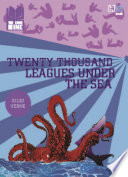
Quotes from book
Twenty Thousand Leagues Under the Sea

Twenty Thousand Leagues Under the Sea
Jules VerneOriginal title Vingt mille lieues sous les mers, Tour du monde sous-marin (French, 1869)

Twenty Thousand Leagues Under the Seas: A World Tour Underwater is a classic science fiction adventure novel by French writer Jules Verne; it was first published in 1870.


Jules Verne photo

“The Nautilus was piercing the water with its sharp spur, after having accomplished nearly ten thousand leagues in three months and a half, a distance greater than the great circle of the earth. Where were we going now, and what was reserved for the future?”

Jules Verne book Twenty Thousand Leagues Under the Sea

Le Nautilus en brisait les eaux sous le tranchant de son éperon, après avoir accompli près de dix mille lieues en trois mois et demi, parcours supérieur à l'un des grands cercles de la terre. Où allions-nous maintenant, et que nous réservait l'avenir?
Part II, ch. VIII: Vigo Bay
Twenty Thousand Leagues Under the Sea (1870)

Jules Verne photo

“In the memory of the dead all chronological differences are effaced.”

Jules Verne book Twenty Thousand Leagues Under the Sea

Les différences chronologiques s'effacent dans la mémoire des morts.
Part I, ch. X: The Man of the Seas (Part I, ch. XI in the French text)
Twenty Thousand Leagues Under the Sea (1870)

Jules Verne photo

“This forcible abduction, so roughly carried out, was accomplished with the rapidity of lightning. I shivered all over. Whom had we to deal with? No doubt some new sort of pirates, who explored the sea in their own way. Hardly had the narrow panel closed upon me, when I was enveloped in darkness.”

Jules Verne book Twenty Thousand Leagues Under the Sea

<p>Cet enlèvement, si brutalement exécuté, s'était accompli avec la rapidité de l'éclair... Un rapide frisson me glaça l'épiderme. A qui avions-nous affaire ? Sans doute à quelques pirates d'une nouvelle espèce qui exploitaient la mer à leur façon.</p><p>A peine l'étroit panneau fut-il refermé sur moi, qu'une obscurité profonde m'enveloppa.</p>
Part I, ch. VIII: Mobilis in Mobili
Twenty Thousand Leagues Under the Sea (1870)

Jules Verne photo

“The Earth does not want new continents, but new men.”

Jules Verne book Twenty Thousand Leagues Under the Sea

Ce ne sont pas de nouveaux continents qu'il faut à la terre, mais de nouveaux hommes!
Part I, ch. XVIII: Vanikoro (Boston: Geo. M. Smith & Co., 1873, p. 101) (Ch. XIX in the French text)
Tr. Walter James Miller (1966)
Twenty Thousand Leagues Under the Sea (1870)
Variant: The planet doesn't need new continents, it needs new men.

Jules Verne photo

“We were alone. Where, I could not say, hardly imagine. All was black, and such a dense black that, after some minutes, my eyes had not been able to discern even the faintest glimmer.”

Jules Verne book Twenty Thousand Leagues Under the Sea

Nous étions seuls. Où ? Je ne pouvais le dire, à peine l'imaginer. Tout était noir, mais d'un noir si absolu, qu'après quelques minutes, mes yeux n'avaient encore pu saisir une de ces lueurs indéterminées qui flottent dans les plus profondes nuits.
Part I, ch. VIII: Mobilis in Mobili
Twenty Thousand Leagues Under the Sea (1870)

Jules Verne photo

“The human mind delights in grand conceptions of supernatural beings. And the sea is precisely their best vehicle, the only medium through which these giants (against which terrestrial animals, such as elephants or rhinoceroses, are as nothing) can be produced or developed”

Jules Verne book Twenty Thousand Leagues Under the Sea

L'esprit humain se plaît à ces conceptions grandioses d'êtres surnaturels. Or la mer est précisément leur meilleur véhicule, le seul milieu où ces géants près desquels les animaux terrestres, éléphants ou rhinocéros, ne sont que des nains — puissent se produire et se développer.
Part I, ch. II: Pro and Con
Twenty Thousand Leagues Under the Sea (1870)

Jules Verne photo

“What good would it be to discuss such a proposition, when force could destroy the best arguments?”

Jules Verne book Twenty Thousand Leagues Under the Sea

A quoi bon discuter une proposition semblable, quand la force peut détruire les meilleurs arguments.
Part I, ch. X: The Man of the Seas
Twenty Thousand Leagues Under the Sea (1870)

Jules Verne photo

“Thus ends the voyage under the seas. What passed during that night — how the boat escaped from the eddies of the maelstrom — how Ned Land, Conseil, and myself ever came out of the gulf, I cannot tell.”

Jules Verne book Twenty Thousand Leagues Under the Sea

Voici la conclusion de ce voyage sous les mers. Ce qui se passa pendant cette nuit, comment le canot échappa au formidable remous du Maelstrom, comment Ned Land, Conseil et moi, nous sortîmes du gouffre, je ne saurai le dire.
Part II, ch. XXIII: Conclusion
Twenty Thousand Leagues Under the Sea (1870)

Jules Verne photo

“Freedom is worth paying for.”

Jules Verne book Twenty Thousand Leagues Under the Sea

La liberté vaut qu’on la paye.
Part II, ch. VIII: Vigo Bay
Twenty Thousand Leagues Under the Sea (1870)

Jules Verne photo

“The sea is everything. It covers seven tenths of the terrestrial globe. Its breath is pure and healthy. It is an immense desert, where man is never lonely, for he feels life stirring on all sides. The sea is only the embodiment of a supernatural and wonderful existence. It is nothing but love and emotion.”

Jules Verne book Twenty Thousand Leagues Under the Sea

La mer est tout! Elle couvre les sept dixièmes du globe terrestre. Son souffle est pur et sain. C'est l'immense désert où l'homme n'est jamais seul, car il sent frémir la vie à ses côtés. La mer n'est que le véhicule d'une surnaturelle et prodigieuse existence; elle n'est que mouvement et amour.
Part I, ch. X: The Man of the Seas
Twenty Thousand Leagues Under the Sea (1870)

Jules Verne photo

“We cannot prevent equilibrium from producing its effects. We may brave human laws, but we cannot resist natural ones.”

Jules Verne book Twenty Thousand Leagues Under the Sea

On ne saurait empêcher l'équilibre de produire ses effets. On peut braver les lois humaines, mais non résister aux lois naturelles.
Part II, ch. XV: Accident or Incident?
Twenty Thousand Leagues Under the Sea (1870)

Jules Verne photo

“Whoever calls himself Canadian calls himself French.”

Jules Verne book Twenty Thousand Leagues Under the Sea

Part I, ch. IV: Ned Land
Twenty Thousand Leagues Under the Sea (1870)

Similar authors

Jules Verne photo
Jules Verne44
French novelist, poet and playwright 1828–1905
Léon Bloy photo
Léon Bloy22
French writer, poet and essayist None
Walter Scott photo
Walter Scott151
Scottish historical novelist, playwright, and poet None
Alfred de Musset photo
Alfred de Musset4
French writer None
Alphonse Karr photo
Alphonse Karr3
French critic, journalist, and novelist None
Emile Zola photo
Emile Zola54
French writer (1840-1902) None
Anatole France photo
Anatole France122
French writer None
Aleksandr Pushkin photo
Aleksandr Pushkin33
Russian poet None
Henrik Ibsen photo
Henrik Ibsen69
Norwegian playwright, theatre director, and poet None
Charles Baudelaire photo
Charles Baudelaire133
French poet None