Quotes from book
The Scientist as Rebel

The Scientist as Rebel

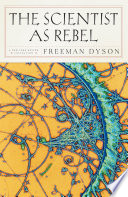
The Scientist as Rebel is a 2006 book by the theoretical physicist Freeman Dyson. A few of the twenty-nine chapters in the book deal with the interactions of religion and science.


Freeman Dyson photo

“The progress of science requires the growth of understanding in both directions, downward from the whole to the parts and upward from the parts to the whole.”

Freeman Dyson book The Scientist as Rebel

Part I : Contemporary Issues in Science, Ch. 1 : "The Scientist as Rebel"
The Scientist As Rebel (2006)
Context: The progress of science requires the growth of understanding in both directions, downward from the whole to the parts and upward from the parts to the whole. A reductionist philosophy, arbitrarily proclaiming that the growth of understanding must go only in one direction, makes no scientific sense. Indeed, dogmatic philosophical beliefs of any kind have no place in science.

Freeman Dyson photo

“There is no such thing as a unique scientific vision, any more than there is a unique poetic vision. Science is a mosaic of partial and conflicting visions.”

Freeman Dyson book The Scientist as Rebel

Part I : Contemporary Issues in Science, Ch. 1 : "The Scientist as Rebel"; this first appeared in New York Review of Books (25 May 1995).
The Scientist As Rebel (2006)
Context: There is no such thing as a unique scientific vision, any more than there is a unique poetic vision. Science is a mosaic of partial and conflicting visions. But there is one common element in these visions. The common element is rebellion against the restrictions imposed by the locally prevailing culture, Western or Eastern as the case may be. It is no more Western than it is Arab or Indian or Japanese or Chinese. Arabs and Indians and Japanese and Chinese had a big share in the development of modern science. And two thousand years earlier, the beginnings of science were as much Babylonian and Egyptian as Greek. One of the central facts about science is that it pays no attention to East and West and North and South and black and yellow and white. It belongs to everybody who is willing to make the effort to learn it. And what is true of science is true of poetry.... Poetry and science are gifts given to all of humanity.

Freeman Dyson photo

“It belongs to everybody who is willing to make the effort to learn it. And what is true of science is true of poetry. … Poetry and science are gifts given to all of humanity.”

Freeman Dyson book The Scientist as Rebel

Part I : Contemporary Issues in Science, Ch. 1 : "The Scientist as Rebel"; this first appeared in New York Review of Books (25 May 1995).
The Scientist As Rebel (2006)
Context: There is no such thing as a unique scientific vision, any more than there is a unique poetic vision. Science is a mosaic of partial and conflicting visions. But there is one common element in these visions. The common element is rebellion against the restrictions imposed by the locally prevailing culture, Western or Eastern as the case may be. It is no more Western than it is Arab or Indian or Japanese or Chinese. Arabs and Indians and Japanese and Chinese had a big share in the development of modern science. And two thousand years earlier, the beginnings of science were as much Babylonian and Egyptian as Greek. One of the central facts about science is that it pays no attention to East and West and North and South and black and yellow and white. It belongs to everybody who is willing to make the effort to learn it. And what is true of science is true of poetry.... Poetry and science are gifts given to all of humanity.

Similar authors

Freeman Dyson photo
Freeman Dyson90
theoretical physicist and mathematician 1923
Max Planck photo
Max Planck30
German theoretical physicist None
Paul Dirac photo
Paul Dirac23
theoretical physicist None
Richard Feynman photo
Richard Feynman181
American theoretical physicist None
Steven Weinberg photo
Steven Weinberg46
American theoretical physicist None
Roy J. Glauber photo
Roy J. Glauber1
American theoretical physicist None
Stephen Hawking photo
Stephen Hawking122
British theoretical physicist, cosmologist, and author None
Werner Heisenberg photo
Werner Heisenberg42
German theoretical physicist None
Vitaly Ginzburg photo
Vitaly Ginzburg2
Russian Physicist None
Abdus Salam photo
Abdus Salam3
theoretical physicist, and Nobel Prize in Physics recipient None