
Albert Einstein book The Evolution of Physics
The Evolution of Physics (1938) (co-written with Leopold Infeld)
1930s
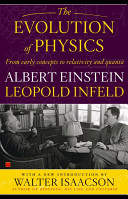
The Evolution of Physics: The Growth of Ideas from Early Concepts to Relativity and Quanta is a science book for the lay reader, by the physicists Albert Einstein and Leopold Infeld, tracing the development of ideas in physics. It was originally published in 1938 by Cambridge University Press. It was a popular success, and was featured in a Time cover story.
Albert Einstein book The Evolution of Physics
The Evolution of Physics (1938) (co-written with Leopold Infeld)
1930s
Albert Einstein book The Evolution of Physics
The Evolution of Physics (1938) (co-written with Leopold Infeld) <!-- later published by Simon & Schuster (1967) -->
1930s
Context: Physical concepts are free creations of the human mind, and are not, however it may seem, uniquely determined by the external world. In our endeavor to understand reality we are somewhat like a man trying to understand the mechanism of a closed watch. He sees the face and the moving hands, even hears its ticking, but he has no way of opening the case. If he is ingenious he may form some picture of a mechanism which could be responsible for all the things he observes, but he may never be quite sure his picture is the only one which could explain his observations. He will never be able to compare his picture with the real mechanism and he cannot even imagine the possibility or the meaning of such a comparison. But he certainly believes that, as his knowledge increases, his picture of reality will become simpler and simpler and will explain a wider and wider range of his sensuous impressions. He may also believe in the existence of the ideal limit of knowledge and that it is approached by the human mind. He may call this ideal limit the objective truth.
Albert Einstein book The Evolution of Physics
The Evolution of Physics (1938) (co-written with Leopold Infeld) <!-- later published by Simon & Schuster (1967) -->
1930s
Context: Physical concepts are free creations of the human mind, and are not, however it may seem, uniquely determined by the external world. In our endeavor to understand reality we are somewhat like a man trying to understand the mechanism of a closed watch. He sees the face and the moving hands, even hears its ticking, but he has no way of opening the case. If he is ingenious he may form some picture of a mechanism which could be responsible for all the things he observes, but he may never be quite sure his picture is the only one which could explain his observations. He will never be able to compare his picture with the real mechanism and he cannot even imagine the possibility or the meaning of such a comparison. But he certainly believes that, as his knowledge increases, his picture of reality will become simpler and simpler and will explain a wider and wider range of his sensuous impressions. He may also believe in the existence of the ideal limit of knowledge and that it is approached by the human mind. He may call this ideal limit the objective truth.
Albert Einstein book The Evolution of Physics
The Evolution of Physics (1938) (co-written with Leopold Infeld) <!-- later published by Simon & Schuster (1967) -->
1930s
Context: Physical concepts are free creations of the human mind, and are not, however it may seem, uniquely determined by the external world. In our endeavor to understand reality we are somewhat like a man trying to understand the mechanism of a closed watch. He sees the face and the moving hands, even hears its ticking, but he has no way of opening the case. If he is ingenious he may form some picture of a mechanism which could be responsible for all the things he observes, but he may never be quite sure his picture is the only one which could explain his observations. He will never be able to compare his picture with the real mechanism and he cannot even imagine the possibility or the meaning of such a comparison. But he certainly believes that, as his knowledge increases, his picture of reality will become simpler and simpler and will explain a wider and wider range of his sensuous impressions. He may also believe in the existence of the ideal limit of knowledge and that it is approached by the human mind. He may call this ideal limit the objective truth.


