Quotes from book
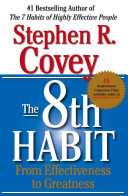
The 8th Habit: From Effectiveness to Greatness

The 8th Habit: From Effectiveness to Greatness

The 8th Habit: From Effectiveness to Greatness is a book written by Stephen R. Covey, published in 2004. It is a follow-up to The Seven Habits of Highly Effective People, first published in 1989. As such, it clarifies and reinforces Covey's earlier declaration that "Interdependence is a higher value than independence."


Stephen R. Covey photo

“Retire from your job but never from meaningful projects.”

Stephen R. Covey book The 8th Habit: From Effectiveness to Greatness

The 8th Habit : From Effectiveness to Greatness‎ (2004)
Context: Retire from your job but never from meaningful projects. If you want to live a long life, you need eustress, that is, a deep sense of meaning and contribution to worthy projects and causes, particularly your intergenerational family.

The 8th Habit : From Effectiveness to Greatness‎ (2004), p. 63

Stephen R. Covey photo

“People simply feel better about themselves when they’re good at something.”

Stephen R. Covey book The 8th Habit: From Effectiveness to Greatness

Source: The 8th Habit: From Effectiveness to Greatness

Stephen R. Covey photo

“Our capacity for production and enjoyment is a function, in the last analysis, of our character, our integrity.”

Stephen R. Covey book The 8th Habit: From Effectiveness to Greatness

The 8th Habit : From Effectiveness to Greatness‎ (2004), p. 63
The 8th Habit : From Effectiveness to Greatness‎ (2004)

Stephen R. Covey photo

“Spiritual Intelligence represents our drive for meaning and connection with the infinite.”

Stephen R. Covey book The 8th Habit: From Effectiveness to Greatness

Source: The 8th Habit : From Effectiveness to Greatness‎ (2004), p. 53

Stephen R. Covey photo

“Consequences are governed by principles and behavior is governed by values; therefore, value principles!”

Stephen R. Covey book The 8th Habit: From Effectiveness to Greatness

The 8th Habit : From Effectiveness to Greatness‎ (2004)
Context: Values are social norms — they're personal, emotional, subjective, and arguable. All of us have values. Even criminals have values. The question you must ask yourself is, Are your values based upon principles? In the last analysis, principles are natural laws — they're impersonal, factual, objective and self-evident. Consequences are governed by principles and behavior is governed by values; therefore, value principles!

p. 49

Stephen R. Covey photo

“Principles are universal — that is, they transcend culture and geography. They're also timeless, they never change”

Stephen R. Covey book The 8th Habit: From Effectiveness to Greatness

principles such as fairness, kindness, respect, honesty, integrity, service, contribution. Different cultures may translate these principles into different practices and over time may even totally obscure these principles through the wrongful use of freedom. Nevertheless, they are present. Like the law of gravity, they operate constantly.

p. 47
The 8th Habit : From Effectiveness to Greatness‎ (2004)

Stephen R. Covey photo

“Values are social norms — they're personal, emotional, subjective, and arguable. All of us have values. Even criminals have values.”

Stephen R. Covey book The 8th Habit: From Effectiveness to Greatness

The 8th Habit : From Effectiveness to Greatness‎ (2004)
Context: Values are social norms — they're personal, emotional, subjective, and arguable. All of us have values. Even criminals have values. The question you must ask yourself is, Are your values based upon principles? In the last analysis, principles are natural laws — they're impersonal, factual, objective and self-evident. Consequences are governed by principles and behavior is governed by values; therefore, value principles!

p. 49

Stephen R. Covey photo

“Are your values based upon principles?”

Stephen R. Covey book The 8th Habit: From Effectiveness to Greatness

Source: The 8th Habit : From Effectiveness to Greatness‎ (2004), p. 49
Context: Values are social norms — they're personal, emotional, subjective, and arguable. All of us have values. Even criminals have values. The question you must ask yourself is, Are your values based upon principles? In the last analysis, principles are natural laws — they're impersonal, factual, objective and self-evident. Consequences are governed by principles and behavior is governed by values; therefore, value principles!

Stephen R. Covey photo

“Different cultures may translate these principles into different practices and over time may even totally obscure these principles through the wrongful use of freedom. Nevertheless, they are present. Like the law of gravity, they operate constantly.”

Stephen R. Covey book The 8th Habit: From Effectiveness to Greatness

The 8th Habit : From Effectiveness to Greatness‎ (2004)
Context: Principles are universal — that is, they transcend culture and geography. They're also timeless, they never change — principles such as fairness, kindness, respect, honesty, integrity, service, contribution. Different cultures may translate these principles into different practices and over time may even totally obscure these principles through the wrongful use of freedom. Nevertheless, they are present. Like the law of gravity, they operate constantly.

p. 47

Similar authors

Stephen R. Covey photo
Stephen R. Covey125
American educator, author, businessman and motivational spe… 1932–2012
Leo Buscaglia photo
Leo Buscaglia84
Motivational speaker, writer None
Zig Ziglar photo
Zig Ziglar87
American motivational speaker None
 Jim Rohn photo
Jim Rohn13
American motivational speaker None
 Brian Tracy photo
Brian Tracy63
American motivational speaker and writer None
Les Brown photo
Les Brown24
American politician None
John C. Maxwell photo
John C. Maxwell145
American author, speaker and pastor None
Robert T. Kiyosaki photo
Robert T. Kiyosaki151
American finance author , investor None
Louise L. Hay photo
Louise L. Hay23
American writer None
Neale Donald Walsch photo
Neale Donald Walsch69
American writer None