
Dante Alighieri book Paradiso
Canto III, lines 85–87 (tr. Longfellow).
The Divine Comedy (c. 1308–1321), Paradiso
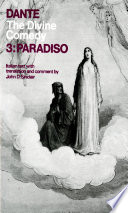
Paradiso is the third and final part of Dante's Divine Comedy, following the Inferno and the Purgatorio. It is an allegory telling of Dante's journey through Heaven, guided by Beatrice, who symbolises theology. In the poem, Paradise is depicted as a series of concentric spheres surrounding the Earth, consisting of the Moon, Mercury, Venus, the Sun, Mars, Jupiter, Saturn, the Fixed Stars, the Primum Mobile and finally, the Empyrean. It was written in the early 14th century. Allegorically, the poem represents the soul's ascent to God.
Dante Alighieri book Paradiso
Canto III, lines 85–87 (tr. Longfellow).
The Divine Comedy (c. 1308–1321), Paradiso
Dante Alighieri book Paradiso
Canto XXXIII, lines 85–87 (tr. Ciardi).
The Divine Comedy (c. 1308–1321), Paradiso
Dante Alighieri book Paradiso
Canto XXII, lines 16–18 (tr. Longfellow).
The Divine Comedy (c. 1308–1321), Paradiso
“A great flame follows a little spark.”
Dante Alighieri book Paradiso
Canto I, line 34 (tr. Sinclair).
The Divine Comedy (c. 1308–1321), Paradiso
Dante Alighieri book Paradiso
Canto XXVII, lines 28–30 (tr. Sinclair).
The Divine Comedy (c. 1308–1321), Paradiso
“The experience of this sweet life.”
Dante Alighieri book Paradiso
Canto XX, lines 47–48 (tr. Longfellow).
The Divine Comedy (c. 1308–1321), Paradiso
“The night that hides things from us.”
Dante Alighieri book Paradiso
Canto XXIII, line 3 (tr. Sinclair).
The Divine Comedy (c. 1308–1321), Paradiso
“From that point
Dependent is the heaven and nature all.”
Dante Alighieri book Paradiso
Canto XXVIII, lines 41–42 (tr. Longfellow).
The Divine Comedy (c. 1308–1321), Paradiso
Dante Alighieri book Paradiso
Canto V, lines 19–24 (tr. Singleton).
The Divine Comedy (c. 1308–1321), Paradiso
“The use of men is like a leaf
On bough, which goeth and another cometh.”
Dante Alighieri book Paradiso
Canto XXVI, lines 137–138 (tr. Longfellow).
The Divine Comedy (c. 1308–1321), Paradiso
Dante Alighieri book Paradiso
Canto XX, lines 136–138 (tr. Longfellow).
The Divine Comedy (c. 1308–1321), Paradiso
Dante Alighieri book Paradiso
Canto XIX, lines 79–81 (tr. Longfellow).
The Divine Comedy (c. 1308–1321), Paradiso
Dante Alighieri book Paradiso
Canto XX, lines 73–77 (tr. Sinclair).
The Divine Comedy (c. 1308–1321), Paradiso
Dante Alighieri book Paradiso
Canto XVII, lines 58–60 (tr. Sinclair).
The Divine Comedy (c. 1308–1321), Paradiso
Dante Alighieri book Paradiso
Canto I, lines 88–90 (tr. Ciardi).
The Divine Comedy (c. 1308–1321), Paradiso
Dante Alighieri book Paradiso
Canto XXXIII, lines 16–18 (tr. Longfellow).
The Divine Comedy (c. 1308–1321), Paradiso
Dante Alighieri book Paradiso
Canto XXXIII, closing lines, as translated by Henry Wadsworth Longfellow
The Divine Comedy (c. 1308–1321), Paradiso
Context: As the geometrician, who endeavours
To square the circle, and discovers not,
By taking thought, the principle he wants,Even such was I at that new apparition;
I wished to see how the image to the circle
Conformed itself, and how it there finds place;But my own wings were not enough for this,
Had it not been that then my mind there smote
A flash of lightning, wherein came its wish. Here vigour failed the lofty fantasy:
But now was turning my desire and will,
Even as a wheel that equally is moved, The Love which moves the sun and the other stars.
Dante Alighieri book Paradiso
Canto I, lines 1–3 (tr. C. E. Norton).
The Divine Comedy (c. 1308–1321), Paradiso
Dante Alighieri book Paradiso
Canto XIX, lines 58–63 (tr. Sinclair).
The Divine Comedy (c. 1308–1321), Paradiso


