Quotes from bookLanguage, Truth, and Logic
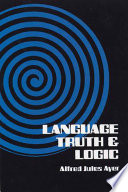
Language, Truth and Logic is a 1936 book by the philosopher by Alfred Jules Ayer. It brought some of the ideas of the Vienna Circle and the logical empiricists to the attention of the English-speaking world.

Alfred Jules Ayer book Language, Truth, and Logic
Source: Language, Truth, and Logic (1936), p. 16.
Context: The criterion which we use to test the genuineness of apparent statements of fact is the criterion of verifiability. We say that a sentence is factually significant to any given person, if, and only if, he knows how to verify the proposition which it purports to express — that is, if he knows what observations would lead him, under certain conditions, to accept the proposition as being true, or reject it as being false.
Alfred Jules Ayer book Language, Truth, and Logic
Source: Language, Truth, and Logic (1936), p. 77.
Context: The principles of logic and mathematics are true simply because we never allow them to be anything else. And the reason for this is that we cannot abandon them without contradicting ourselves, without sinning against the rules which govern the use of language, and so making our utterances self-stultifying. In other words, the truths of logic and mathematics are analytic propositions or tautologies.
Alfred Jules Ayer book Language, Truth, and Logic
Source: Language, Truth, and Logic (1936), p. 49.
Context: The problem of induction is, roughly speaking, the problem of finding a way to prove that certain empirical generalizations which are derived from past experience will hold good also in the future. There are only two ways of approaching this problem on the assumption that it is a genuine problem, and it is easy to see that neither of them can lead to its solution.
Alfred Jules Ayer book Language, Truth, and Logic
Source: Language, Truth, and Logic (1936), Ch. 1, first lines.
Context: The traditional disputes of philosophers are, for the most part, as unwarranted as they are unfruitful. The surest way to end them is to establish beyond question what should be the purpose and method of a philosophical enquiry. And this is by no means so difficult a task as the history of philosophy would lead one to suppose. For if there are any questions which science leaves it to philosophy to answer, a straightforward process of elimination must lead to their discovery.


