
W. H. Auden book Forewords and Afterwords
"The Protestant Mystics", p. 73
Forewords and Afterwords (1973)
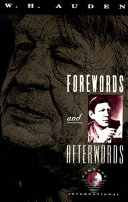
Forewords and Afterwords is a prose book by W. H. Auden published in 1973.
W. H. Auden book Forewords and Afterwords
"The Protestant Mystics", p. 73
Forewords and Afterwords (1973)
W. H. Auden book Forewords and Afterwords
"Walter de la Mare", p. 393
Forewords and Afterwords (1973)
W. H. Auden book Forewords and Afterwords
"One of the Family", p. 369
Forewords and Afterwords (1973)
W. H. Auden book Forewords and Afterwords
Assessing St. Augustine's perspectives in "Augustus to Augustine", p. 37
Forewords and Afterwords (1973)
Context: Man … always acts either self-loving, just for the hell of it, or God-loving, just for the heaven of it; his reasons, his appetites are secondary motivations. Man chooses either life or death, but he chooses; everything he does, from going to the toilet to mathematical speculation, is an act of religious worship, either of God or of himself.
Lastly by the classical apotheosis of Man-God, Augustine opposes the Christian belief in Jesus Christ, the God-Man. The former is a Hercules who compels recognition by the great deeds he does in establishing for the common people in the law, order and prosperity they cannot establish for themselves, by his manifestation of superior power; the latter reveals to fallen man that God is love by suffering, i. e. by refusing to compel recognition, choosing instead to be a victim of man's self-love. The idea of a sacrificial victim is not new; but that it should be the victim who chooses to be sacrificed, and the sacrificers who deny that any sacrifice has been made, is very new.
“One can only blaspheme if one believes.”
W. H. Auden book Forewords and Afterwords
"Concerning the Unpredictable", p. 472
Forewords and Afterwords (1973)
W. H. Auden book Forewords and Afterwords
"As It Seemed to Us", p. 498
Forewords and Afterwords (1973)
W. H. Auden book Forewords and Afterwords
"The Justice of Dame Kind", p. 464
Forewords and Afterwords (1973)
W. H. Auden book Forewords and Afterwords
"The Protestant Mystics", p. 52
Forewords and Afterwords (1973)
W. H. Auden book Forewords and Afterwords
"The Protestant Mystics", p. 51
Forewords and Afterwords (1973)
W. H. Auden book Forewords and Afterwords
"Un Homme d'Esprit", p. 361
Forewords and Afterwords (1973)
“Money is the necessity that frees us from necessity.”
W. H. Auden book Forewords and Afterwords
"A Poet of the Actual", p. 266
Forewords and Afterwords (1973)
Context: Money is the necessity that frees us from necessity. Of all novelists in any country, Trollope best understands the role of money. Compared with him even Balzac is a romantic.
W. H. Auden book Forewords and Afterwords
"A Poet of the Actual", p. 265
Forewords and Afterwords (1973)
Context: A craftsman knows in advance what the finished result will be, while the artist knows only what it will be when he has finished it. But it is unbecoming in an artist to talk about inspiration; that is the reader's business.
W. H. Auden book Forewords and Afterwords
"A Russian Aesthete", p. 279
Forewords and Afterwords (1973)
Context: Machines have no political opinions, but they have profound political effects. They demand a strict regimentation of time, and, by abolishing the need for manual skill, have transformed the majority of the population from workers into laborers. There are, that is to say, fewer and fewer jobs which a man can find a pride and satisfaction in doing well, more and more which have no interest in themselves and can be valued only for the money they provide.
W. H. Auden book Forewords and Afterwords
On Søren Kierkegaard, in "A Knight of Doleful Countenance", p. 192
Forewords and Afterwords (1973)
Context: He suffers from one great literary defect, which is often found in lonely geniuses: he never knows when to stop. Lonely people are apt to fall in love with the sound of their own voice, as Narcissus fell in love with his reflection, not out of conceit but out of despair of finding another who will listen and respond.
W. H. Auden book Forewords and Afterwords
"The Greatest of the Monsters", p. 247
Forewords and Afterwords (1973)
Context: I said earlier that I do not believe an artist's life throws much light upon his works. I do believe, however, that, more often than most people realize, his works may throw light upon his life. An artist with certain imaginative ideas in his head may then involve himself in relationships which are congenial to them.
W. H. Auden book Forewords and Afterwords
"The Protestant Mystics", p. 72
Forewords and Afterwords (1973)
Context: The mystics themselves do not seem to have believed their physical and mental sufferings to be a sign of grace, but it is unfortunate that it is precisely physical manifestations which appeal most to the religiosity of the mob. A woman might spend twenty years nursing lepers without having any notice taken of her, but let her once exhibit the stigmata or live for long periods on nothing but the Host and water, and in no time the crowd will be clamoring for her beatification.


